



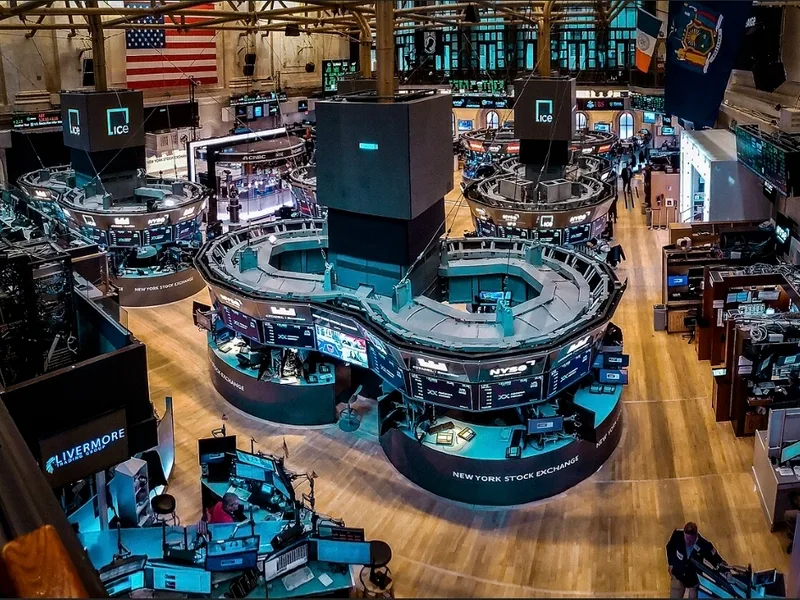
Major U.S. stock indices finished sharply lower on October 30, as a disappointing fourth-quarter outlook from Intel and concerns over the massive capital expenditures required for artificial intelligence (AI) investments triggered a broad sell-off in the technology sector.
The Dow Jones Industrial Average fell 572.25 points (1.09%) to close at 51,770.31. The S&P 500 retreated 140.32 points (1.82%) to 7,580.07, while the Nasdaq Composite plummeted 747.73 points (2.86%) to 25,437.00. The Philadelphia Semiconductor Index bore the brunt of the volatility, cratering approximately 7.2%.
Intel shares plunged nearly 29% after the company’s post-market guidance for the fourth quarter signaled a miss on Wall Street expectations. Intel projected Q4 revenue of $15 billion to $16 billion and adjusted earnings per share (EPS) of $0.25, both falling short of analyst forecasts for $17.1 billion in revenue and $0.43 in adjusted EPS.
The broader semiconductor sector faced heavy selling pressure in tandem. AMD fell 10.88%, Qualcomm slid 11.12%, while industry giants Nvidia and Broadcom declined 4.22% and 5.48%, respectively. Memory chipmaker Micron Technology retreated 5.30%.
The downturn rippled through the semiconductor equipment and data infrastructure ecosystem. Applied Materials and Lam Research dropped 7.49% and 6.01%, respectively, while Dell Technologies and SanDisk suffered losses of 10.77% and 13.47%. Cloud infrastructure player Oracle also saw its shares tumble 6.37%.
Meanwhile, Amazon shares fell roughly 1.4% as the company reported a shortfall in third-quarter revenue and EPS, further highlighting the burden of aggressive AI-related spending. Although Amazon Web Services (AWS) revenue rose 39% year-on-year to approximately $46 billion, the company reported a free cash flow outflow of $42.4 billion over the 12 months ending in September—a stark reversal from the $14.8 billion inflow recorded a year prior.
Amazon attributed the decline in free cash flow to increased capital expenditure, primarily driven by investments in AI hardware and infrastructure. The company reaffirmed its 2024 capital expenditure forecast of approximately $220 billion.
Major technology bellwethers also struggled: Microsoft dipped 1.55%, Meta dropped 1.53%, Alphabet (Class A) lost 1.40%, and Apple shed 1.23%.
Outside of the tech sphere, sector performance was bifurcated. Defensive sectors showed resilience: Eli Lilly rose 3.19%, Merck climbed 2.18%, and Pfizer gained 1.90%. In the consumer staples sector, Walmart, Costco, and PepsiCo rose 1.86%, 1.63%, and 2.65%, respectively. T-Mobile surged 6.21% following an earnings beat earlier in the week, while Verizon added 2.45%.
Energy stocks saw gains, with ExxonMobil and Chevron rising 2.16% and 1.75% respectively, supported by better-than-expected Q3 earnings. Conversely, financial stocks faced headwinds: JPMorgan Chase fell 1.90%, Bank of America slid 2.21%, and Goldman Sachs dropped 3.58%.
In the fixed-income market, the 10-year U.S. Treasury yield fell approximately 0.06 percentage points to 4.928% as investors sought refuge in safe-haven assets.
On a monthly basis, the Nasdaq recorded its sharpest decline since March of last year, falling 5.3% in October. The S&P 500 finished the month down 0.9%, while the Dow managed a 1.7% gain.
[SOURCE]


