



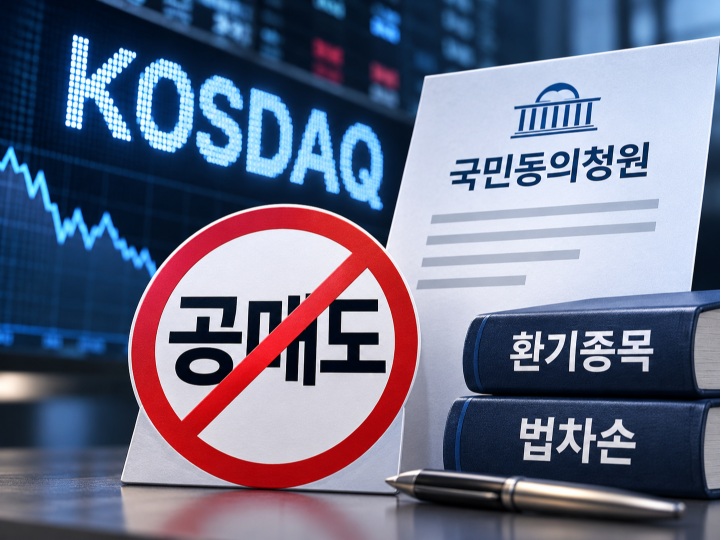
Petitions urge short-selling ban, abolition of investor-caution status, and reform of pre-tax loss regulations.
Distinction needed between R&D expenditures and management failures; balancing growth support and investor protection remains a core challenge.
With the KOSDAQ market teetering on the brink of breaking below the 700 mark, a wave of public petitions is calling for a temporary ban on short-selling and sweeping improvements to listing maintenance rules. Proponents argue that the regulatory framework fails to reflect KOSDAQ's unique function as a growth-capital provider for innovative companies.
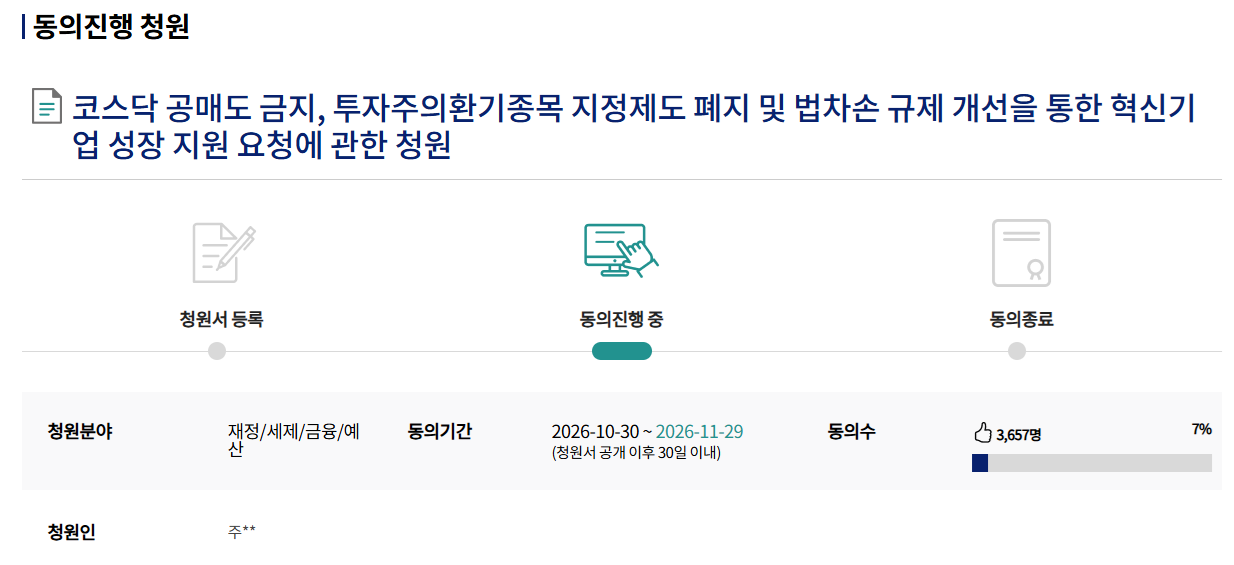
Following a public petition in July demanding a six-month suspension of short-selling on the KOSDAQ and a comprehensive fact-finding probe, subsequent petitions have emerged demanding an outright ban on short-selling, the scrapping of the investor-caution stock designation system, and revisions to regulations concerning losses before income taxes (pre-tax continuous business losses). Deep-seated distrust toward short-selling has thus evolved into a broader challenge against KOSDAQ's growth-financing mechanism and overall listing retention standards.
KOSDAQ slips to 720s amid deepening distrust in short-selling
The persistent downturn in the KOSDAQ market is exacerbating investor anxiety. On October 30, the KOSDAQ index closed down 28.85 points (3.83%) at 724.38. Having once breached the 1,200 level back in April, the index is now alarmingly close to surrendering the 700-point line.
Investors advocating for a short-selling ban contend that when short positions concentrate on specific equities, downward pressure on stock prices intensifies independently of fundamental corporate value, thereby compounding retail investor losses. Critics point out that structural disparities in capital and information between institutional and retail investors undermine fair price discovery.
These petitions emphasize that KOSDAQ serves as a funding arena for innovative sectors such as biotechnology, artificial intelligence, and semiconductors. Given that its corporate composition and market characteristics diverge sharply from the mainboard KOSPI, short-selling regulations must likewise account for KOSDAQ’s distinctive nature.
Nevertheless, whether short-selling is the primary driver of the recent KOSDAQ slump warrants rigorous, independent analysis. Short-selling inherently serves price discovery and anti-overheating functions. Assessing the merits of a ban requires a comprehensive examination of short-selling volumes, outstanding balances, market liquidity, and trading patterns across different investor cohorts.
Five straight years of operating losses: Controversy over caution-designation criteria
The criteria for designating stocks as "investor-caution issues" have also become a flashpoint. Under current KOSDAQ regulations, a company is designated if it records operating losses in each of the past five fiscal years, though technology-growth enterprises are granted exemptions.
Petitioners question whether it is appropriate to apply consecutive operating loss criteria to companies requiring prolonged periods of research and development. They argue that losses incurred from future-oriented investments, such as novel drug development, must be clearly differentiated from deficits stemming from eroded business competitiveness.
In reality, R&D-centric firms frequently accumulate costs well ahead of commercialized revenues. Concerns are rising that slapping a caution designation on such companies during this phase dampens market sentiment, raises capital-raising hurdles, and ultimately jeopardizes ongoing research.
Conversely, the caution designation system serves a vital role in flashing early warning signals to investors. The grounds for designation extend beyond consecutive operating losses to include weaknesses in internal accounting control systems. Scrapping or softening the framework necessitates distinguishing between R&D-related losses and corporate transparency issues, alongside establishing alternative mechanisms to relay risk information.
Pre-tax loss regulations: Separating R&D deficits from financial distress
Management-caution designation criteria tied to pre-tax losses represent another battleground. Under current rules, a company can face management-caution designation if it incurs pre-tax continuous losses exceeding 50% of equity in two out of the last three fiscal years, with loss amounts totaling at least 1 billion won, alongside a pre-tax loss in the most recent fiscal year. Technology-growth enterprises are granted temporary exemptions from these rules.
The biotech industry has consistently warned that applying pre-tax loss regulations while long-term R&D expenditures are recognized as losses places an undue burden on technological innovation and financing.
Recent petitions also highlighted accounting anomalies, such as non-cash valuation losses linked to convertible bonds (CBs). Even if certain financial liability valuation losses are excluded from pre-tax loss calculations, shrinking equity capital can artificially inflate the pre-tax loss ratio, critics argue.
The core issue is that regulatory authorities must evaluate not just the magnitude of losses, but their root causes and operational trajectories. It is imperative to examine whether deficits generated through R&D investment should be weighed identically against losses accumulated from declining business competitiveness.
At the same time, financial risks cannot be dismissed simply on the grounds of corporate innovation. Regulators must comprehensively assess cash flows, fundraising capabilities, R&D stages, and commercialization potential, while ensuring sufficient disclosures so investors can properly gauge capital-impairment risks.
Retail-dominated market: Incorporating retail sentiment into policy debates
The heavy participation of retail investors remains a critical variable in discussions surrounding KOSDAQ reforms. According to Korea Exchange data, retail investors accounted for 65.4% of total KOSDAQ trading value through October 30 this year. While down from 79.3% in 2024 and 73.8% last year, retail investors continue to command the lion's share of market activity.
Although foreign and institutional trading proportions are creeping upward, retail investors remain the heartbeat of KOSDAQ trading. Effectively capturing and reflecting their perspectives throughout the regulatory reform process poses a formidable challenge.
Of course, accepting all demands raised in the petitions is not a panacea. The efficacy and side effects of a short-selling ban must be rigorously tested, and investor protection safeguards designed to filter out insolvent enterprises must be preserved. State support for innovative companies must not devolve into a shelter for unviable businesses.
Nonetheless, these petitions should not be dismissed as mere demands for market stimulation. They represent a fundamental plea to recalibrate market rules so that innovative enterprises are granted adequate time to mature, while equipping investors with the tools to properly assess risks.
Policymakers and the exchange must respond to these grievances with concrete regulatory reviews and viable alternatives. While upholding the principle of weeding out insolvent companies, authorities must ascertain whether current standards and exception rules adequately account for the unique profile of firms whose investments in the future temporarily manifest as bottom-line losses.



