Outlines life sciences growth strategy in IPO prospectus; pursues biotech acquisitions and expands research infrastructure
Discloses antibody optimization results with BigHat; therapeutic efficacy and commercial viability require further validation
Artificial intelligence firm Anthropic is making a concerted push into the life sciences sector. Moving beyond merely supplying research-oriented AI to pharmaceutical and biotech companies, Anthropic is establishing its own research organization and laboratories to participate directly in the drug discovery process. The company's strategic vision involves deploying Claude across every stage—from candidate material design and experimental data analysis to clinical trial planning.
In its initial public offering (IPO) registration statement filed with the U.S. Securities and Exchange Commission (SEC) on October 26 (local time), Anthropic designated life sciences as a key new market for expansion. The company stated that it is building AI agents designed to support scientists at each phase of drug discovery and development.
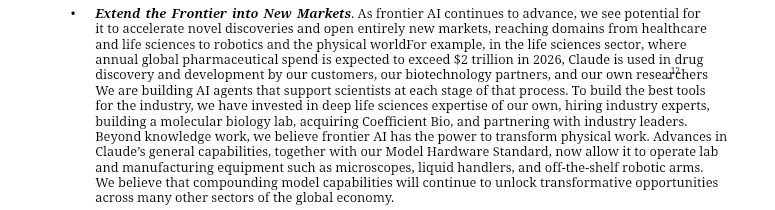
[Photo Description: A section of Anthropic's SEC registration statement detailing its life sciences business strategy. Source: Anthropic S-1, SEC EDGAR.]
Securing Pharmaceutical Clients; Bolstering Research Capabilities Through Acquisitions and Proprietary Tools
According to the filing, among clients that generated more than $100,000 each in revenue for Anthropic during the 12-month period ending September 30 were nine of the top 10 pharmaceutical companies on the Fortune 500 list and eight of the top 10 healthcare firms. This figure is based on total spending across Anthropic's products and services and does not imply that all such expenditures were allocated exclusively to drug research.
The company is concurrently investing to scale its research capabilities. In April of this year, Anthropic acquired Coefficient Bio, an AI startup specializing in biological research. The filing also disclosed ongoing initiatives to build molecular biology laboratories, recruit specialized talent, and foster industry partnerships.
Anthropic has also rolled out products tailored for researchers. "Claude Science," unveiled in June, is an application that integrates literature search, data analysis, and research program execution into a single environment. It is engineered to preserve the analysis code and work history, enabling researchers to verify and reproduce their results.
From Antibody Optimization to Clinical Planning: Applications in Experimentation and Documentation
Practical applications in actual drug research have already begun to emerge. On October 27, Anthropic disclosed collaborative outcomes with six organizations, including BigHat Biosciences, Bristol Myers Squibb (BMS), and Enveda. Depending on the research subject and development stage, Claude was utilized across diverse tasks such as molecular design, candidate optimization, clinical planning, and the drafting of manufacturing and regulatory documents.
According to Anthropic's announcement, its research with BigHat involved generating and testing approximately 10^10 variants across two types of antibody fragments over a span of roughly 10 weeks. As Claude and Anthropic researchers proposed structural modifications, BigHat researchers validated them in an automated laboratory, feeding the results back into subsequent designs. BigHat noted that an integrated data environment—linking experimental equipment measurements, sample information, and quality control records in a single repository—underpinned this iterative process.
The research team successfully derived variants with enhanced target binding affinity while improving the stability and aggregation properties of individual antibodies. Anthropic stated that an antibody fragment targeting cancer cells maintained its liquid state at temperatures 18 degrees Celsius higher than conventional fragments, while another fragment designed to extend the drug's retention time in the body exhibited a more than 100-fold reduction in aggregation velocity.
This case study illustrates the cyclical process wherein AI-generated designs are validated against experimental data and iteratively refined. It underscores the principle that the speed and systematic return of experimental results are just as critical as the AI's analytical capability.
Claude's utility extends into post-design phases of drug development as well. BMS is leveraging Claude to review development plans for early-stage clinical pipeline assets and evaluate their probabilities of trial success. Meanwhile, Enveda has applied the technology to review manufacturing documentation and draft regulatory submission filings. This demonstrates a broader strategic pivot toward supporting analytical and documentation workflows generated throughout the entire development lifecycle, rather than strictly upstream research.
Distinguishing Research Milestones from Therapeutic Commercialization
However, industry experts caution that it is premature to interpret these published achievements as direct therapeutic benefits for patients. Anthropic clarified that the majority of the studies highlighted are currently in the preclinical phase, preceding human clinical trials. Improvements in antibody binding affinity and stability are characteristics measured strictly in laboratory settings and do not constitute proof of clinical efficacy and safety.
The company explicitly stated in its securities filing that candidate materials derived from its life sciences research must navigate protracted development and regulatory hurdles, and ultimately may fail to generate commercial revenue.
Market observers view this move as part of Anthropic's broader strategy to channel hands-on experience from the drug discovery front lines into product enhancements and client acquisition. Assessing the long-term commercial viability of this venture will require looking beyond isolated experimental milestones to evaluate whether Anthropic can tangibly reduce development timelines and costs, and prove its utility in subsequent clinical trials.