



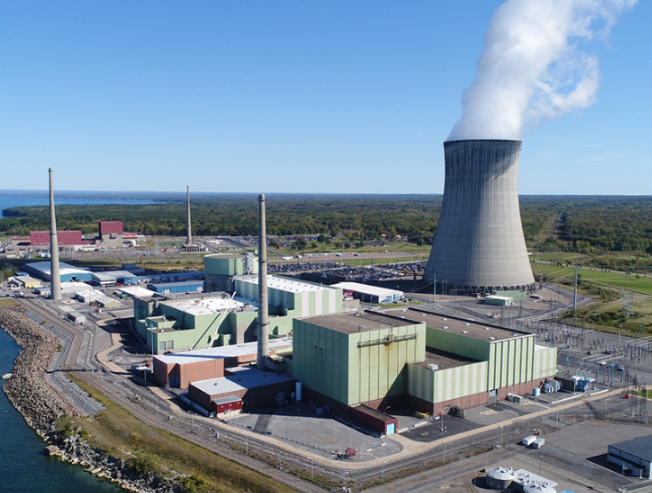
First project confirmed: $22.3 billion Texas combined-cycle power plant; framework agreement reached for 8 US nuclear reactors.
Trump cites over $50 billion for Alaska LNG project; South Korea initiates commercial feasibility review.
Energy megaprojects—including a combined-cycle gas power plant in Texas, eight large-scale nuclear reactors in the United States, and an Alaska liquefied natural gas (LNG) development project—have emerged as key targets under South Korea’s $200 billion strategic investment commitment to the US. Combined, the maximum proposed scale across the three initiatives reaches $196.3 billion.
South Korean and US government officials unveiled the implementation framework for the strategic investment roadmap on Dec. 1. The Encinal combined-cycle gas-fired power plant in Texas was designated as the inaugural project, while the two nations also established a framework agreement to build eight large nuclear reactors in the US. Meanwhile, Seoul is launching a formal review to determine whether to participate in the Alaska LNG project.
US President Donald Trump also highlighted the Texas power facility, the eight nuclear reactors, and the Alaska LNG project as central to South Korea's strategic investments during a White House presentation on Nov. 30 (local time). These represent the first concrete projects unveiled under the $200 billion strategic investment fund, which forms part of the broader $350 billion US investment framework agreed during last year's bilateral tariff negotiations (excluding $150 billion designated for shipbuilding).
$22.3B Texas Project Confirmed; Framework Reached on 8 Nuclear Reactors
The inaugural project is the Encinal combined-cycle gas power plant in Texas, with an estimated project cost of $22.3 billion and a total capacity exceeding 6 gigawatts (GW). Designed to supply electricity to artificial intelligence data centers and key industrial facilities, the project aims to begin commercial operation by 2029.
Under a phased development plan, a 1.4 GW gas turbine facility will be built first, with combined-cycle units added incrementally based on power demand and economic viability.
In monetary terms, the nuclear project is the largest, with a proposed budget of up to $120 billion for eight large-scale reactors in the US. While both governments agreed on a general framework for nuclear construction, details regarding reactor design models, the scope of South Korean corporate participation, and financial structuring remain subject to further negotiation.
Discussions include potentially incorporating two units of South Korea's proprietary APR1400 reactor model, though the final fleet configuration has not been finalized.
For the Alaska LNG project, the US side proposed an investment scale exceeding $50 billion. The venture involves constructing a 1,300-kilometer pipeline and liquefaction facilities to transport natural gas from the North Slope in northern Alaska to the southern coast.
Combining the $22.3 billion Texas facility, up to $120 billion for nuclear reactors, and $54 billion for Alaska LNG yields a potential total of $196.3 billion—representing roughly 98% of South Korea’s $200 billion strategic investment cap. Government officials emphasized, however, that this figure reflects maximum prospective valuations rather than finalized commitments from South Korea.
Alaska LNG Under Review; Capital Commitment Undecided
Among the three initiatives, Alaska LNG remains at a distinctly preliminary stage. While President Trump listed Alaska LNG as part of South Korea's strategic investment portfolio during his White House briefing—and US Commerce Secretary Howard Lutnick cited an investment figure above $50 billion—the South Korean government maintains that it is currently only initiating feasibility studies to assess participation.
 [Source: Alaska LNG, layout map of the LNG pipeline and primary facilities spanning from the North Slope to Nikiski in southern Alaska]
The scale of the project itself is formidable. According to Reuters, total construction costs are estimated between $44.5 billion and $54.5 billion, requiring the construction of a new 1,300-kilometer gas pipeline and LNG liquefaction complex.
While tentative off-take arrangements covering 13 million metric tons of LNG per year have been established, most remain non-binding. Securing project financing will require obtaining additional long-term volume commitments and converting existing terms into definitive contracts.
The South Korean government has emphasized that commercial profitability is a non-negotiable prerequisite for investment. Kim Jung-kwan, Minister of Trade, Industry and Energy, identified the guaranteed recovery of principal and interest as a primary criterion for all US investments. Seoul's requirement of "commercial rationality" focuses squarely on whether projected cash flows over the project lifecycle can ensure complete capital return.
Implementation of the $200 billion strategic investment package is now underway, anchored by the Texas power plant and advancing negotiations on nuclear construction. While Washington has framed Alaska LNG as a $50 billion-plus opportunity, South Korea's actual capital participation will depend entirely on the outcome of its commercial feasibility review.



