



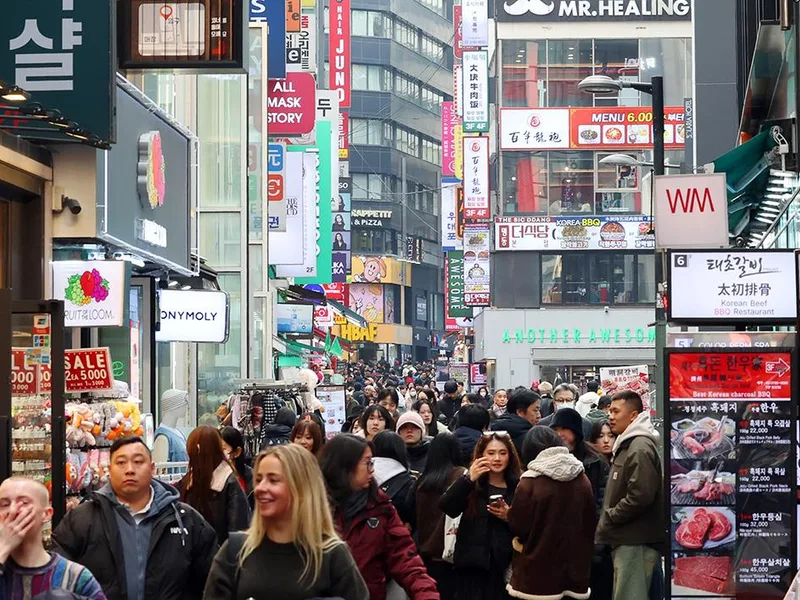
First-to-third-quarter inbound visitors rise 21.5%, while tourism-related card spending surges 47.7%
Clear growth trend led by Chinese and Taiwanese tourists, alongside expanding entries through regional airports
A steady rise in foreign tourists visiting South Korea is breathing new life into the domestic tourism and consumer markets. The number of inbound travelers surpassed 17 million in the first nine months of the year, while foreign card spending in the tourism sector increased by more than 5 trillion won compared to the previous year. As spending extends across shopping, lodging, and medical-wellness sectors, expectations within related industries are on the rise.
According to the 'September 2026 Korea Tourism Statistics' released by the Korea Tourism Organization on the 28th, inbound foreign visitors totaled 17,110,477 during the January-September period, up 21.5% from the same period last year. This is also 32.3% higher than during the pre-pandemic period in 2019.
During the same period, outbound Korean travelers edged up just 2.0% year-on-year to 22.08 million. While the number of outbound travelers still exceeds inbound visitors, the figures present a stark contrast given the much faster growth rate of foreign arrivals.
Spending Outpaces Visitor Growth, Concentrated in Shopping and Lodging
Data released by the Ministry of Culture, Sports and Tourism on the 22nd showed that foreign card spending in the tourism sector reached 15.94 trillion won in the first nine months of the year, a 47.7% increase from the same period last year. The increase alone amounted to 5.14 trillion won, with the growth rate of spending more than double that of inbound visitors.
Shopping accounted for the largest share of spending at 37.0%, followed by accommodation at 19.6% and medical-wellness at 16.6%. Combined, these three sectors accounted for 73.2% of total expenditures.
As foreign tourist spending expands beyond shopping and lodging into medical services, tourism demand is spilling over into various consumer industries. In particular, the fact that the shopping share exceeds one-third of the total underscores the heavy footprint of foreign tourists in the domestic retail market.
Tourism-related card spending is at an all-time high since data collection began in 2018. However, because card spending statistics differ in scope from overall tourism revenue, it is difficult to interpret the spending growth rate directly as an increase in spending per tourist.
China and Taiwan Lead Growth, Setting New Annual Records
The upward trend in inbound tourism was spearheaded by Greater China markets, including China and Taiwan. In the first nine months of the year, Chinese tourists rose 29.2% year-on-year to 5.47 million, accounting for roughly 32% of all inbound visitors. Taiwanese visitors jumped 32.4% to 1.86 million, recording the highest growth rate among major markets, while Japanese visitors increased 16.9% to 3.12 million.
Foreign visitors to South Korea in September alone reached 2.06 million, up 21.1% from the same month last year. This marks the fifth time this year that monthly inbound visitors have surpassed the 2 million mark.
Entry routes are also diversifying. Through September this year, foreign visitors entering through non-capital region airports such as Gimhae, Jeju, Cheongju, and Daegu reached 3.24 million, a 37.4% increase from the previous year, while arrivals via regional ports rose 14.5% to 1.58 million. Combined, these two pathways accounted for 28.2% of all inbound visitors.
With the growth rate of entries through regional airports outpacing capital-region airports, the influx channels for foreign tourists are broadening. However, entering through a regional airport does not necessarily guarantee that spending occurred in that specific region, meaning the actual local economic impact requires a closer examination of travelers' itineraries and movement patterns.
Buoyed by the surge in inbound visitors, annual records have already been broken. The Ministry of Culture, Sports and Tourism estimated on the 27th that cumulative inbound visitors this year have already surpassed the previous annual record of approximately 18.94 million set last year. The government's target for inbound tourist attraction this year is set at 23 million, bringing the historic milestone of 20 million annual visitors within arm's reach.
Kang Jung-won, Deputy Minister for Tourism Policy at the Ministry, stated during a recent briefing on inbound tourism trends that "multidimensional efforts—including enhancing awareness of inbound tourism, improving the travel environment, and expanding content—are bearing fruit."
Following the rise in foreign tourist arrivals, the scale of domestic consumption is also expanding. With spending concentrated in shopping, lodging, and medical-wellness, alongside an increase in entries through regional airports, shifts in tourism demand are rippling through the broader domestic consumer market.



