



KOSPI falls 1.09%, KOSDAQ climbs 5.78% as trading activity spreads to smaller caps.
Large-cap semiconductor stocks face corrections despite high volume; KOSDAQ sees net institutional buying of 642.9 billion KRW.
The domestic stock market witnessed a clear divergence between the KOSPI and KOSDAQ indices upon returning from the Chuseok holiday. While the large-cap-heavy KOSPI underwent a correction, the KOSDAQ experienced a robust rebound, with trading activity spreading into growth sectors, particularly semiconductors and biotechnology.
The KOSPI, which closed at 7,080.92 on the 23rd, slipped to 7,003.74 by the 2nd, marking a weekly decline of 1.09%. Conversely, the KOSDAQ rose from 844.48 to 893.29 during the same period, gaining 5.78%.
The disparity between the two markets was evident not only in index performance but also in trading volume, individual stock fluctuations, and the behavior of market participants.
KOSPI Correction vs. KOSDAQ 5.78% Rally
The KOSPI opened on the 28th—the first session after the holiday—at 6,889.74, down 2.70%. The downward trend persisted on the 29th and 30th, pushing the index as low as 6,838.04, before rebounding in October. Gains of 1.95% on the 1st and 0.46% on the 2nd allowed the index to reclaim the 7,000-point level.
The KOSDAQ followed a different trajectory. It maintained an upward trend immediately following the holiday, surging 4.48% on October 1st to hit 894.29. Despite a minor 0.11% dip on the 2nd, it recorded a total weekly gain of 5.78%.
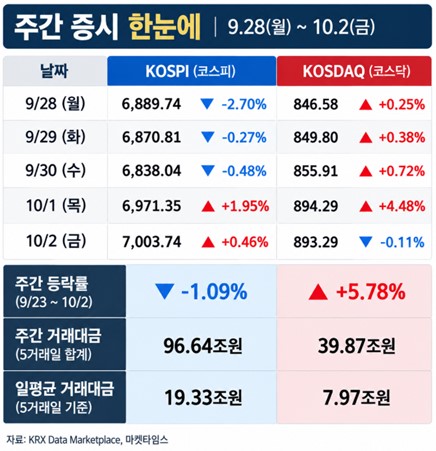 Cumulative trading volume from September 28th to October 2nd reached 96.64 trillion KRW for the KOSPI and 39.87 trillion KRW for the KOSDAQ, with daily averages of 19.33 trillion KRW and 7.97 trillion KRW, respectively.
It was a week defined by the KOSDAQ’s standout performance while the KOSPI underwent consolidation.
KOSDAQ Sector Strength: Pharmaceuticals up 16.73%, Machinery up 10.24%
Sector-specific performance also varied sharply between the two exchanges. On the KOSPI, the electricity and gas sector led with a 4.89% gain, followed by retail (4.12%), transportation equipment/parts (2.41%), machinery/equipment (1.93%), and chemicals (1.27%). In contrast, electric and electronic stocks fell 2.96%, alongside drops in steel/metals (1.74%), securities (0.89%), telecommunications (0.52%), and pharmaceuticals (0.41%).
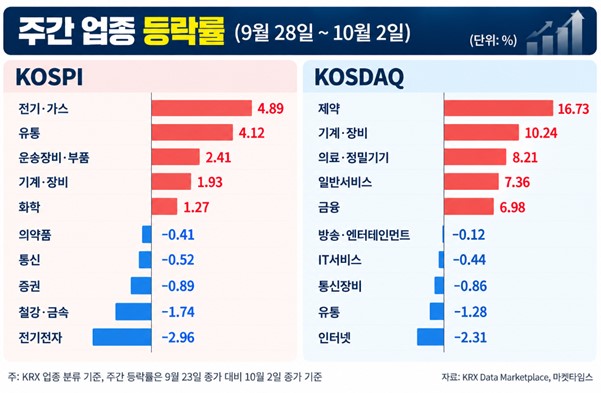 On the KOSDAQ, pharmaceuticals dominated with a 16.73% jump. Machinery/equipment (10.24%), medical/precision instruments (8.21%), general services (7.36%), and financials (6.98%) also saw significant gains. Conversely, internet-related stocks dipped 2.31%, with retail (1.28%), telecommunications equipment (0.86%), IT services (0.44%), and broadcasting/entertainment (0.12%) showing weakness.
The KOSDAQ showed broad-based strength centered on pharma and machinery, whereas gainers on the KOSPI remained relatively limited.
Semiconductor and Biotech Gains; Small-cap Outperformance
At the individual stock level, small-to-mid-cap KOSDAQ names led the gains. Excluding price-adjusted stocks and SPACs, notable performers included C-Sight (+75.25%), WinPak (+67.28%), Duckwoo Electronics (+57.21%), Cosem (+55.37%), Wonil TNI (+51.34%), Vuno (+49.91%), KeyEast (+44.02%), AbClon (+42.35%), and HLB (+32.41%).
KOSPI leaders included TMC (+28.68%), SoluM (+28.46%), Mirae Industry (+28.07%), SH Energy Chemical (+27.39%), Ecopro Specialty Chemical (+27.12%), Korea Circuit (+26.57%), Lotte Energy Materials (+26.53%), SNT Dynamics (+25.14%), Daeduck Electronics (+23.79%), and Hanwha Solutions (+23.63%).
The semiconductor and biotech sectors showed particular strength. Semiconductor plays such as SemiFive (+25.85%), Jeju Semiconductor (+19.07%), HPSP (+18.02%), Jusung Engineering (+13.13%), Hanmi Semiconductor (+11.70%), and Hana Micron (+11.47%) saw significant gains. In biotech, Vuno, AbClon, and HLB also posted strong double-digit growth.
Trading Concentrated in Semiconductors; Large-caps Lagging
Semiconductors remained at the center of market activity. On the KOSPI, trading was heavily concentrated in SK hynix (-1.13%, 24.69 trillion KRW) and Samsung Electronics (-3.33%, 21.55 trillion KRW). Both stocks topped the trading volume charts, yet their prices fell for the week.
Other high-volume stocks included Samsung Electro-Mechanics (+4.91%, 4.42 trillion KRW) and SK Square (-2.52%, 2.73 trillion KRW).
On the KOSDAQ, trading in small-to-mid-cap semiconductor names was vibrant, including Jusung Engineering (+13.13%, 1.43 trillion KRW), HPSP (+18.02%, 1.15 trillion KRW), Jeju Semiconductor (+19.07%, 920.1 billion KRW), and Wonik IPS (+3.37%, 813.8 billion KRW). In biotech, HLB (+32.41%, 465.8 billion KRW) saw heavy concentration.
Foreign Selling in KOSPI; Institutional Buying in KOSDAQ
Investor behavior further highlighted the market divide. From September 28th to October 2nd, foreigners net-sold 8.32 trillion KRW in KOSPI stocks, while institutions net-sold 971.8 billion KRW. Individuals were net buyers of 1.90 trillion KRW.
On the KOSDAQ, institutions were net buyers of 642.9 billion KRW, while foreigners and individuals net-sold 95.8 billion KRW and 514.7 billion KRW, respectively.
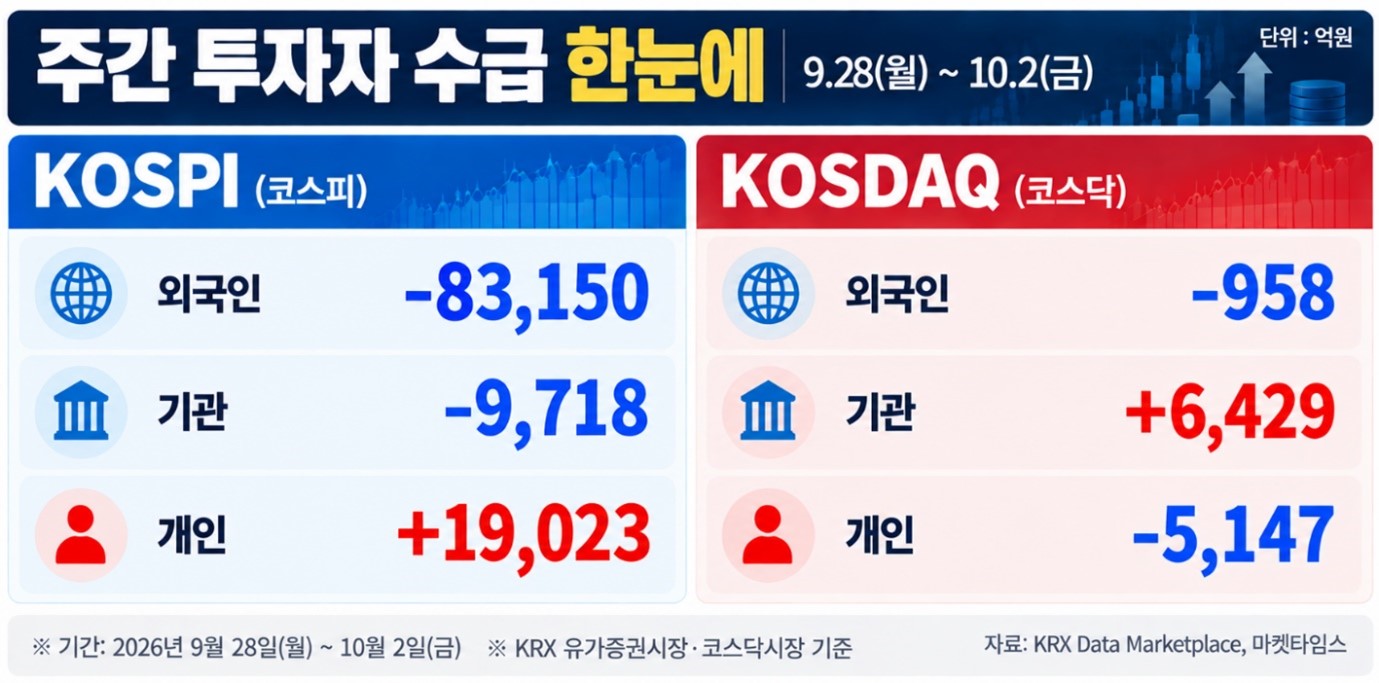 The KOSPI faced heavy foreign outflows, whereas the KOSDAQ benefited from solid institutional support, which helped drive its outperformance.
Short Trading Week Ahead: Samsung Earnings, FOMC, and TSMC
With market holidays on the 5th and 9th, next week will feature only three trading sessions (6th–8th).
Key US events include the September ISM Services Index on the 5th, FOMC minutes on the 7th, and the University of Michigan Consumer Sentiment Index on the 9th.
Domestically, the focus turns to semiconductor earnings and data. Samsung Electronics is expected to release its Q3 preliminary earnings, while TSMC is slated to disclose its September revenue on the 8th. Investors will be watching to see if the momentum in semiconductor stocks continues.



