



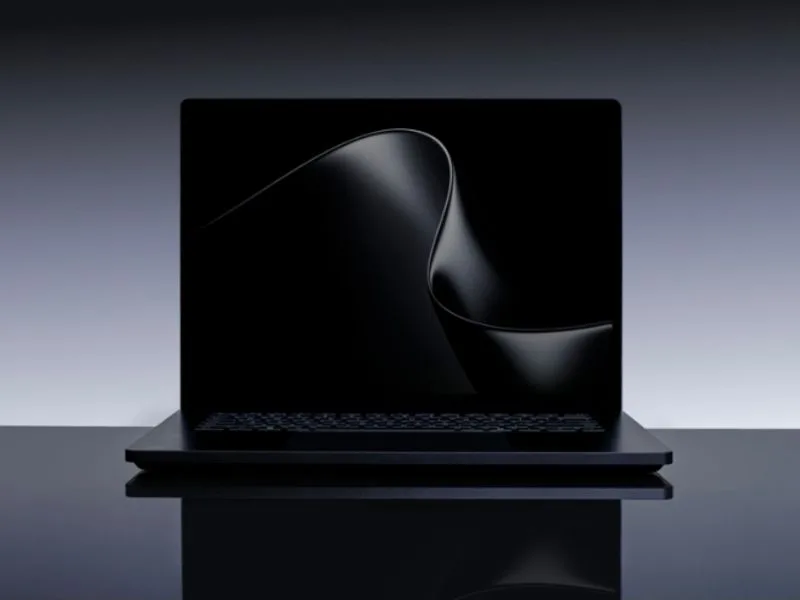
Pre-orders open for ‘Surface Laptop Ultra’ supporting up to 128GB of memory.
New strategy leverages hybrid AI processing between PCs and cloud to improve security and lower operational costs.
Microsoft has stepped up its market offensive by opening pre-orders for a high-performance AI PC equipped with Nvidia technology. The move is part of a broader strategy to shift a portion of AI workloads from the cloud to local PCs, thereby reducing operational expenses and granting users greater control over their own data.
Microsoft announced on the 7th (local time) that pre-orders for the "Surface Laptop Ultra" have commenced. The device features the "RTX Spark" chip, jointly developed by Nvidia and MediaTek, and supports up to 128GB of unified memory. Microsoft explained that the device is capable of running certain large-scale AI models locally, facilitating tasks such as code generation, review, and model testing. The official launch is scheduled for the 16th.
This local computing power serves as the foundation for Microsoft’s "Hybrid Intelligence" strategy. The approach involves performing tasks locally on the PC whenever possible, while offloading more compute-intensive operations to the cloud. This dual-track system aims to reduce the cloud usage burden—and associated costs—incurred by repetitive AI requests, while still leveraging the scalability of cloud infrastructure when needed.
This strategy also extends to Microsoft’s AI assistant, Copilot. By obtaining user consent, Copilot will analyze files and work context stored on the PC to assist with file organization and troubleshooting, utilizing on-device AI models as necessary. These features are slated to be rolled out sequentially to Copilot+ PCs over the coming months.
As AI gains broader access to read and manipulate files, Microsoft has introduced new control mechanisms. The company announced the official rollout of the "Microsoft Execution Container (MXC)" for Windows 11. This technology allows enterprises to define specific file and network access scopes for AI agents, ensuring that these rules are strictly enforced during runtime. The objective is to enable AI-driven automation while preventing unauthorized access to sensitive data or internal systems.
The ecosystem of supported products is also expanding, with ASUS, Dell, HP, Lenovo, and MSI opening pre-orders for their own RTX Spark-based PCs. Furthermore, Microsoft has begun accepting pre-orders for the "Surface RTX Spark Dev Box," a compact desktop designed for developers and AI engineers, with U.S. shipments expected in November. The initiative aims to provide a versatile environment for running and testing AI models across various form factors, including laptops and desktops.
However, high hardware costs remain a significant hurdle for mass adoption. The base model of the Surface Laptop Ultra, featuring 24GB of memory, starts at $2,599.99 in the U.S. Market analysts cited by Reuters note that elevated hardware costs—driven by rising memory prices—may act as a barrier to the widespread adoption of on-device AI. While the shift promises long-term savings on cloud subscription fees, the substantial upfront investment remains a critical factor for both consumers and enterprises.



