



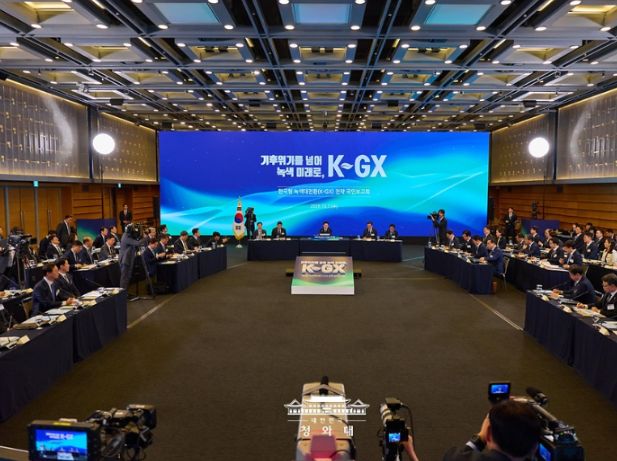
Government to inject 1,000 trillion won in fiscal and climate finance by 2035; 220 trillion won in private projects slated for advancement
Strategic focus on hydrogen-based steelmaking, next-generation batteries, solar cells, and SMRs to catalyze industrial modernization
The South Korean government is set to deploy 1,000 trillion won in fiscal support and policy finance over the next decade to spearhead a national green transition. Complementing this, major domestic firms have committed to 220 trillion won in private investment projects across the steel, battery, solar, and power sectors, signaling a fundamental overhaul of manufacturing infrastructure and energy supply chains.
The "Korean Green Transformation" (K-GX) strategy transcends traditional environmental policies; it is, in essence, an industrial policy aimed at revolutionizing production methods and energy systems. As the government unveils its long-term funding and tax incentive framework, corporate production and R&D strategies are increasingly aligning with these national objectives.
Key industry players, including POSCO Holdings, Hanwha Qcells, LG Energy Solution, and Doosan Enerbility, have integrated next-generation technology commercialization and facility expansion into their project pipelines. However, it should be noted that these figures include existing business plans, and not all of the 220 trillion won represents strictly new investment.
200 Trillion Won in Fiscal Support and 790 Trillion Won in Climate Finance; Green Bond Issuance Planned
According to relevant ministries on the 8th, the government announced the K-GX strategy at a national briefing held the previous day at the Korea Chamber of Commerce and Industry. The plan entails providing 1,000 trillion won in capital—comprising 200 trillion won in fiscal spending and over 790 trillion won in climate finance—from 2026 to 2035.
Climate finance will be channeled through five state-run policy institutions: the Korea Development Bank (KDB), Industrial Bank of Korea (IBK), Export-Import Bank of Korea (KEXIM), Korea Credit Guarantee Fund (KODIT), and Korea Technology Finance Corporation (KOTEC). The government intends to allocate over 50% of this financing to regional areas and more than 70% specifically to small and medium-sized enterprises (SMEs).
The budget for the Climate Response Fund is set to scale from 2.6 trillion won this year to 7.6 trillion won by next year. Furthermore, the government aims to finalize details for the issuance of "green sovereign bonds" by the first half of 2027, with an inaugural issuance targeted for 2028.
The policy package also includes the introduction of domestic production tax credits for solar power, wind energy, and key secondary battery components. Support measures further encompass the designation of Small Modular Reactors (SMRs) as a national strategic technology, alongside streamlined permitting processes for related companies.
While the 1,000 trillion won figure represents the government’s long-term supply plan—including loans, guarantees, and fiscal aid—it does not imply direct subsidies or total cash injections. Because policy finance may also overlap with the 220 trillion won in private projects, these totals cannot be conflated into a single net-new investment figure.
POSCO’s Hydrogen Steelmaking and Hanwha’s Next-Gen Solar Cells: Corporate Projects Take Shape
Companies participating in the K-GX strategy are prioritizing the decarbonization of existing production lines and the securing of next-generation technologies. Despite differences across sectors like steel, batteries, solar, nuclear, and shipbuilding, the common denominators remain massive facility investment and commercialization hurdles.
 In the steel sector, the transition from coal-based to hydrogen-based production is particularly capital-intensive and technologically complex. The government plans to support a 300,000-ton-scale hydrogen-reduction steelmaking demonstration plant by 2030. This initiative will require auxiliary investments in clean hydrogen production and stable power grid infrastructure.
In solar and batteries, the focus is on scaling cutting-edge tech. Hanwha Qcells is advancing tandem solar cells to surpass the efficiency limits of traditional silicon products, while LG Energy Solution is diversifying energy storage options through its sodium-ion battery ESS projects.
Doosan Enerbility plans to establish an SMR-exclusive production facility in Changwon by 2030, while HD Korea Shipbuilding & Offshore Engineering is utilizing its Ulsan shipyard to develop electric-propelled and fuel-cell-integrated vessels. While these projects involve significant capital expenditure, the exact timing and scale of new investments will be clarified as individual corporate plans evolve.
Expanding to Power Grids, Eco-friendly Vehicles, and Residential Tech; Focus Shifts to Execution
The government aims to secure 100GW of renewable energy capacity by 2030, necessitating a significant expansion of solar and wind power, alongside upgrades to transmission and distribution grids. This increase in renewable capacity will inevitably drive demand for transformers, grid equipment, and energy storage systems.
Hyundai Motor Group is spearheading electric vehicle (EV) production, core component manufacturing, and autonomous driving infrastructure in Ulsan and Hwaseong. The government has set a goal to make over 70% of new vehicle sales electric or hydrogen-powered by 2035, supported by EV subsidies and expanded charging networks.
In the residential sector, LG Electronics and Samsung Electronics are participating in green transition projects involving heat pumps and high-efficiency home appliances. Samsung aims to supply integrated heating and cooling heat pumps to 30,000 residential units by 2030, while LG plans to demonstrate an energy-independent modular housing complex in Jeju by 2029.
However, there will be a significant lag before these investments translate into measurable bottom-line growth for these firms. Commercializing next-gen technologies and building large-scale facilities takes years, and the efficacy of government support will depend on the timely implementation of follow-up regulations.
As government policy finance and tax benefits are codified, corporate investment schedules will become clearer. Key indicators to watch in the coming years will include the expansion of the Climate Response Fund, the issuance of green sovereign bonds in 2028, and the actual groundbreaking dates for new production facilities across the major conglomerates.



