




Moderna Plunges 17% Despite Successful Phase 3 Cancer Vaccine Trial Amid Profit-Taking on Surging Shares
Alteogen and Hanmi Pharm Also Slip Following Positive News, Drawing Focus to Contract Terms and Commercialization Metrics
Success in Phase 3 clinical trials, multi-trillion-won licensing agreements, and new drug approvals—milestones typically expected to drive biotech valuations higher—have been met with a surprisingly muted market response. Moderna saw its shares plummet more than 17% in a single session despite positive results from its Phase 3 cancer vaccine trial. Alteogen fell 5.98% over two days despite announcing a 4.4 trillion won ($3.2 billion) licensing deal with Novartis, while Hanmi Pharm tumbled over 10% the day after receiving regulatory approval for a novel obesity treatment.
The catalysts behind the downturn varied by company. For Moderna and Hanmi Pharm, steep stock appreciation prior to the announcements created heavy valuation burdens. For Alteogen, the massive licensing agreement failed to spark a meaningful rebound amid a broader slump. The market is taking an increasingly rigorous approach, looking beyond clinical successes and contract signings to evaluate the tangible path to actual sales and operating profit.
Moderna Plunges Despite Cancer Vaccine Success as Expectations Run Ahead of Data
The personalized mRNA cancer vaccine 'INTocimab autogen' (investigational name), co-developed by Moderna and Merck & Co. (MSD), met its primary endpoint in a global Phase 3 clinical trial involving 1,137 high-risk melanoma patients.
Patients treated with the combination of the cancer vaccine and the immunotherapy Keytruda experienced a 42% lower risk of cancer recurrence or death compared to those receiving Keytruda monotherapy. The risk of distant metastasis or death was also reduced by 38%. The recurrence-free survival rate at two years stood at 82.2% for the combination group versus 70.0% for the monotherapy group, marking a 12.2 percentage point difference.
Despite demonstrating therapeutic efficacy in a large-scale trial, Moderna shares closed down 17.57% at $202.63 on the U.S. stock market on October 22 (local time), with intraday losses exceeding 25%.
Following a premature leak of detailed clinical data initially scheduled for presentation at the European Society for Medical Oncology (ESMO) congress on October 24, Moderna and Merck released the full results on October 22. Heavy selling ensued immediately following the earlier-than-expected data disclosure.
Of note is the pre-announcement price action. Following Moderna and Merck's August 19 disclosure that the Phase 3 trial had met its primary objective, Moderna's stock nearly quadrupled through October 21, boasting a year-to-date gain exceeding 500%.
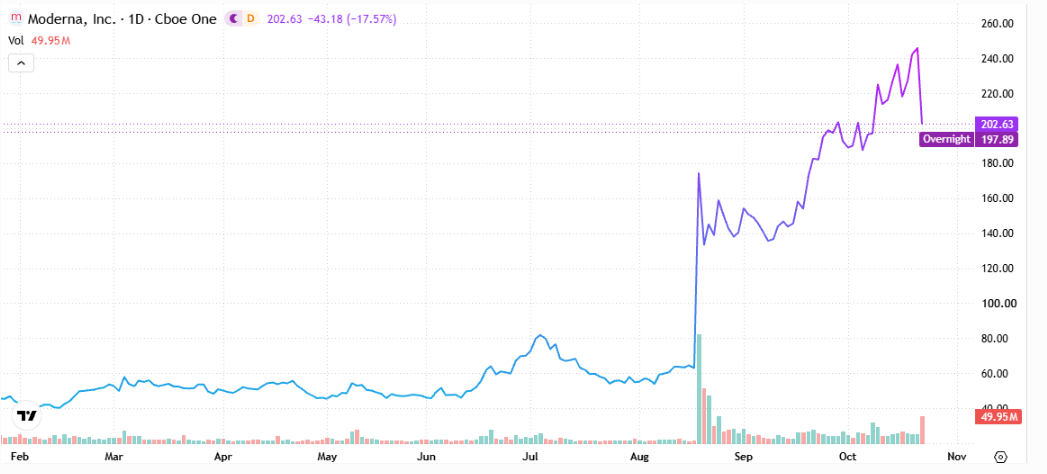
[Source: TradingView, Moderna Stock Price Trend (Feb–Oct 2026)]
In August, the market was only informed of the clinical success without specific efficacy figures. Investors priced in the commercialization potential of the personalized cancer vaccine and the possibility of expanding indications to other cancer types.
While the recurrence-suppression effect in the latest Phase 3 trial was statistically significant, some analysts noted that the distant metastasis-suppression effect fell short of certain market expectations. Although direct comparisons with the previous Phase 2b trial are difficult due to differences in patient demographics and follow-up durations, the already-inflated stock price had baked in far loftier expectations.
While the core fact of clinical success remained unchanged, the market in August—trading on the *probability* of success—reacted in stark contrast to the market in October, which digested concrete performance metrics.
Moderna and Merck are pursuing regulatory approval in the U.S. with a target commercial launch in 2027. Future corporate valuation will hinge on whether the therapeutic efficacy observed in melanoma can be replicated in other cancer types and just how far the addressable commercial market expands.
Alteogen Slides Despite 4.4 Trillion Won Deal as Market Focus Shifts from Total Value to Profit Terms
Alteogen has been expanding its global licensing agreements based on ALT-B4, a core technology of its 'Hybrozyme' platform designed to convert intravenous (IV) formulations into subcutaneous (SC) injectables.
Following successive deals with Tesaro (a subsidiary of GSK) in January, Biogen in March, and an undisclosed partner in August, the company announced a licensing agreement with Novartis on September 2 valued at up to $3.223 billion (approximately 4.4165 trillion won at the time). It marked Alteogen's fourth ALT-B4 licensing deal of the year and the largest among its existing contracts.
However, on the day of the announcement, the stock spiked more than 9% intraday before reversing course to close down 0.83% at 298,500 won. It fell an additional 5.19% the following day to 283,000 won. Compared to the closing price on September 1, right before the announcement, the stock dropped 5.98% over the two-day span.
Despite the massive licensing announcement, buying momentum was insufficient to reverse the stock's sluggishness. Because a broader downturn in the KOSDAQ market also played a role, the pullback cannot be attributed solely to disappointment over contract terms. Nevertheless, it is noteworthy that a headline figure of up to 4.4 trillion won failed to trigger sustained post-announcement buying. This caution stems from the reality that a wide gap often exists between total contract values and actual cash inflows, which are contingent upon option exercises and the achievement of development and commercialization milestones.
The maximum value of the Novartis contract is contingent upon future option exercises and milestone achievements across development and commercialization phases. Sales royalties will be paid separately, leaving room for potential expansions in applicable drug indications and business scope.
The market showed a similar sensitivity to profit-sharing terms back in January. When Alteogen announced its deal with Tesaro on the 20th, its shares fell 3.0%, and plunged 22.35% the following day after details regarding Merck's Keytruda SC royalty terms were disclosed.
While the market had previously estimated a royalty rate of around 4% to 5%, the disclosed terms revealed a 2% royalty on net sales only *after* the receipt of up to $1 billion in sales milestones. Although the existing contract terms had not been altered, the discrepancy between market expectations and actual terms was swiftly priced into the stock.
According to a filing submitted by Biogen to the U.S. Securities and Exchange Commission (SEC), its sales royalty rate is listed in the mid-single digits. Even when utilizing the same ALT-B4 technology, royalty rates vary by contract, and actual profitability must be gauged by factoring in drug-specific sales, milestones, and other conditions.
Alteogen is expanding its business performance through the commercialization of Keytruda SC and additional licensing deals, but the stock market is increasingly dissecting the specific terms that translate into actual revenue rather than celebrating the contract announcements themselves.
Hanmi Pharm Plumbs 10% the Day After Obesity Drug Approval; Attention Shifts to Post-Launch Sales
Hanmi Pharm also suffered a steep post-approval stock decline. Following domestic regulatory approval from the Ministry of Food and Drug Safety on the 7th for its proprietary GLP-1 obesity treatment 'Epeotoinjector' (efpeglenatide), the company's shares closed down 10.02% at 480,500 won the next day.
The downward trend persisted. The closing price on the 14th stood at 404,500 won—22.66% lower than its close of 523,000 won on the 6th, just prior to the approval. During intraday trading on the 15th, the stock plummeted as low as 378,000 won.
Hanmi Pharm shares had surged from the low 300,000-won range in late July to over 500,000 won right before the approval. As anticipation for the greenlight was priced in ahead of time, investor focus promptly shifted to real-world market competitiveness.
Efpeglenatide demonstrated an average weight loss efficacy of 9.75% in a 40-week interim analysis of Hanmi's domestic Phase 3 clinical trial. Prescriptions are slated to begin at select medical institutions around the 29th, with the supply price for the first month's treatment reported at roughly 130,000 won, though out-of-pocket costs for actual patients may vary.
In a domestic obesity treatment market already dominated by Wegovy and Mounjaro, Hanmi's ability to secure prescriptions and revenue by leveraging a lower relative price point will be the ultimate litmus test for its valuation.
While the root causes varied—pre-announcement surges for Moderna and Hanmi Pharm, alongside contract profitability terms and broader market sentiment for Alteogen—the common thread is that milestones like clinical success, licensing pacts, and drug approvals no longer guarantee immediate post-announcement stock rallies.
The experiences of these three companies underscore that biotech achievements must...



