




Tesla initiates Optimus production, targeting external supply by late 2027; Hyundai Motor slated for factory deployment in 2028.
Samsung and LG join the robot development race; despite surging Chinese shipments, industrial and logistics deployment remains at just 18%.
Artificial intelligence (AI) is stepping out of the screen. As AI trained in data centers begins to serve as the brain for robots moving and assembling parts in factories, the deployment of humanoid robots from tech demonstrations to industrial floors is coming into view. Global corporate competition is also expanding beyond merely demonstrating robot mobility toward securing technologies that can be practically applied on production lines.
As the commercialization of Physical AI draws closer, mass-production capabilities, access to operational data, and productivity in real-world environments are becoming paramount. While Tesla and Hyundai Motor Group flesh out their commercialization timelines, Nvidia, Samsung Electronics, and LG Electronics are also accelerating their robot development and AI training capabilities.
Tesla Begins Production and Pushes External Sales; Hyundai Motor Starts with Its Own Plants
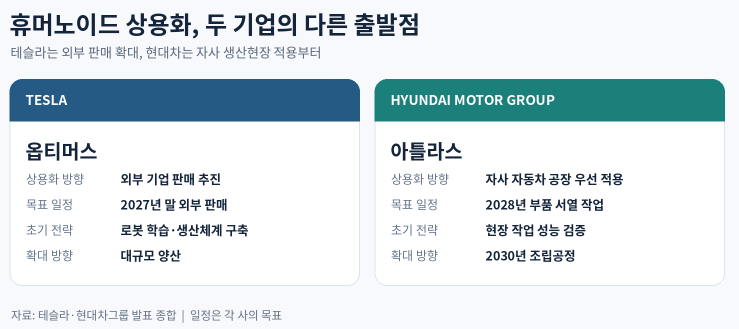
In its third-quarter shareholder report released on the 21st, Tesla announced that the production line for its "Optimus" humanoid robot at the Fremont factory in California has entered the early ramp phase. Existing Model S and X production facilities have been converted into robot manufacturing lines, with a long-term goal of securing an annual production capacity of one million units.
During an earnings conference call, Tesla CEO Elon Musk projected that weekly production would reach around 20,000 units in roughly a year. This represents a future target rather than current output. Tesla plans to supply the robots to external companies by the end of 2027, following improvements to fine motor skills, durability, and AI learning capabilities.
The company is concurrently securing large-scale training data. Through "Optimus Academy," Tesla aims to have 10,000 to 20,000 robots repeatedly perform various tasks to generate training data. Unlike automobiles, humanoid robots struggle to accumulate massive amounts of data from actual operations, necessitating a dedicated training environment.
Hyundai Motor Group is taking a different approach. Rather than selling Boston Dynamics' humanoid robot, "Atlas," to external buyers, the group is pursuing a strategy of deploying it within its own production facilities first to verify operational capability and economic viability.
Hyundai Motor Group plans to conduct task training and validation for Atlas at the Robotics Metaplant Application Center (RMAC) in Georgia, US, before deploying it to the Hyundai Motor Group Metaplant America (HMGMA) in 2028. The initial goal is to perform sequencing tasks—arranging parts in the order required for production—and expand the application scope to assembly processes by 2030.
While Tesla pursues entry into external markets via mass production, Hyundai Motor Group is utilizing its existing automotive plants as testing grounds and initial demand centers for robotics technology. Although both companies are developing robots capable of working in actual industrial settings, their chosen market-entry pathways in the early stages of commercialization differ.
Nvidia Expands AI Platform; Samsung and LG Parallelize Robot Development and Training
For humanoids to work effectively in actual factories, they must go beyond merely recognizing the location and shape of objects to accurately execute actions such as grasping and moving them. Even with repetitive tasks, object locations or surrounding environments can vary, requiring learning capabilities to adapt to diverse situations.
On the 21st, Nvidia expanded its "Isaac" robotics development platform and unveiled reference platforms and simulation technologies for humanoids. These tools allow robots to train in virtual environments and verify safety before being deployed to actual factories, with global industrial robot makers such as ABB Robotics and KUKA also utilizing the technology.
Domestic electronics firms are leveraging these AI training technologies while accelerating their own robot development. Samsung Electronics announced the establishment of the RX (Robotics eXperience) Business Promotion Office directly under the CEO on July 21st, embarking on the development of humanoid walking, object manipulation, and AI learning technologies. It is also pushing to build a robot data factory at its Gumi complex in North Gyeongsang Province and expanding cooperation with Rainbow Robotics.
LG Electronics established its Robotics Business Center in July and is concurrently developing the home robot "Cloyd" and next-generation humanoids. It is developing a bipedal humanoid utilizing Nvidia's robot AI technology, aiming for an unveiling in the first quarter of 2027. The wheeled Cloyd is undergoing field testing on the washing machine production line at its Tennessee plant in the US.
Efforts to secure real-world operational data alongside robot development are also underway. LG Electronics is collecting robot training data at its Yangjae Data Factory in Seocho-gu, Seoul, with plans to secure 100,000 hours of combined real and synthetic data by year-end. The approach involves leveraging Nvidia's Omniverse, Cosmos, and Isaac technologies to expand actual operational data into virtual environments to train the robots.
This is precisely why Samsung Electronics and LG Electronics are utilizing their manufacturing facilities. Repetitive assembly, transport, and inspection tasks in factories serve as vital training data to enhance robots' task accuracy and environmental adaptability. Their strategy is to secure technologies applicable to future manufacturing processes and service settings by simultaneously developing proprietary robots and accumulating data.
Despite Surging Chinese Shipments, Industrial and Logistics Utilization Remains Limited: The Test of Economic Viability
Chinese firms are rapidly increasing humanoid robot production volumes, driving market expansion. According to market researcher Counterpoint Research, global humanoid robot shipments in the first half of 2026 exceeded 22,000 units, surging roughly 300% year-on-year.
Shipments by China’s AGIBOT topped 9,700 units, while Unitree exceeded 7,000 units. Combined, the two companies accounted for over 74% of the total market. In terms of sheer production volume, Chinese enterprises are leading the initial supply expansion in the global humanoid market.
However, looking at actual application fields, industrial deployment remains limited. Among first-half shipments, intelligent manufacturing accounted for 13% and warehousing and logistics for 5%, bringing their combined share to just 18%. Conversely, performance/entertainment and data production/research accounted for over 60%. This indicates that shipment growth does not immediately translate to factory automation or enhanced logistics productivity.
 Deploying robots in industrial settings requires verifying not only the speed and accuracy of repetitive tasks, but also failure rates under prolonged operation, maintenance costs, and safety when working alongside humans. Reuters reported in August that some humanoids showed speeds in simple tasks equivalent to only about 20% of human performance. While this does not apply to all robots, it illustrates the gap in actual operational performance.
As Tesla and Hyundai Motor Group flesh out their production and factory deployment schedules, and Samsung Electronics and LG Electronics embark on proprietary robot development and training data acquisition, Chinese firms are pulling ahead in shipment expansion. While commercialization strategies vary by company, the speed at which robots can reliably perform human tasks and reduce costs in industrial settings will ultimately dictate the pace of future market expansion.



