



Rates held steady following September increase; Cook and Hammack dissent in favor of 0.25-percentage-point hike
Assessment of tightening in financial conditions underway; Fed emphasizes that interest rates influence AI investment
Rate-setting meetings to be reduced to seven in 2027 and six in 2028 to expand strategic discussions
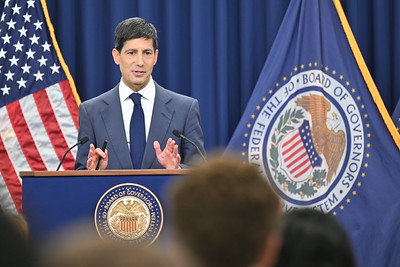
Federal Reserve Chair Kevin Warsh reaffirmed his commitment to price stability on Thursday, while declining to signal a definitive direction for the benchmark interest rate at the upcoming December meeting. Citing shifts in financial and credit conditions since the September rate hike, Warsh emphasized the importance of assessing the lagged effects of monetary policy.
At the conclusion of its Federal Open Market Committee (FOMC) meeting, the Fed left its target range for the federal funds rate unchanged at 3.75% to 4.00%. The decision maintained the status quo following a 25-basis-point increase on September 16. The vote was 10-2, with Fed Governor Lisa Cook and Cleveland Fed President Beth Hammack dissenting in favor of a 0.25-percentage-point increase. Cook’s dissent marked her first vote against an FOMC monetary policy decision since taking office in 2022.
In its policy statement, the central bank upgraded its assessment of economic activity from a "solid pace" in September to a "strong pace." Policymakers noted that domestic spending remains resilient, underpinned by robust productivity and capital investment. The Fed reiterated that inflation remains elevated, adding that incoming data will help determine the appropriate policy stance required to return inflation to its 2% target in a timely manner.
Speaking at a post-meeting press conference, Warsh emphasized, "Bringing inflation down is our responsibility." While evaluating labor market conditions positively, he noted that discussions at the meeting focused primarily on inflation. However, he maintained that he would not pre-judge the outcome of future meetings, stating that much can happen ahead of the December gathering roughly six weeks away, and that the appropriate policy stance will be determined based on incoming economic data.
Addressing the rationale behind the pause, Warsh pointed to shifts in financial and credit conditions observed since the September rate hike. He noted that policy adjustments are beginning to filter through, resulting in tighter financial conditions for certain corporations and households—a trend largely in line with his expectations. He distinguished, however, between tighter financial conditions relative to the past and evaluating the current level itself as restrictive. The ultimate policy objective, he added, is not to suppress economic activity or reduce employment, but to foster sustainable growth through price stability.
Warsh also highlighted the broad transmission of interest rates when asked about artificial intelligence (AI) investments. "Interest rates affect virtually everything, directly or indirectly," he remarked, pointing to instances where investors are exercising greater selectivity and credit spreads are widening in certain asset segments. He observed that corporate capital expenditures are gradually broadening beyond AI and select sectors.
The Fed Chair clarified that a strong economy does not inherently signal overheating. Even with some demand pressures stemming from expanded AI investment, Warsh stated that the majority of his colleagues do not view the U.S. economy as running excessively hot. Growth itself, he suggested, is not currently fueling inflation in a way that complicates the Fed’s mandate, though he added that productivity gains remain difficult to measure precisely.
Asked whether political considerations influenced the decision to pause ahead of the midterm elections, Warsh dismissed the notion. He stated that politics played no role in the decision, noting that this applied not only to himself but to his fellow committee members.
The Fed also signaled a structural shift in how it conducts monetary policy meetings. While maintaining a schedule of eight FOMC meetings per year, the central bank plans to dedicate one of those meetings exclusively to monetary policy strategy rather than rate decisions, beginning in the autumn of 2027. In 2028, the number of strategy sessions will expand to two, reducing regular rate-setting meetings to six annually.
Warsh explained that alongside regular assessments of short-term economic conditions, the Fed requires dedicated time to re-examine critical long-term issues, effectively separating meetings focused on immediate rate decisions from those addressing medium- to long-term policy strategy.
A review of the Fed’s balance sheet management is expected to extend into next year. Warsh noted that recommendations from the relevant task force are anticipated to reach the FOMC in the first quarter of next year, though the exact timeline remains subject to change. Any actual alterations to balance sheet policy will be decided only after a thorough review of the recommendations, he said.
Treasury yields showed mixed movements across maturities. According to Bloomberg, the 2-year Treasury yield erased its earlier gains and turned lower after Warsh announced plans to reduce the frequency of rate-setting meetings. During the session following the press conference, the 2-year yield fell 3.8 basis points (1 bp = 0.01 percentage point) to 4.70%, while the 10-year yield rose 5 basis points to 5.04%, steepening the yield curve as short-term rates declined and long-term rates advanced.
Market expectations for a rate hike in December remained intact. According to Reuters reporting on Wall Street’s close, CME FedWatch data put the probability of a 25-basis-point increase in December at 85.0%, up from 78.3% the previous day. Although Warsh refrained from signaling the trajectory of the next meeting, futures markets continue to price in an additional hike before the end of the year.



