




HBM4 and server memory demand drive nine-fold surge in operating profit; semiconductor margin reaches 72%
Mobile and home appliance divisions remain in the red; 30 trillion won dividend declared with additional shareholder returns to be finalized in January
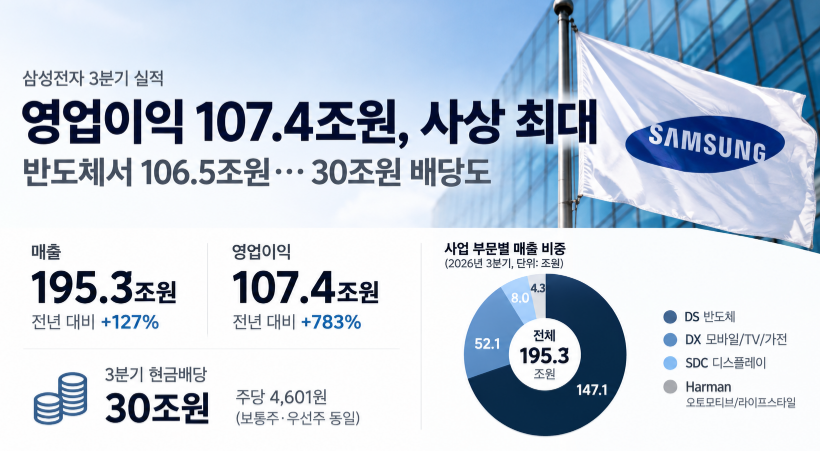
Samsung Electronics (005930) has posted a record-breaking performance for the third quarter, reporting an operating profit of 107.4 trillion won. The semiconductor business alone generated 106.5 trillion won, accounting for 99% of the company's total profit. While a surge in demand for AI server memory bolstered results, the smartphone and home appliance divisions remained in deficit despite growth in revenue.
On the 29th, Samsung Electronics announced consolidated third-quarter revenue of 195.3 trillion won and an operating profit of 107.4 trillion won. Compared to the same period last year, revenue rose by 127% and operating profit by 783%. Both metrics marked the fourth consecutive quarter of record highs.
The operating profit, which stood at 12.2 trillion won in the third quarter of last year, has increased nearly nine-fold in just one year. The operating margin improved by 2.8 percentage points from the previous quarter to 55.0%, with net profit reaching 75.1 trillion won.
HBM4 and rising memory prices drive 15-fold profit growth in semiconductors
The Device Solutions (DS) division, responsible for the semiconductor business, posted revenue of 147.1 trillion won and an operating profit of 106.5 trillion won—an increase of more than 15 times compared to the 7 trillion won recorded in the same period last year.
The growth was fueled by High Bandwidth Memory (HBM) and server-focused memory products. Sales of the sixth-generation HBM, HBM4, expanded significantly, and demand for server-grade Solid State Drives (SSDs) remained robust. Revenue for the memory business reached 140.7 trillion won, a 427% increase year-on-year.
The combination of high-value product sales and a broader rise in memory prices bolstered profitability. As AI server investments intensified, limited supply capacity triggered price increases, particularly for server-oriented products, pushing the DS division's operating margin to 72%.
In the foundry business, increased supply of base dies for HBM and higher utilization rates for advanced nodes contributed to improved performance. The company also secured further orders for 2nm high-performance computing (HPC) products from major cloud service providers.
Samsung plans to expand sales of HBM, server-grade DRAM, and SSDs in the fourth quarter. It expects memory demand to significantly outpace industry supply capacity next year as AI infrastructure investment grows. In the foundry sector, the company aims to scale up 2nm advanced nodes and 4nm neural processing unit (NPU) production, while moving forward with the operational ramp-up of its Taylor, Texas facility.
Foldables grow, but mobile and appliances struggle with losses
While the semiconductor division achieved record earnings, the smartphone and home appliance businesses faced headwinds. The Device eXperience (DX) division reported third-quarter revenue of 52.1 trillion won—up 8% from the previous quarter—but suffered an operating loss of 800 billion won.
The Mobile eXperience (MX) and Network business saw revenue grow 14% quarter-on-quarter to 37.7 trillion won, driven by the new Galaxy Z Fold 8 and other foldable products. However, ongoing cost pressures for components resulted in an operating loss of 600 billion won, a 100 billion won improvement from the previous quarter.
The TV and home appliance business recorded a loss of 200 billion won. TV demand slowed following the conclusion of major sporting events, while profitability in home appliances was eroded by rising raw material costs and logistics expenses.
In the third quarter of last year, the DX division posted an operating profit of 3.5 trillion won. Unlike the semiconductor business, which saw profit surge from 7 trillion won to 106.5 trillion won, the finished goods business swung from a profit to a loss, widening the profitability gap between business units.
Samsung Display recorded an operating profit of 1.1 trillion won, supported by new product launches from key clients and higher sales of large panels. Harman posted an operating profit of 600 billion won, bolstered by increased sales of automotive and audio products and one-off gains from U.S. tariff refunds.
30 trillion won dividend confirmed; up to 75 trillion won remaining for shareholder returns
Concurrent with the earnings announcement, Samsung Electronics declared a cash dividend totaling 30 trillion won for the third quarter. A dividend of 4,601 won per share will be paid to both common and preferred shareholders. The record date was September 30, with the payment date scheduled for November 27.
The total shareholder return budget for this year is set at 90 trillion to 110 trillion won. Accounting for the 35 trillion won already executed or committed under the 2024–2026 shareholder return policy, approximately 55 trillion to 75 trillion won remains.
Samsung intends to utilize the remaining funds for additional cash dividends and large-scale share buybacks and cancellations. The company is also reviewing the allocation of preferred shares in the buyback process to account for price discrepancies between common and preferred stock.
The company's cash position has strengthened, with net cash reaching 197.6 trillion won at the end of the third quarter, an increase of 30 trillion won from the previous quarter. Operating cash flow hit 98.6 trillion won, and 12.5 trillion won was used for share buybacks during the quarter.
Samsung Electronics plans to finalize the scale and implementation strategy for the remaining shareholder returns at its board meeting in late January. Specific plans regarding the allocation of excess cash from the semiconductor boom toward dividends and share cancellations are expected to be disclosed at that time.
[SOURCE]


