



Nvidia and Nokia successfully execute AI-RAN calls on US commercial network, unveil Blackwell GPU servers
Samsung Electronics secures supply contracts with KT and SK Telecom, upgrades Japanese network performance, and expands its footprint in AI infrastructure
Mobile communication base stations, long used strictly for transmitting voice and data, are entering an era where they will also handle AI processing. In the US, a live 5G commercial network was successfully connected to AI computing servers to place calls, while European trials tested performing telecom signal processing and video analytics AI on a single platform. As key players including Nvidia, Nokia, and Samsung Electronics accelerate the development of related technologies, the fundamental role of telecommunications networks is transforming.
At the center of this paradigm shift is the AI-based Radio Access Network (AI-RAN). This technology executes AI computations directly within the servers handling telecom signals, which not only improves network quality but also enables services such as industrial factory robots and video analytics. If telecom operators accelerate their adoption of AI-RAN equipment, the demand for GPUs and server memory—historically concentrated in large-scale data centers—could expand directly into the telecom network infrastructure.
Integrating AI Computations into Telecom Networks: Field Trials in the US and Europe
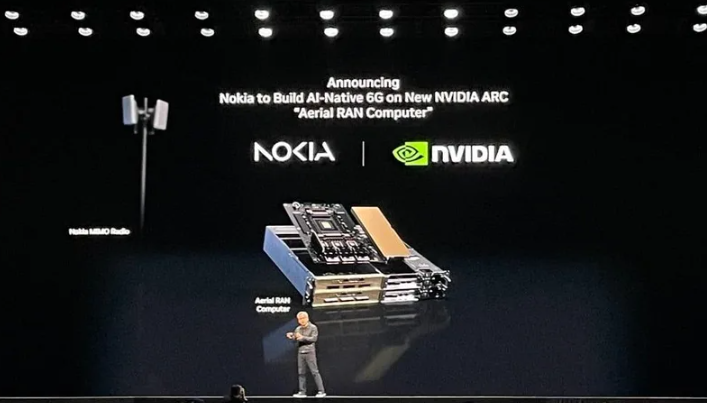
During the GTC event in Berlin on the 21st, Nvidia and Nokia unveiled a strategy to transition telecom networks into decentralized AI infrastructures. With nearly 20 global telecom operators participating in the collaboration, field tests combining AI computing functions with existing 5G networks are underway in the US and Europe.
The most notable milestone is the commercial network trial conducted by T-Mobile in the US. T-Mobile successfully placed a call by connecting Nvidia's AI-RAN server and Nokia's telecom software to an existing 5G core network and commercial smartphones in Bellevue, Washington. This marks a significant achievement as the AI-RAN technology was validated in a live operational network rather than a controlled research facility.
In Europe, trials demonstrating the simultaneous processing of telecom and AI workloads on a single platform followed. Finland's Elisa successfully processed voice calls, mobile data, and video analytics AI concurrently in a live 5G environment. Meanwhile, Deutsche Telekom achieved lab-scale results by applying AI-based signal processing at research facilities in Germany and Finland, boosting uplink data throughput by 10% to 15%.
Field testing is slated to continue next year. The UK's BT and Deutsche Telekom are pushing for field trials by 2027, and Elisa plans to evaluate the commercial viability of the technology as it expands its deployment of decentralized AI-RAN. If telecommunications networks built over decades for voice and data transmission take on AI processing duties as well, the utility of base stations and servers operated by telecom companies will fundamentally change.
Samsung Electronics Selected as Supplier for KT and SK Telecom, Enhances Performance in Japan
Domestically, Samsung Electronics is expanding its AI-RAN business, focusing heavily on industrial sites. In September, Samsung signed supply contracts with KT and SK Telecom tied to the Ministry of Science and ICT's 'Hyper AI Network' project, participating as the sole global equipment supplier for KT's initiative and a key supplier for SK Telecom's.
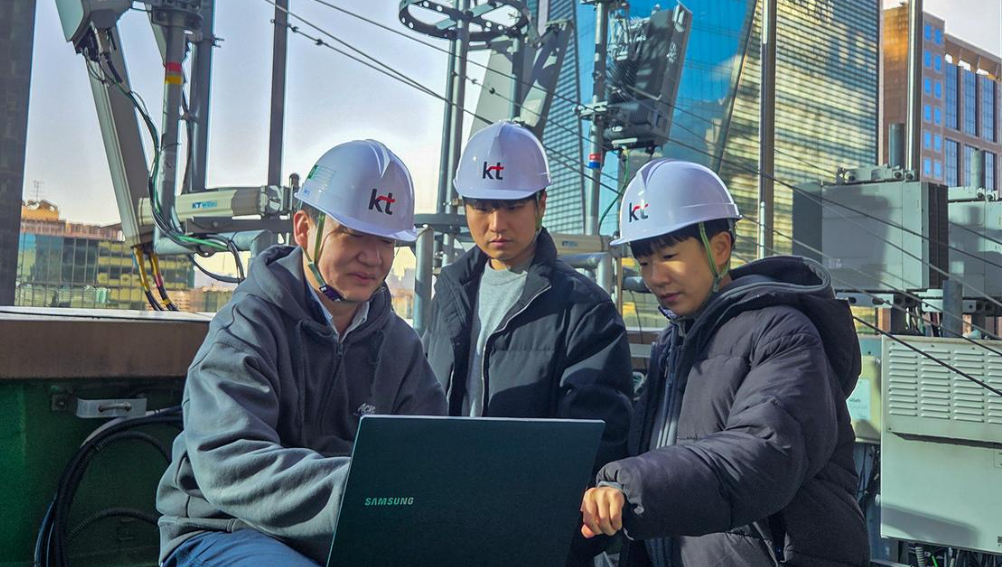 [Source: KT. Researchers from KT and Samsung Electronics testing AI-RAN technology]
With KT, Samsung is testing physical AI services—such as welding and painting robots—at HD Hyundai Samho's shipyard in Yeongam, South Jeolla Province. With SK Telecom, the company is demonstrating autonomous patrol robots and video-based safety management technology at SK Incheon Petrochemical's plant. Both sites represent industrial environments where robotics and AI are deployed directly onto active shop floors.
In such industrial settings, data processing speed is critical. Analyzing information close to the telecom network rather than sending robot-collected data back to a distant data center significantly reduces latency. Moon Jun, Vice President of R&D for Samsung Electronics' Networks Business, stated in September, "As AI evolves into physical intelligence, networks are emerging as platforms connecting new intelligent machines, including humanoids and autonomous vehicles."
While driving industrial adoption at home, Samsung has also achieved tangible results in improving telecom quality using AI in Japan. According to a joint test with NTT Docomo announced in August, the frequency of service transmission speed drops decreased from 13.1% to 7.2%. The two companies utilized data gathered from Japanese commercial and test networks in January for simulations, employing an AI model that predicts potential quality degradation and adjusts network settings on a per-user basis.
Samsung is combining these AI technologies with its virtualized Radio Access Network (vRAN) framework, which runs telecom software on generic servers. Its integrated edge AI platform, 'Network in a Server (NIS),' is designed to handle both communication functions and AI services within a single server environment, with the flexibility to add GPUs based on required computing performance.
While these technologies are currently being tested within 5G networks, they will ultimately tie into the development of 6G, which aims to incorporate AI from the initial network design phase. Unlike Nvidia, which spearheads GPU-accelerated computing, Samsung is broadening its business on the back of telecom equipment and virtualization software, while also pursuing collaboration with Nvidia in the development of AI-driven communication networks.
Arrival of Blackwell Servers: Semiconductor Demand Hinges on Telecom Capex
At the recent GTC event, Nvidia unveiled two types of AI-RAN platforms utilizing RTX PRO 6000 Blackwell server GPUs. Targeted at centralized telecom facilities that handle signal processing and AI tasks for multiple base stations, these servers will be supplied by Dell Technologies, Quanta Cloud Technology, and Supermicro.
AI-RAN does not require installing standalone GPUs at every single base station. Instead, computing hardware can be deployed at regional hubs or centralized facilities connecting multiple base stations. As telecom operators expand AI computing capabilities across their networks, the demand for GPUs and server memory—historically concentrated in data centers—will permeate new domains.
This trend also presents a major expansion opportunity for Samsung Electronics, which possesses capabilities spanning telecom equipment, virtualization software, memory, and foundry operations. Although current AI-RAN operations center heavily around network hardware, any future surge in AI computing demand within telecom networks will heighten the potential synergies with its semiconductor business.
Telecom operators are eyeing AI-RAN for reasons that extend far beyond mere improvements in communication quality. The technology allows them to leverage existing networks to deliver novel AI services—such as industrial robotics and video analytics—while simultaneously boosting network operational efficiency. Although challenges remain in validating power and cooling costs associated with server deployment as well as overall profitability, telecom networks taking on AI workloads are officially introducing a fresh source of hardware demand outside the traditional data center.



