
H1 Revenue at 71.5 Billion Won, Operating Profit at 15.5 Billion Won… Operating Margin Stands at 21.8%
Americas and Asia Revenue Up 24.7% and 41.2%, Respectively… Overseas Sales Account for 84.8%
Surging Data Center Security Demand Prompts Expansion into AI Video Surveillance, Integrated Control, and Robot Security
Suprema (236200) is sustaining its upward trajectory in global markets on the back of high profitability in its biometric-based access control business, while actively broadening its operational footprint into AI video surveillance, integrated monitoring, and robot security, Small Insight Research reported on the 2nd.
For the first half of 2026, Suprema posted consolidated revenue of 71.5 billion won, up 16.5% year-on-year, with operating profit climbing 17.3% to 15.5 billion won. The company’s operating margin, which improved from 17.6% in 2023 to 23.8% in 2025, remained solid at 21.8% in the first half of 2026. This resilient profitability is underpinned by high-value-added product competitiveness built on proprietary biometric algorithms and software technologies.
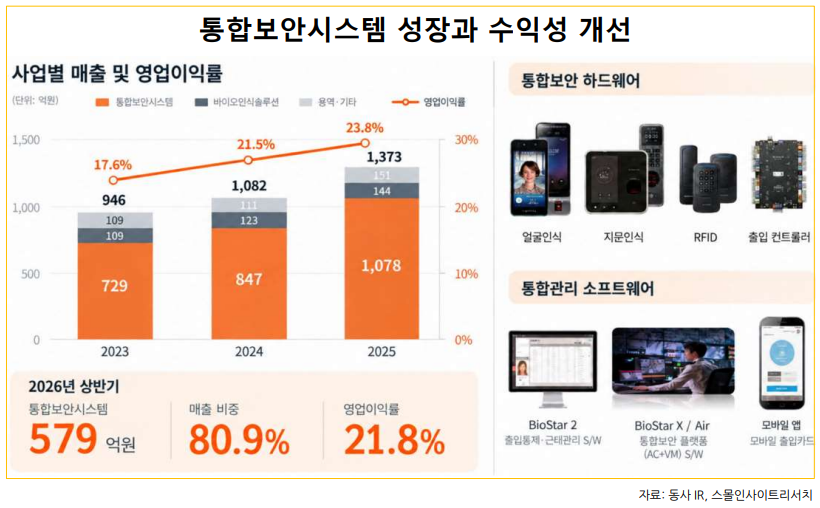 However, preliminary consolidated figures for the third quarter of 2026 showed revenue rising 8.2% year-on-year to 32.8 billion won, while operating profit contracted 13.1% to 5.7 billion won. The slowdown is attributed to a combination of rising raw material costs, short-term currency fluctuations, sluggish demand in select overseas markets, and seasonality. Cumulative revenue and operating profit for the first three quarters grew 13.8% and 7.2%, respectively, with the operating margin holding steady at 20.3%, indicating that the fundamental growth drivers of the core business remain intact.
Suprema possesses over two decades of accumulated expertise in biometric algorithms and the technological capability to commercialize them into hardware and software solutions. According to market research firm Omdia's 2025 market share projections, Suprema ranks second globally in the biometric reader market with a 12.6% share, and ties for fourth in the total access control reader market with a 4.5% share. Furthermore, the revenue contribution of high-value-added AI-enabled products expanded from 23.5% in 2021 to 53.0% in 2025.
International expansion is being spearheaded by robust growth in the Americas and Asia. In the first half of 2026, overseas revenue reached 60.6 billion won, representing 84.8% of total sales. Revenue from the Americas rose 24.7% year-on-year to 19.2 billion won, while Asian sales surged 41.2% to 16.5 billion won. Growth in these two regions accounted for approximately 85% of total revenue increase.
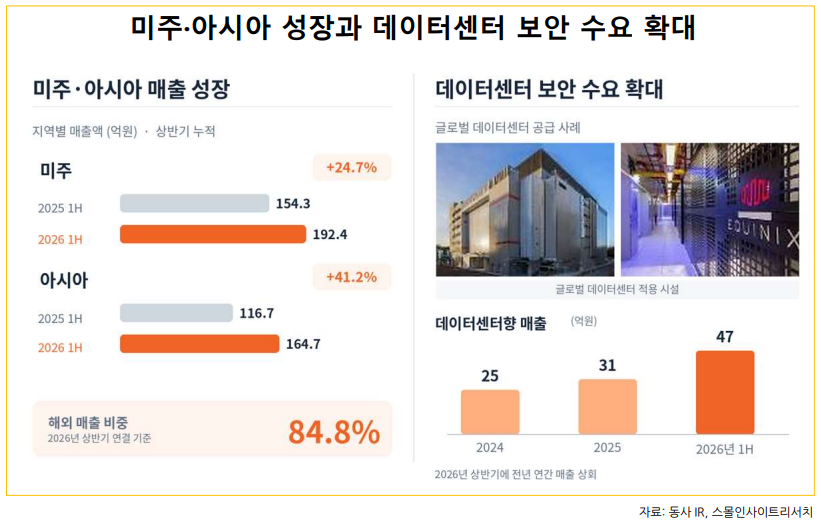 Suprema operates globally through a sales network spanning over 140 countries, supported by 446 partners and 7 overseas subsidiaries. In North America, the company is expanding its supply infrastructure by leveraging local distribution networks and integrations with global security platforms. In India and South Asia, it is ramping up the deployment of access security solutions for global manufacturing conglomerates and major domestic enterprises. In Japan, building on its deployment experience with the CLUe cloud-based access authentication service, Suprema is driving the expansion of its AI video surveillance market.
Building on its integrated security systems business—which accounted for 80.9% of total revenue in the first half of 2026—Suprema is extending its reach into high-security facilities such as data centers. Revenue from data center applications grew from 2.5 billion won in 2024 and 3.1 billion won in 2025 to 4.7 billion won in the first half of 2026 alone, already surpassing its full-year performance from the previous year.
Concurrently, the company is evolving its solution portfolio beyond basic access authentication into video analytics and integrated monitoring. Launched in 2025, "BioStar X" is a unified platform solution that combines access control and video management systems. Meanwhile, the "ViOnyx" AI camera integrates facial recognition with person re-identification technology to track movement and detect unauthorized access within facilities. By linking these with cloud-based access management, Suprema is broadening the applicable scope of its security solutions.
The company is also securing lucrative business opportunities in robot security and smart buildings. Collaborating with Hyundai Motor Group's Robotics LAB and Hyundai Engineering & Construction, Suprema is pursuing projects to integrate AI access authentication, integrated monitoring, and robotic services into smart residential complexes. Additionally, it has unveiled an AI patrol robot solution in partnership with autonomous driving robotics firm Neubility, expanding its reach into mobile security domains.
Enhanced shareholder returns represent another pivotal variable for a revaluation of the company’s corporate value. Suprema has pledged a target annual dividend of at least 400 won per share for the 2026–2028 period, alongside a three-year average total shareholder return ratio exceeding 40%. Meanwhile, U.S. activist investment firm Dalton Investments has increased its stake in the company to 8.00% this year.
While financial stability remains sound, managing earnings volatility stemming from financial asset management presents an ongoing challenge. As of the end of June 2026, the consolidated debt-to-equity ratio stood at 9.5%, with cash and cash equivalents reaching 77.4 billion won. Conversely, preliminary Q3 results showed a non-operating loss of approximately 23.5 billion won, leading to a net loss of 12.6 billion won. This was primarily driven by foreign currency translation losses and deteriorating valuation gains/losses on financial assets, underscoring the need for tighter risk management regarding financial asset operations.
"Despite the Q3 margin compression, cumulative earnings continue to demonstrate growth, making it difficult to argue that the fundamental competitiveness of the core business has suffered structural damage," noted Choi Sung-won, an analyst at Small Insight Research. "Key catalysts for a corporate value revaluation moving forward will include the sustainability of revenue growth in the Americas, Asia, and data centers; actual revenue contributions from AI video surveillance, cloud, and robot security; and the faithful execution of shareholder return policies."