Q3 operating profit hits 9450 billion won, up 48% year-on-year... Debt reduced by 4.3 trillion won
1.1 trillion won earmarked for Australian lithium mine... 250 billion won to be used for share buyback and cancellation within the year
POSCO Holdings detailed these plans during its third-quarter earnings conference call on the 2nd. Consolidated revenue for the third quarter reached 19.1410 trillion won, with operating profit coming in at 9450 billion won—up approximately 10.9% and 47.9%, respectively, from the same period last year. Operating profit for its flagship steel subsidiary, POSCO, also rebounded to the 400-billion-won range. The earnings improvement was driven by higher selling prices, increased production and sales volumes, and cost-cutting measures.
Financial metrics strengthened alongside profitability. The consolidated operating margin rose from 4.3% in the previous quarter to 4.9%, while borrowings decreased by 4.2690 trillion won from 16.1060 trillion won to 11.8370 trillion won. The net debt-to-equity ratio also fell by 6.7 percentage points, from 25.1% to 18.4%.
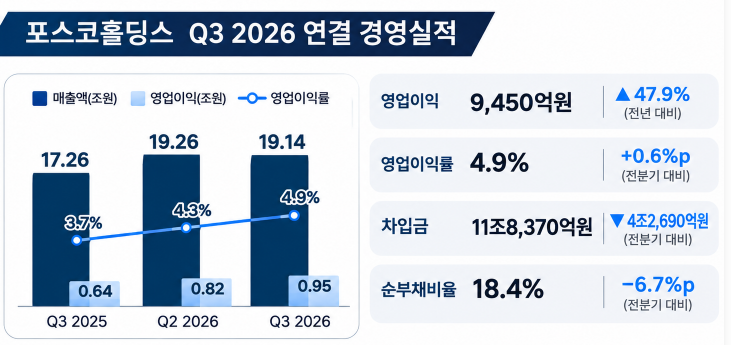 [Source: POSCO Holdings, Q3 2026 Consolidated Financial Results and Financial Metrics]
POSCO Brings Forward Share Cancellations... Where Will the W2.5 Trillion Go?
In August, POSCO Holdings monetized a portion of its stakes in POSCO International and POSCO DX. The transaction values stood at approximately 2.0184 trillion won and 481.7 billion won, respectively, totaling roughly 2.5 trillion won. While its shareholdings in both companies were reduced to 50%, POSCO Holdings retained its status as the controlling shareholder.
The transactions utilized three-year Total Return Swaps (TRS). This structure involves trading stocks based on an underlying asset with financial institutions, followed by the settlement of the difference resulting from future stock price fluctuations. While this secures immediate cash, a settlement liability tied to future stock price movements remains.
The company has also accelerated its shareholder return timeline. Although POSCO Holdings initially considered executing share buybacks and cancellations only after monetizing its stake in POSCO Future M, it decided to proceed within this year using funds already secured. The program is valued at approximately 250 billion won.
Management explained during the conference call that the current stock price fails to fully reflect the company's asset value and future earnings potential. This prompted the decision to pursue share buybacks and cancellations using existing financial resources rather than waiting for the POSCO Future M stake sale.
Of the 2.5 trillion won, approximately 1.35 trillion won has been allocated to lithium mine investments and shareholder returns. The remaining funds are planned for follow-up investments in Argentine lithium projects. Prior to executing these investments, the company is also reviewing options to further alleviate its debt burden.
Diverging Timelines for Lithium Turnaround: Argentina Ahead, Ore Business Lags
Profitability recovery speeds vary across production facilities within the lithium business. While Argentine brine lithium aims for an operating profit turnaround next year by ramping up production, ore-based lithium will first target a turnaround in earnings before interest, taxes, depreciation, and amortization (EBITDA), excluding depreciation expenses.
In April, POSCO Holdings signed a roughly 1.1 trillion won mine equity investment agreement with Australia’s Mineral Resources. The deal secures a 15% indirect stake in each of the Wodgina and Mount Marion mines in Western Australia. Once finalized, this will broaden the company's lithium raw material supply base.
Performance at the target mines has improved. According to Mineral Resources’ fiscal year 2026 data, the combined EBITDA of the two mines surged more than eightfold from 93 million Australian dollars the previous year to 772 million Australian dollars. The gains were driven by increased spodumene sales volumes, rising prices, and lowered production costs.
In Argentina, the company plans to raise the operational rate of the No. 2 lithium plant—completed in October—to 70% by next July and 90% by next December. Based on current lithium prices, management expects an operating profit turnaround by the third quarter of next year. Production at the No. 1 plant is also slated to expand from 14,000 to 15,000 tons this year to 21,000 to 22,000 tons next year.
The ore-based lithium business requires more time to improve profitability. The raw material cost share for POSCO Pilbara Lithium Solution has dropped from 80–87% of selling prices in the first half of the year to below 70% currently. The price spread between products and raw materials has also widened from $3.5–$4 per kilogram to $4.5–$5.
However, the operating profit turnaround threshold set by the company is $6 or more per kilogram. Because current price spreads are insufficient to fully absorb depreciation expenses, achieving an EBITDA-positive result has been set as the primary goal for next year.