FDA formally accepts resubmission and initiates six-month review, targeting April 9, 2027
Follows recent cholangiocarcinoma approval; global Phase 3 trial demonstrated median overall survival of 23.8 months
Having secured its first US oncology approval in September, South Korean biotech firm HLB (028300) has entered formal review for the commercialization of its second new drug, this time targeting liver cancer. The combination therapy extended patient survival by 8.6 months compared to existing treatments in global Phase 3 trials, with the U.S. Food and Drug Administration (FDA) setting a target action date of April 9 of next year.
HLB announced on the 4th that its U.S. subsidiary, Elevar Therapeutics, received notification from the FDA that the New Drug Application (NDA) for the combination of rivoceranib and camrelizumab as a first-line treatment for hepatocellular carcinoma (HCC) has been accepted for substantive review.
The FDA classified the resubmission as a Class 2 review, which carries a six-month review cycle. Under the Prescription Drug User Fee Act (PDUFA), the target review completion date is set for April 9, 2027. This target date represents the FDA's goal for completing its review and does not constitute a guaranteed approval.
Elevar resubmitted the NDA for rivoceranib on October 9. China’s Jiangsu Hengrui Pharmaceuticals also resubmitted the Biologics License Application (BLA) for its co-administered drug, camrelizumab. The FDA is reviewing the regulatory approval for both drugs concurrently.
Expanding US Oncology Portfolio from Cholangiocarcinoma to Liver Cancer
On September 23 (local time), HLB secured FDA marketing approval for Repicitinib (generic name: lirafugratinib). Repicitinib is indicated for previously treated adult patients with locally advanced or metastatic cholangiocarcinoma harboring FGFR2 gene fusions or rearrangements.
Elevar holds the global exclusive commercialization license for Repicitinib and has been preparing for its U.S. launch. Securing approval for the liver cancer treatment would enable HLB to supply two distinct oncology drugs targeting different cancer types to the U.S. market. Furthermore, the regulatory experience and local business infrastructure built during the Repicitinib approval process can be leveraged to support subsequent commercialization efforts.
Rivoceranib is an oral targeted anti-angiogenic drug that inhibits tumor blood vessel formation, while camrelizumab is an immune checkpoint inhibitor targeting the PD-1 protein. The combination therapy was approved in China in 2023 as a first-line treatment for unresectable or metastatic hepatocellular carcinoma. Elevar holds commercialization rights for the combination outside of China and South Korea.
23.8-Month Overall Survival Puts Drug on Par with Global Competitors
The regulatory filing is backed by the global Phase 3 CARES-310 study. In clinical trials involving patients with unresectable or metastatic hepatocellular carcinoma, the median overall survival (mOS) for the combination therapy was 23.8 months, an 8.6-month improvement over the 15.2 months recorded by the standard-of-care sorafenib. The hazard ratio (HR) for death was 0.64, representing an approximately 36% reduction in the risk of death compared to the comparator arm, with statistical significance achieved.
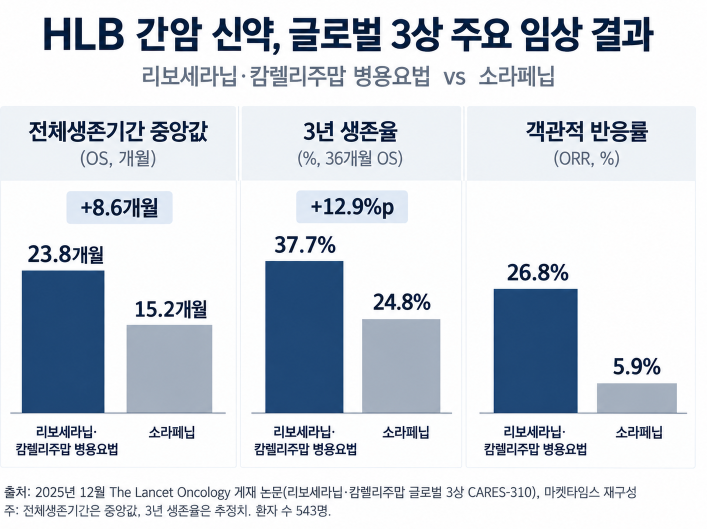 The 23.8-month survival figure ranks among the longest reported in major global Phase 3 trials for first-line liver cancer treatments. It is comparable to the 23.7-month overall survival recorded in the CheckMate-9DW trial by Bristol Myers Squibb’s (BMS) Opdivo and Yervoy combination therapy. However, as these figures stem from separate clinical trials, they do not imply direct clinical superiority between the therapies.
The final analysis of the CARES-310 study was published in the international medical journal *The Lancet Oncology* in December 2025. The combination therapy has also been included as a first-line treatment option for advanced hepatocellular carcinoma in the Barcelona Clinic Liver Cancer (BCLC) staging classification and the European Society for Medical Oncology (ESMO) guidelines.
HLB proceeded with the resubmission after addressing manufacturing and quality control deficiencies raised during the previous FDA review. The current substantive review will focus on evaluating the supplemental data and chemistry, manufacturing, and controls (CMC) requirements.
"Through the CARES-310 study, we demonstrated the meaningful survival improvements offered by the rivoceranib and camrelizumab combination therapy in first-line treatment for unresectable hepatocellular carcinoma," said Kim Dong-gun, CEO of Elevar Therapeutics. "With the substantive review now back underway, we will work closely with Hengrui Pharmaceuticals to ensure a thorough and successful FDA review."