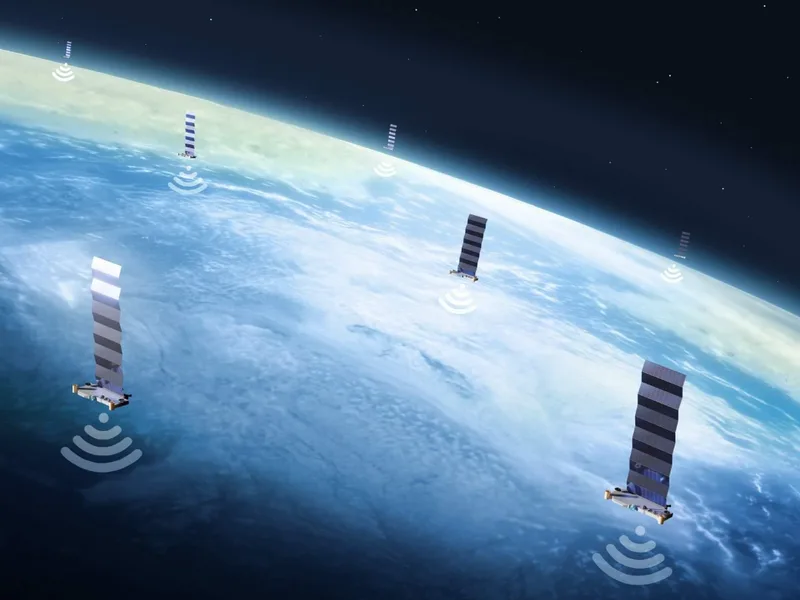
SpaceX transaction valued at roughly $20 billion, Amazon at $11.57 billion… accelerating push into mobile markets
Markets expanding from disaster zones to remote regions… South Korea exploring independent network of up to 512 satellites
From oceans and remote mountain ranges to digitally underserved rural communities in Africa, low-Earth orbit (LEO) satellites are filling the gaps in terrestrial communication networks. Beyond merely providing internet access from hundreds of kilometers above, the commercialization of technology connecting satellites directly to standard smartphones is rapidly broadening the market for satellite communications. While SpaceX, builder of the world's largest satellite internet network, has led the charge, Amazon is now closing the gap through aggressive, large-scale acquisitions.
The focus of competition has shifted from satellite launches to securing radio frequencies and mobile subscribers. The combined value of recent deals signed by SpaceX and Amazon reaches approximately $31.6 billion (about 45 trillion won). Because building a satellite network alone is not enough to break into the mainstream mobile telecommunications market, a full-scale race to secure spectrum rights and existing telecom infrastructure is now underway.
SpaceX Surpasses 10,000 Satellites, Sets Sights on Mobile Carriers
Operating a fleet of over 10,000 Starlink satellites, SpaceX holds a commanding lead in the LEO satellite internet market. To extend its constellation's advantage to standard smartphone services, the company signed a spectrum transaction agreement last year with U.S. satellite and mobile operator EchoStar for up to 65 MHz of spectrum. The total transaction value, including additional agreements, is approximately $20 billion, settled through cash and SpaceX shares. The spectrum transfer process is still ongoing.
Building on its spectrum gains, SpaceX is also expanding into terrestrial mobile services. Under its agreement with EchoStar, SpaceX previously committed to providing direct-to-cell Starlink services to Boost Mobile subscribers, and is reportedly discussing either acquiring Boost Mobile or utilizing its network infrastructure. Boost Mobile operates by leasing network capacity from AT&T and T-Mobile. If this cooperation expands, SpaceX could combine its satellite network with terrestrial base stations to offer services directly to mainstream mobile subscribers. However, negotiations remain unfinalized.
Amazon is narrowing the gap through mergers and acquisitions. On November 27, the U.S. Federal Communications Commission (FCC) approved Amazon’s acquisition of Globalstar in a deal valued at $11.57 billion. Globalstar provides the satellite emergency messaging feature for Apple’s iPhone; upon completion, the acquisition will give Amazon crucial spectrum as well as space and ground-based communication facilities. Unlike SpaceX, which gained an early lead in satellite deployment, Amazon is looking to fast-track its market entry by acquiring an established operator's spectrum and commercial service foundation.
Simultaneously, Amazon is building its own proprietary constellation, "Amazon Kuiper." Having launched its first test satellites in April of last year, the company plans to deploy roughly 3,200 satellites, while separately applying for operating licenses for up to 5,105 additional satellites dedicated to direct-to-smartphone communications. While SpaceX leverages its massive satellite fleet to expand its mobile business, Amazon is pursuing a dual strategy of building its own constellation while acquiring established operators.
Both companies are targeting the Direct-to-Device (D2D) market, which connects ordinary smartphones directly to satellites. While traditional satellite internet required dedicated receiver terminals, D2D allows users to communicate via satellite in areas beyond the reach of terrestrial cell towers. As service scopes expand from text and emergency messaging to voice and data, the business boundaries between satellite operators and traditional mobile carriers are increasingly blurring. This is why a competition that began in space is rapidly translating into a fight for terrestrial mobile subscribers.
The applications of satellite communications have long transcended commercial services. Following the Russian invasion, Starlink provided critical military and civilian communications in Ukraine. At the same time, this highlighted a potential security risk: heavy reliance on foreign private operators. While LEO networks can open up new markets in remote African regions where laying fiber-optic cables and building cell towers is impractical, translating this into actual subscribers will depend heavily on affordable pricing and device availability.
As satellite communications exert growing influence over national security and mobile markets, spectrum policies are also evolving. On November 29, the FCC proposed a 25 MHz spectrum auction framework and began exploring ways to expand shared spectrum bands between satellite and terrestrial networks from 5 to 13. While discussions point to the potential release of up to 482 MHz of additional spectrum, actual opening remains unconfirmed.
South Korea Considers Up to 512 Satellites… Who Will Foot the 14 Trillion-Won Bill for an Independent Network?
The South Korean government is also weighing the scale of its project to build an independent low-Earth orbit satellite communication network (K-LEO) by 2035. Three scenarios have been tabled: 128 satellites for roughly 4 trillion won, 256 satellites for about 7.4 trillion won, and 512 satellites for approximately 14.3 trillion won. These figures represent cycle-based cost estimates assuming a 5-year satellite lifespan, and the actual project scope and budget have not been finalized. The nature of this initiative also differs from the multi-billion-dollar spectrum acquisitions made by U.S. firms.
The government's roadmap targets securing satellite mass-production and launch technologies by 2030, verifying space operations by 2032, and building the independent network by 2035. Putting hundreds of satellites into orbit first requires establishing robust domestic launch capabilities. Speaking at a parliamentary audit last year, Tae-Seok Oh, Administrator of the Korea AeroSpace Administration (KASA), noted that domestic launch vehicles have inherent limitations, necessitating the use of overseas launch providers.
Even with launch capabilities secured, the project will struggle to sustain itself without stable service demand. Speaking at the K-Space Forum on November 28, Kim Sun, Vice President and Head of Space Business at Hanwha Group, remarked, "The government should not act as the primary developer, but as the primary market maker—meaning a service buyer." Long-term procurement contracts in the defense and public sectors, he explained, could underpin private investment and satellite network operations.
Independently of the state-led network, domestic Korean companies are expanding their footprints in the global satellite communications market. Hanwha Systems has developed military communication systems and mobile terminal technologies utilizing Eutelsat OneWeb’s satellite network. Meanwhile, Intellian Technologies supplies antennas and terminals to overseas satellite operators, unveiling a portable low-Earth orbit communication terminal for military and government agencies in partnership with Eutelsat this February.
While SpaceX and Amazon pour massive capital into securing spectrum and subscribers, South Korea remains at the stage of determining the scale and operational model of its independent network. Beyond acquiring hundreds of satellites, securing a steady base of paying customers and operational revenue has become the ultimate imperative.