


Dow rises 0.10% despite tech weakness; cooling producer prices fail to ease interest rate concerns.
Upcoming retail sales data and Nvidia's earnings report on the 17th will be key indicators for consumer resilience and the sustainability of AI investment.
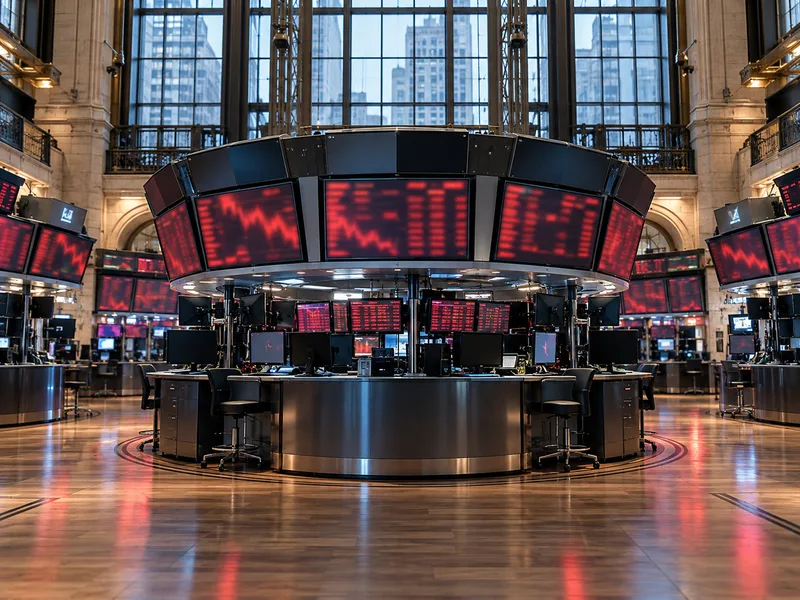
The shock resignation of Nvidia founder and CEO Jensen Huang has rippled through the market, fueling broader concerns over artificial intelligence (AI) investment and dragging down technology stocks on Wall Street. While semiconductor and AI-related shares generally weakened, the Dow Jones Industrial Average posted a modest gain, leading to a mixed close for major indices.
On the 13th (local time), the Dow Jones Industrial Average rose 50.46 points (0.10%) to close at 52,347.55. The S&P 500 index fell 30.73 points (0.40%) to 7,561.67, and the Nasdaq Composite index dropped 229.82 points (0.91%) to 25,136.27. On a weekly basis, all major indices finished higher, with the S&P 500 and Nasdaq snapping a four-week losing streak.
Nvidia shares fell 2.01% to close at $162.85, pushing its market capitalization below the $4 trillion mark. Nvidia announced the previous day that Huang had stepped down immediately from his roles as president, CEO, and board member, with CFO Colette Kress appointed as interim CEO. The company stated it would continue existing operations, customer commitments, and product development schedules.
Markets are focused on Nvidia's role in financing AI infrastructure companies that utilize its semiconductors. Uncertainty regarding how new leadership will manage this strategy has heightened concerns over funding for related firms, though Nvidia has not officially announced a suspension of support.
Competitors AMD and Broadcom, which had risen 5.86% and 5.54% respectively on expectations of a windfall following Huang's departure, fell 8.75% and 4.76% today. Selling pressure spread to memory and storage providers, AI server and data center firms, and AI cloud companies like CoreWeave and Nebius.
Inflation data failed to improve investor sentiment. While the monthly increase slowed, the year-over-year rate accelerated. According to the U.S. Bureau of Labor Statistics (BLS), the Producer Price Index (PPI) for final demand rose 0.3% in October, missing the upwardly revised 1.4% increase in September and the 0.4% market consensus estimated by Reuters.
However, the year-over-year increase rose from 6.3% in September to 6.5% in October, marking the highest level since November 2022. While energy prices fell 0.1% month-over-month, food prices rose 1.3%, and goods excluding food and energy increased 0.5%.
Federal Reserve officials also signaled the possibility of further tightening. Mary Daly, President of the Federal Reserve Bank of San Francisco, pointed to persistent service inflation and suggested that further rate hikes might be necessary. She raised concerns that if companies cannot absorb rising costs, they may pass them on to consumers. The U.S. 10-year Treasury yield hovered in the 5.1% range during the session, weighing on tech stocks.
Nevertheless, some analysts suggest that Nvidia's share price decline has increased its valuation appeal. The company reported $96.2 billion in revenue for the second quarter of fiscal year 2027, a 106% increase from the same period last year, and had previously projected third-quarter revenue of $108 billion (±2%).
Nvidia is scheduled to release its third-quarter fiscal 2027 earnings after the U.S. market close on the 17th. Investors are watching to see if results meet expectations and what the outlook for future demand will be. The management's explanation regarding support for customers and partners following the leadership change is also expected to influence the trajectory of AI-related stocks.
Market participants are also awaiting the release of October retail sales and industrial production data on the 17th. These indicators will provide clarity on the resilience of consumption and production amid ongoing inflation and interest rate pressures.