

KOSDAQ struggles below 700-point threshold; skepticism remains over whether stricter delisting alone can restore investor sentiment.
Proposals include mandatory IR and market segmentation, but attracting institutional capital and protecting growth-oriented firms remain key challenges.
With the KOSDAQ index failing to recover the 700-point level, the government has embarked on a market overhaul centered on delisting insolvent firms and enhancing corporate disclosure. Despite President Lee’s direct call for capital market reform, it remains questionable whether merely purging listed companies and increasing investor relations (IR) activities will resolve the issues of dampened investor sentiment and a lack of institutional capital.
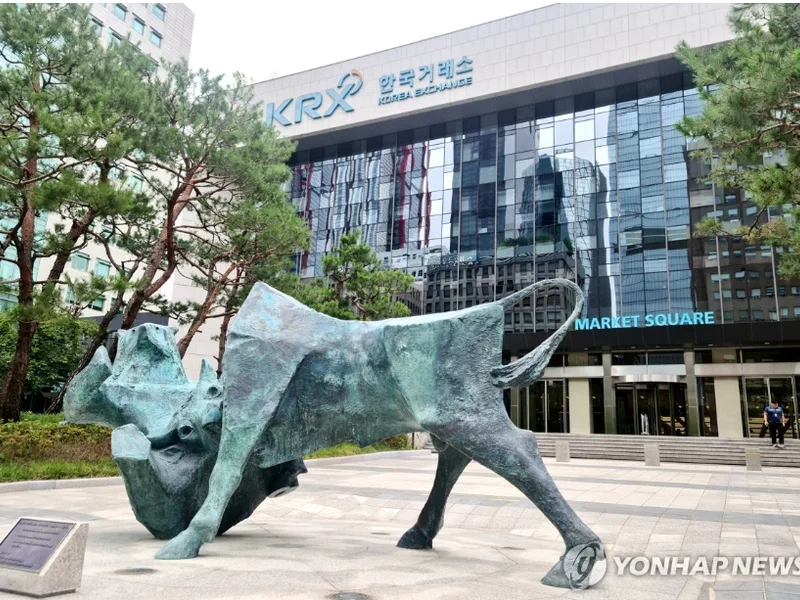
According to the Financial Services Commission on the 13th, President Lee discussed plans for KOSDAQ market redesign, corporate value enhancement, and the expansion of long-term investment demand at a policy roundtable titled 'Trusted Capital Market: Asking and Finding Answers in the Field,' held at the Korea Exchange in Yeouido, Seoul.
The KOSDAQ index closed at 699.66 on the day, marking an increase from the previous trading session but failing to reclaim the 700-point mark.
Accelerating Delisting of Insolvent Firms: A Separate Issue from Sentiment Recovery
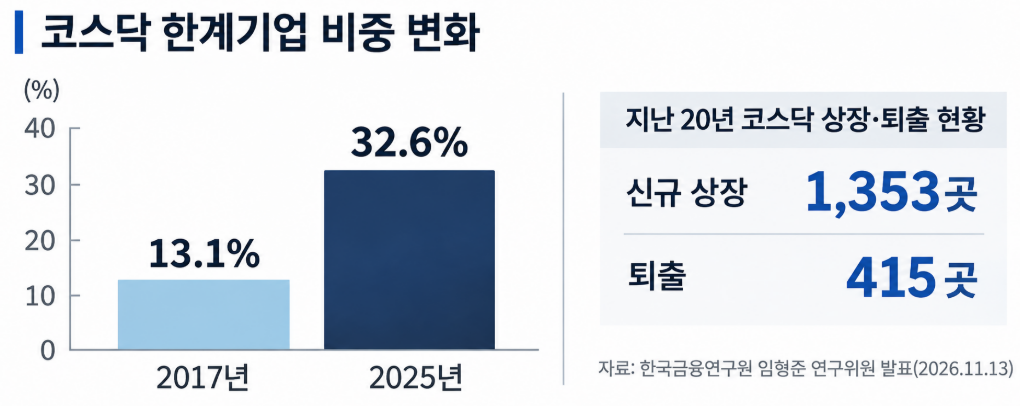
The issue of insolvent firms in the KOSDAQ market is evident in the statistics. Data presented by Lim Hyung-jun, a research fellow at the Korea Institute of Finance, shows that the proportion of marginal firms on the KOSDAQ rose from 13.1% in 2017 to 32.6% in 2025. Over the past 20 years, 1,353 companies were newly listed, while only 415 were delisted. The problem lies not in the increase of listed companies, but in the failure to properly evaluate firms and filter out insolvent ones.
 President Lee emphasized, "Insolvent and underperforming companies must be promptly delisted by strictly applying delisting criteria." He added that measures must be taken to ensure that companies with technological prowess and growth potential are not unfairly penalized due to a lack of proper valuation.
While swift delisting is necessary to improve market integrity, it does not solve all the immediate problems facing the KOSDAQ, such as falling stock prices and liquidity shortages. Increased delisting risks can trigger panic selling, and financially distressed firms may face further burdens in raising capital. If minority shareholder protection is insufficient during the delisting process, it could further erode market trust.
In particular, a company's growth potential should not be undervalued simply because it is currently posting a loss. Criteria are needed to distinguish between insolvent firms and bio or high-tech companies that require long-term R&D investment. If innovative firms are pushed out of the market during the push for stricter delisting, it would contradict the original purpose of the KOSDAQ.
The lack of corporate disclosure has also been identified as a target for improvement. From June 2025 to June of this year, 60% of KOSDAQ-listed companies did not have a single analyst report published by securities firms.
Jung Eun-bo, Chairman of the Korea Exchange, stated, "Currently, we mandate IR activities only at the time of listing, but we are actively reviewing a plan to require at least one IR session per year while a company remains listed." The specific implementation timeline has not yet been determined.
However, holding IR sessions does not automatically increase corporate value. While it is important for management to explain the reasons for poor performance and outline business plans, companies with small market capitalizations and low trading volumes are easily excluded from analyst coverage. Mandatory IR alone is unlikely to resolve the lack of research reports or the indifference of institutional investors.
Will Segmenting the Market Save the KOSDAQ?
Proposals to segment the KOSDAQ market based on growth potential and corporate characteristics were also discussed. The intent is to increase institutional access to high-quality, high-growth firms and reduce incentives for companies to transfer their listings to the KOSPI.
However, separating high-quality firms does not automatically render the remaining companies insolvent. If firms excluded from the premium segment are shunned by investors, capital concentration within the market could worsen. If market segmentation becomes linked to index inclusion or institutional investment criteria, some firms may face increased pressure from capital outflows.
Institutional investors' reluctance to invest in the KOSDAQ is not solely due to unclear market segmentation. Factors such as earnings volatility, low liquidity, lack of corporate information, and distrust in corporate governance all play a role. Without addressing these fundamental issues, market segmentation may lead to the concentration of existing capital rather than the influx of new institutional funds.
The reliance of venture capital exit routes on initial public offerings (IPOs) was also highlighted as a challenge. The proportion of IPOs in domestic venture capital (VC) exits is 37.3%, significantly higher than in the U.S. (4.7%) or Europe (9.0%). Analysts suggest that the lack of a well-developed secondary market for M&A and equity trading forces companies to rely heavily on IPOs.
Proposals to increase long-term institutional capital inflows were also presented. Kim Hak-kyun, head of the research center at Shinyoung Securities, suggested improving dividend policies, managing listed stocks, and revitalizing Individual Savings Accounts (ISA) and public funds as key tasks.
President Lee ordered the formation of a task force (TF) for the normalization and advancement of the capital market, involving relevant ministries, the National Assembly, and the private sector. The Financial Services Commission plans to design follow-up policies based on these discussions, though a specific timeline for the comprehensive measures, including KOSDAQ market reform, has not been set.
Measures to revitalize the KOSDAQ have been introduced multiple times in the past. While delisting insolvent firms and enhancing disclosure are starting points for restoring market trust, they are unlikely to bring investors back on their own. These measures must address not only which companies to remove from the market, but also who will provide long-term investment for the growth-oriented firms that remain.