

Taiwan Approves NT$500 Billion Stabilization Fund, Restricts Short Selling and Eases Margin Trading
South Korea Prioritizes Collateral Regulation Relief Despite 44% Drop From Peak
When the stock market plunged, Taiwan slashed its short-sale order limits by 90% and approved intervention by its national financial stabilization fund. It also unveiled comprehensive measures, including easing margin trading burdens and encouraging share buybacks. In contrast, the South Korean government's primary initial response was to waive the obligation of brokerages to maintain margin loan collateral ratios. Despite facing the common shock of a global tech stock plunge, the policy tools deployed to stabilize the markets differed significantly.
South Korea's muted response is particularly disappointing because this is not its first sharp downturn. Back in July, a plunge in semiconductor stocks and the liquidation of leveraged investments shook the market, prompting the government to pursue stronger regulations on related products. Less than four months later, the market plummeted again, yet the primary remedy was once more the relaxation of collateral rules. Even then, the actual criteria applied to investors vary widely among brokerage firms.
Taiwan Combines Short-Sale Restrictions, Stabilization Fund, and Margin Relief
Taiwan's Financial Supervisory Commission announced on the 6th that it would lower the short-sale order limit for borrowed shares from 30% to 3% of the average trading volume of the past 30 trading days for each stock. Rather than imposing a blanket ban on short selling, the measure slashes daily permitted orders by 90%. The short-sale margin requirement was also raised from 90% to 130%. Both measures take effect on the 9th.
Taiwan also decided to alleviate the burden on margin trading investors. Subject to the agreement of brokerages and other institutions, the range of collateral assets that can be used to meet additional margin calls was broadened. Listed companies were encouraged to consider share buybacks and actively communicate their management status, earnings, and industry outlook through investor relations events.
Separately, the National Financial Stabilization Fund Management Committee approved market intervention. The fund's maximum available size is NT$500 billion (approximately 22 trillion won), which is distinct from the actual amount deployed for purchases. According to the Central News Agency, this decision marks the tenth market intervention approval since the fund's establishment in 2000.
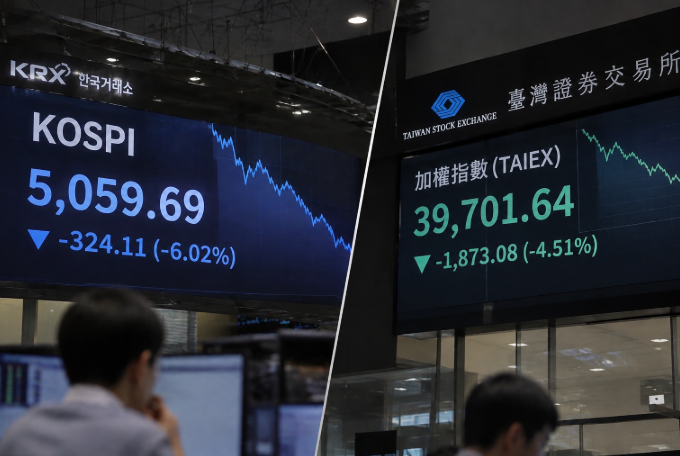
The Taiwan Weighted Index closed down 4.51% at 39,701.64 on the 6th. Following net sales of NT$994.3 billion in October, foreign investors offloaded an additional NT$524.4 billion in November up to the 6th. October's net selling volume was the largest monthly figure on record.
While assessing that Taiwan's economic fundamentals and technology industry competitiveness remain solid, the stabilization fund management committee judged that market intervention was necessary. It viewed economic confidence and responses to financial market instability as separate issues.
Short-sale restrictions do not prevent foreigners from selling spot shares, nor does the stabilization fund's intervention guarantee a stock price rebound. However, Taiwan rolled out a simultaneous package of policies addressing selling pressure, investor sentiment, and margin trading burdens.
South Korea Plunges 44% From Peak After July's Sharp Sell-off
The South Korean stock market also plunged, led by large-cap semiconductor stocks. On the 6th, the KOSPI closed down 6.02% at 5,059.69. During trading hours, the 5,000 mark was breached and a circuit breaker was triggered.
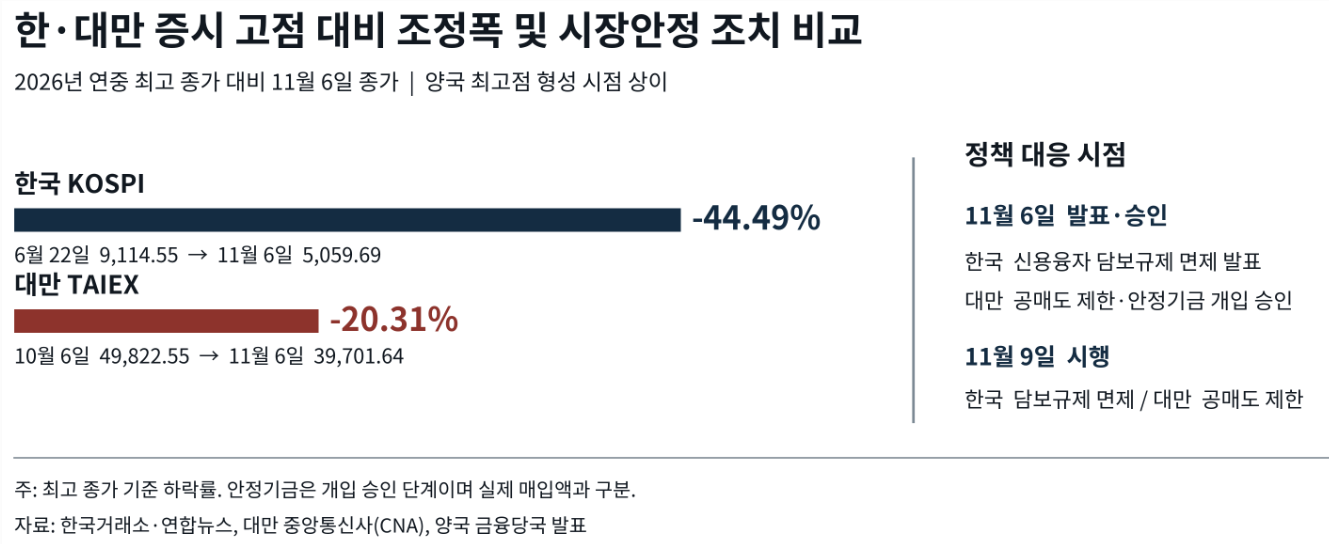
The scale of the correction is starker when compared to the year's peak closing price. The KOSPI tumbled 44.49% from 9,114.55 on June 22 to 5,059.69 on November 6. In contrast, the Taiwan Weighted Index fell 20.31% from its peak closing price of 49,822.55 on October 6 to 39,701.64. Although the timing of their peaks differed, South Korea's decline was 24.18 percentage points deeper.
 The market suffered a similar shock last July. At the time, Reuters reported that the KOSPI plummeted more than 12% during intraday trading as forced liquidations of leveraged investors exacerbated selling pressure. The government stated it would pursue additional regulations on single-stock leverage products and establish legal grounds for emergency market stabilization measures.
Investment losses were massive. According to data submitted by the Financial Supervisory Service to lawmaker Park Sung-hoon of the National Assembly's Political Affairs Committee, individual investors' losses on single-stock leverage and inverse exchange-traded products (ETPs) across 10 major brokerages totaled 6.313 trillion won between May 27 and August 14. This combined realized losses of 2.3242 trillion won and unrealized valuation losses of 3.9888 trillion won.
These figures do not include losses from the November plunge or margin loan forced liquidations. However, they demonstrate that the risks associated with leveraged investing have already manifested on a substantial scale.
At an emergency market situation inspection meeting on the 6th, the government decided to exempt brokerages from the obligation to maintain a 140% margin loan collateral ratio from the 9th until January 31 of next year. The measure aims to mitigate situations where falling stock prices trigger margin calls, and forced liquidations in turn drive stock prices down further.
However, the government's waiver of collateral regulations does not mean that margin calls are suspended for all investors.
Mirae Asset Securities lowered its domestic stock collateral maintenance ratio from 140% to 130%. Conversely, Korea Investment & Securities requires applications for collateral ratios between 130% and 140% to defer margin calls by one day, and investors must reapply daily to maintain the deferral. For the 120% to 130% bracket, deferral is granted only once. Kiwoom Securities applies a one-day deferral to clients in the 130–140% range who submit an application.
Even with the exact same collateral ratio of 135%, the timing of forced liquidation can vary depending on the brokerage and whether an application was filed. Even if the government relaxes regulations, investors may miss out on benefits if they are unaware of the application procedures or miss deadlines.
Dismissing Reactions as 'Excessive' While Lacking Criteria for Additional Stabilization Measures
At the emergency meeting on the 6th, the government assessed that policy uncertainties surrounding the artificial intelligence industry and a contraction in global investment sentiment had impacted the domestic stock market, adding that domestic stocks were showing an "aspect of excessive reaction" to external factors. It also reiterated that South Korea's economic fundamentals remain solid.
Taiwanese authorities similarly judged that their economic fundamentals were sound. The divergence lies in what followed. Taiwan chose a combination of stabilization fund intervention, short-sale restrictions, and margin trading relief to safeguard market confidence. South Korea focused primarily on lowering the burden of margin calls.
This does not mean South Korea should blindly copy Taiwan's policies. Short-sale restrictions can weaken price discovery functions and affect trading liquidity, while deploying public funds requires separate judgment. South Korea's relaxation of collateral rules is also a viable response to reduce forced liquidations during market crashes.
Yet, the risks highlighted kept changing: leverage products in July, and margin loan forced liquidations in November. Since different risks surface with each shock, it is worth examining whether financial authorities' oversight has gone beyond individual products and accounts to thoroughly assess systemic selling pressure across the entire market.
Financial authorities must verify how many accounts actually benefit from deferred margin calls under the current collateral rule exemption. They need to make it easy for investors to check application procedures and criteria by brokerage, and disclose how much the volume of forced liquidations changed following the measures.
The response to the broader market must also be clear. While the government stated it would prepare additional stabilization measures if volatility escalates, it failed to specifically explain which risk signals would trigger which tools. Another point to review is the progress made on establishing the legal basis for emergency stabilization measures pursued in July.
While the government cannot be blamed for failing to prevent stock declines, the narrative changes if it repeatedly faces risks yet fails to present a scorecard of previous measures or criteria for future responses.
What market stabilization policies require is not unconditionally harsher regulations, but clear criteria to determine which measures apply to specific risks and whether implemented policies actually deliver results. This is the question South Korea's financial authorities must now answer.