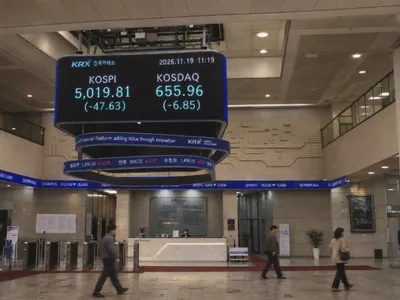



216 trading days tracked: 62 trillion won in short selling and 86 trillion won in net foreign selling since June.
Impact of US AMD short-selling report: Focus on potential abuse of information and orders.
Monitoring large-scale capital-linked trades: Taiwan reduces short-selling limit to 1%.
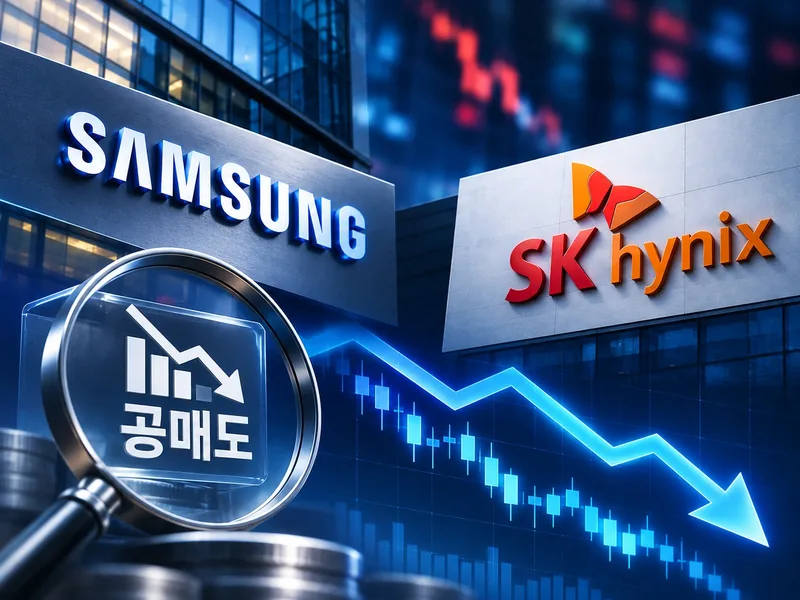
As shares of Samsung Electronics and SK hynix have plummeted by 47% and 60% respectively from their peaks, the total value of short-selling transactions for these two stocks has exceeded 109 trillion won this year.
Between June 19 and November 19, short-selling transactions reached 62 trillion won. During the same period, foreign investors net sold over 86 trillion won in these two stocks, while retail investors net purchased more than 27 trillion won.
This analysis is based on a comprehensive review of Korea Exchange (KRX) short-selling data for the 216 trading days from January 2 to November 19, conducted by Market Times (MKT).
Short selling is a legal practice that allows investors to seek profits even during market downturns. However, it can be abused to disrupt the market if combined with the spread of false information, manipulative orders, or illicit coordination between large-scale capital entities.
The recent fallout from a short-selling report on US-based AMD highlights the necessity of reviewing these risks.
109 Trillion Won in Short Selling on 'Sam-Hynix': Retail Investors Net Buy 27 Trillion Won
According to KRX short-selling statistics, the cumulative transaction value for the two stocks during the survey period was 109.33 trillion won, with a volume of 253.37 million shares.
Samsung Electronics accounted for 217.41 million shares worth 51.52 trillion won, while SK hynix saw 35.97 million shares traded for 57.82 trillion won.
From June 19 to November 19, short-selling transactions totaled 62.22 trillion won, accounting for 56.9% of the total since the beginning of the year.
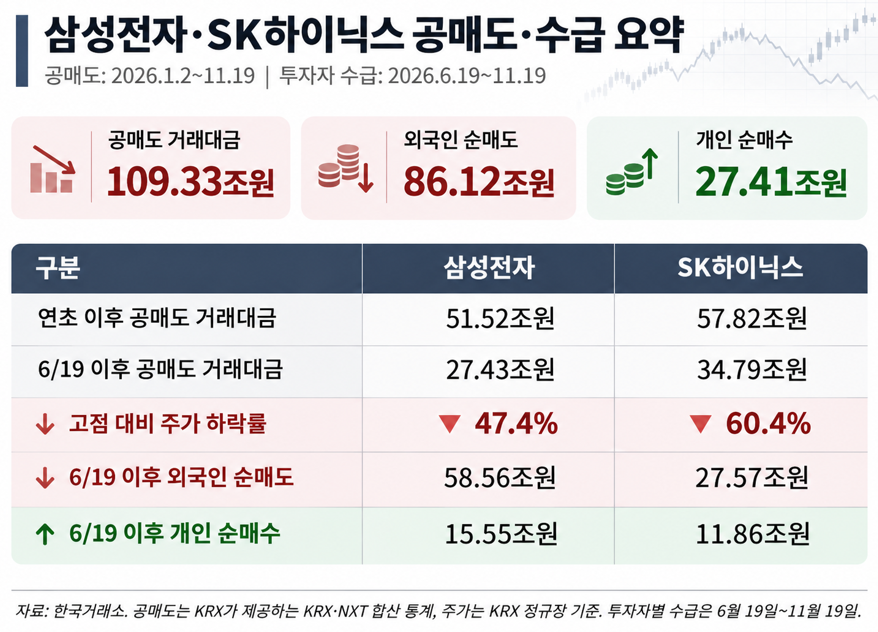
Samsung Electronics fell 47.4% from its intraday high of 374,500 won on June 19 to 196,900 won on November 19. SK hynix dropped 60.4% from its intraday high of 2,987,000 won on June 25 to 1,183,000 won.
If an investor had purchased 100 million won worth of stock at the peak, they would face an unrealized loss of approximately 47.42 million won for Samsung Electronics and 60.40 million won for SK hynix by November 19.
Tracking 216 Trading Days: Limitations in Assessing Short-Selling Profits and Losses
Short selling involves borrowing shares to sell them first, then buying them back at a lower price to return them. In this study, the weighted average selling price was 236,962 won for Samsung Electronics and 1,607,732 won for SK hynix.
These figures were 40,062 won and 424,732 won higher, respectively, than the closing prices on November 19. However, this difference cannot be calculated as actual profit, as the outcome depends on the specific buy-back price and the timing of the transactions.
The analysis also confirmed that it is difficult to calculate actual repayment volumes solely from daily short-selling volume and changes in net open interest, as KRX reporting standards do not reflect a simple sum of all outstanding short positions.
Potential for Information Abuse: Lessons from the AMD Report
In the US, a negative report from a short-selling firm recently caused significant market volatility. On November 19, Hunterbrook Media released a report raising concerns about AMD’s business in China and US export controls, while disclosing that its affiliate, Hunterbrook Capital, held a short position in AMD.
AMD shares fell by as much as 11% intraday, closing down 7.72%. While short selling and the publication of negative reports are legal, the potential for market disruption increases when such activities are combined with false information or organized manipulative orders, particularly in volatile KOSDAQ small-cap stocks.
Monitoring Large-Scale Capital and Coordinated Trades
The risk of abuse extends beyond false information. If large-scale investment entities collude to coordinate spot sales, short selling, and derivatives trading to artificially influence prices, it could disrupt market order.
Regulators should examine whether specific accounts are submitting orders to artificially influence closing prices—determined during the 3:20 PM to 3:30 PM session—to profit from short-selling or derivatives positions.
Taiwan Reduces Short-Selling Limit to 1%: Korea Must Also Review Trading During Downturns
The Taiwan Financial Supervisory Commission (FSC) has tightened short-selling regulations in response to market volatility, reducing the intraday short-selling limit to 1% of the average daily volume of the previous 30 trading days.
While Korea operates a Centralized Monitoring System for Naked Short Selling (NSDS) and monitors for overheating, preventing naked short selling is a separate task from preventing the abuse of legal short selling for market manipulation.
Financial authorities need to comprehensively review short-selling activities during market downturns, including price impacts, closing price manipulation, and the potential for illicit links between investment information and actual trading. Enhancing transparency and strengthening surveillance, especially for KOSDAQ small-cap stocks, is essential to protect investors.