

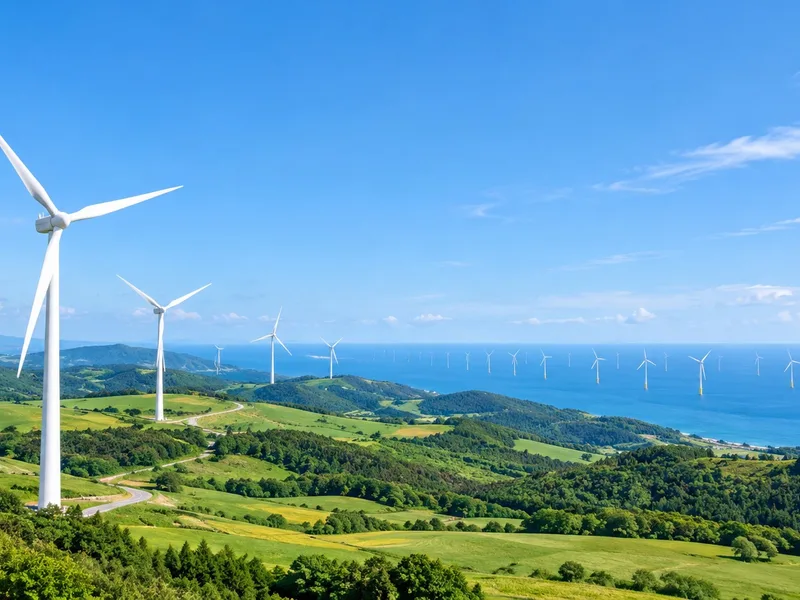
Global wind power installations reach a record 160GW, yet offshore wind investment plunges 72% in the first half of the year.
Chinese turbine manufacturers expand dominance; South Korea's 55GW tender roadmap draws attention to the local supply chain.
The global wind power market has recorded its highest-ever installation figures, yet new investment is contracting. In particular, offshore wind projects are facing delays due to high construction costs, financing burdens, and bottlenecks in permitting and power grid infrastructure.
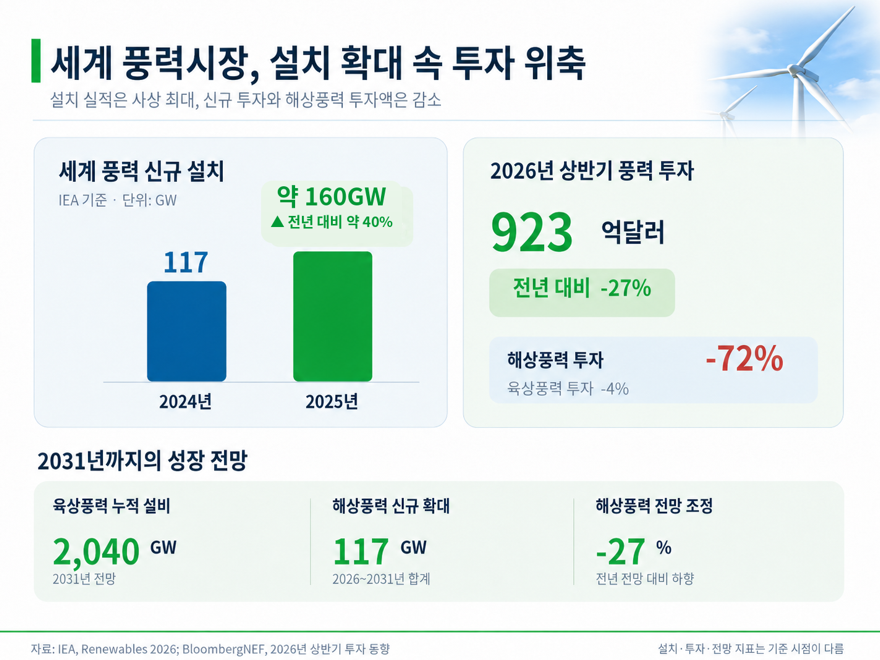
In 2025, global new wind power installations reached a record 160GW, a 40% increase year-on-year. Conversely, new offshore wind contract awards plummeted to one-fifth of the previous year's level, while onshore wind awards fell by 39%.
Global wind investment declined by 27% in the first half of this year, with offshore wind suffering a 72% drop. The expansion of Chinese turbine manufacturers' dominance, coupled with aggressive pricing and the trend toward larger turbines, is reshaping the global supply chain.
Following the implementation of the Offshore Wind Special Act in March, South Korea announced a roadmap in June to tender 55GW of capacity by 2035. As the global market grows and domestic deployment accelerates, the focus is shifting toward the order-winning potential of South Korean firms.
Global Wind Growth Expected Through 2031; Offshore Outlook Downgraded
According to the International Energy Agency (IEA), global new onshore wind installations in 2025 reached approximately 150GW, a 37% increase from the previous year. China led the market with roughly 117GW of combined onshore and offshore installations.
Global cumulative onshore wind capacity is projected to reach 2,040GW by 2031, a more than 70% increase from 2025. New installations between 2026 and 2031 are expected to average approximately 140GW annually.
Offshore wind capacity is expected to add 117GW during the same period, roughly doubling the previous six-year total. However, growth forecasts have been downgraded by 27% compared to last year due to high construction costs and financing pressures.
 According to the Global Wind Energy Council (GWEC), new offshore wind contract awards in 2025 totaled 11.4GW, only about one-fifth of the previous year. New onshore wind awards also fell by 39% to 32.8GW.
Wind Investment Down 27%; Policy Responses Vary by Nation
According to BloombergNEF, global wind investment in the first half of this year totaled $92.3 billion, a 27% decrease year-on-year. While onshore wind investment fell by 4% to $80.7 billion, offshore wind investment plummeted by 72%. Key drivers include sluggish bidding in Europe, project cancellations in the U.S., and high financing costs.
Policy responses vary by country. Germany is pursuing streamlined permitting and expanded tenders, while the U.K. is easing regulations on onshore wind. India is also working to foster its domestic turbine manufacturing industry. Conversely, in the U.S., policy shifts such as reduced tax credits and restrictions on offshore development are weighing on new investment.
The cost gap between onshore and offshore remains significant. According to the International Renewable Energy Agency (IRENA), the 2025 global average Levelized Cost of Energy (LCOE) was $33 per MWh for onshore wind and $78 per MWh for offshore wind.
While onshore wind's price competitiveness is strengthening, high initial capital expenditures and financing burdens continue to constrain the expansion of offshore wind projects.
Chinese Turbine Manufacturers Dominate; Price Competition and Upsizing Accelerate
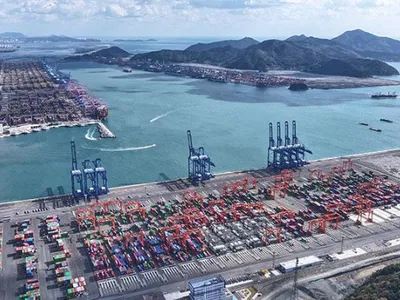
In 2025, the top five global wind turbine suppliers were all Chinese companies. Goldwind ranked first with 29.7GW, followed by Envision (21.8GW), Windey (19.8GW), Mingyang (18.6GW), and Sany (15.1GW). However, over 93% of Chinese manufacturers' installations are concentrated in their domestic market, while European and U.S. firms maintain a strong foothold in markets outside of China.
Price competitiveness is a key strength for China. Chinese wind turbines have been supplied to overseas markets at prices up to 50% lower than international benchmarks.
The combined net loss of major non-Chinese manufacturers in 2025 narrowed to approximately $900 million, half of the previous year's figure. Despite this recovery in profitability, price competition with China remains intense.
The trend toward larger turbines is also accelerating. The average capacity of newly installed turbines globally increased by 16.4% for onshore (from 5.29MW in 2024 to 6.16MW in 2025) and by approximately 5% for offshore (from 9.82MW to 10.31MW).
While larger turbines improve power generation efficiency, they also increase investment costs by requiring larger substructures, installation vessels, and port facilities.
Competitiveness in the wind industry is increasingly defined not just by price, but by technical capabilities to handle larger equipment, production capacity, and the security of stable supply chains.
South Korea Targets 55GW Offshore and 12GW Onshore Deployment
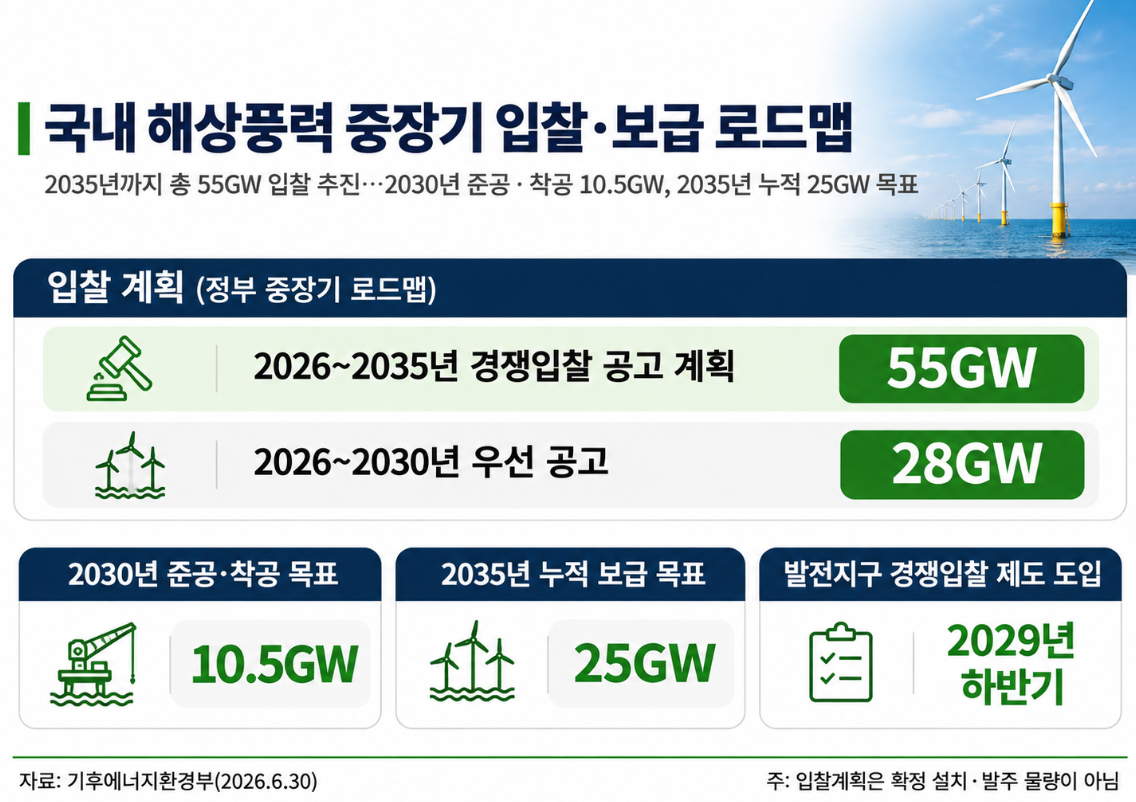
The Ministry of Climate, Energy and Environment presented a "Mid-to-Long-Term Offshore Wind Bidding Roadmap" in June, outlining a total of 55GW in competitive tenders from 2026 to 2035. The goal is to announce 28GW by 2030, with 10.5GW slated for completion or construction by 2030, and a cumulative deployment of 25GW by 2035.
 The Offshore Wind Special Act, implemented in March, focuses on reducing project uncertainty and promoting development by introducing a state-led site planning system.
In the first half of this year, 1,786MW were selected in the offshore wind competitive tender, and an additional tender for approximately 2,200MW was announced on October 30.
Onshore wind deployment is also expanding with targets of 6GW by 2030 and 12GW by 2035. Since October, the project preparation process has been simplified by allowing wind measurement data to be substituted with Korea Meteorological Administration data when applying for power generation permits.
The expansion of onshore and offshore wind is expected to create growth opportunities for related industries, including wind turbines, substructures, subsea cables, and port/installation vessel services.
From Power Generation to Subsea Cables: Growth Opportunities for Korean Firms
CS Wind (112610) is a global wind tower supplier that has expanded into offshore wind substructures.
The company maintains production bases in the U.S., Europe, and Asia, and entered the offshore wind substructure market—including monopiles and transition pieces—through the acquisition of Denmark's Bladt in 2023.
SK Eternix (475150) is a renewable energy operator covering the development, construction, and operation of domestic onshore wind farms.
With the start of commercial operations at the 99MW Hwanghaksan Wind Farm in Uiseong this August, the company increased its onshore wind operating capacity to 257MW. It is also pursuing offshore wind development projects totaling approximately 1.1GW, including Sinan Uui and Gureopdo.
Unison (018000) has expanded from onshore turbine manufacturing into the large-scale offshore wind market.
Onshore, it is developing the 30.8MW Yukbaeksan wind project. Offshore, it signed a supply contract worth approximately 99.3 billion won for the Gochang Offshore Wind Farm in August and is pursuing the supply of 25 units of 13.6MW turbines for the 340MW Hanbit Offshore Wind project.
Doosan Enerbility (034020) is focusing on the development and commercialization of large-scale domestic offshore wind turbines.
Following its 8MW model, the company has secured international type certification for its 10MW offshore wind turbine. Including projects selected in the first half of this year, the total scale of projects confirmed for 8MW and 10MW turbine supply reaches 1,213MW.
SK Oceanplant (100090) has entered the European market based on its experience supplying substructures for Taiwan's offshore wind projects.
In July, it won a project worth approximately 160.5 billion won for the substructures of the German BalWin 5 offshore substation. Its core business focuses on fixed and floating offshore wind substructures.
LS Marine Solution (060370) handles subsea cable installation required for offshore wind and subsea power grid construction.
In September, it signed a 156.9 billion won contract for the transport and installation of subsea cables for the Sinan Uui offshore wind project. In November, it signed a Cable Route Agreement (CRA) with LS Cable & System for the supply and installation of subsea cables for the 504MW Taean Offshore Wind project.
The growth of the global wind market and the expansion of domestic deployment present new opportunities for South Korean companies. As project construction and equipment orders increase, firms that have secured competitiveness in large-turbine technology and supply chain stability are expected to play an increasingly significant role.
Market Times will highlight the growth prospects of the bioenergy market, global policy shifts, and the competitiveness of Korean firms in the next installment.