

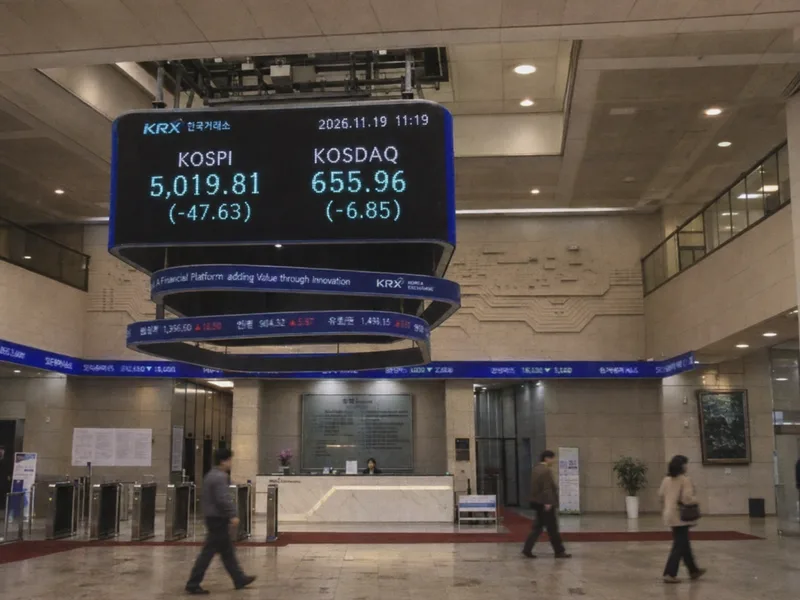
Short selling reached 1.24 trillion KRW in a single day, with foreign investors accounting for approximately 80%—regulators must address growing market distrust.
Taiwan has tightened short-selling order limits and authorized stabilization fund intervention; South Korea must also clarify its response criteria.
Beyond explaining the utility of the system, authorities must investigate stock-specific concentration, illegal trading, and conflicts of interest.
On the 18th, the total value of short-selling transactions in the domestic stock market reached 1.2448 trillion KRW. Of this, foreign investors accounted for approximately 990.5 billion KRW, or about 80% of the total. In some stocks, short selling comprised more than 40% of total trading volume.
What retail investors are asking financial authorities is not about the justification for the existence of the short-selling system. Rather, they are questioning whether trading fairness is maintained during market volatility, whether trading by specific entities is excessively concentrated in certain stocks, and whether regulatory surveillance and responses are functioning properly.
There are various policy options between a total ban on short selling and maintaining the status quo. What is needed is not a debate over pros and cons or an explanation of the system's theoretical benefits, but rather judgment and execution tailored to current market conditions.
Foreign Short Selling Hits 990.5 Billion KRW… Concentration in Specific Stocks
According to Korea Exchange statistics, short-selling transaction values on the 18th were 916.1 billion KRW for the KOSPI and 328.7 billion KRW for the KOSDAQ. The foreign investor share was 82.53% and 71.31%, respectively, amounting to approximately 756.1 billion KRW and 234.4 billion KRW. Combined, this accounts for about 79.6% of the total across both markets.
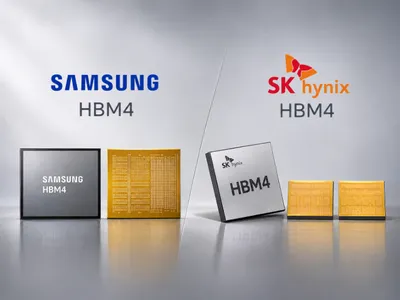
Top stocks for short selling included Samsung Electro-Mechanics (84.8 billion KRW), SK hynix (73.3 billion KRW), and Samsung Electronics (73 billion KRW). On the KOSDAQ, Symtek (21.4 billion KRW), Jusung Engineering (18.7 billion KRW), and Wonik IPS (13.5 billion KRW) were among the most heavily shorted.
Concentration in individual stocks was even more pronounced. Short selling accounted for 37.44% of total trading volume in Hanwha Systems and 44.66% in Caregen.
While these figures alone do not prove illegal activity or market manipulation, there is sufficient reason to investigate the stock-specific concentration hidden by market averages. Authorities must examine order and execution patterns in heavily traded stocks and the effectiveness of short-selling overheating control mechanisms.
The Core Issue: Fairness and Surveillance Over Scale
The fact that the short-selling amount is larger than the daily net selling by foreigners is not in itself evidence of abnormal trading. Short selling is only one part of sell transactions, while net selling is the result of subtracting buy orders from total sell orders.
On this day, the ratio of short selling to total stock trading value was 4.48%. The fact that 'about 80% of short selling is by foreigners' should not be misread as '80% of total trading is foreign short selling.'
However, this does not invalidate the concerns raised. The proportion of short selling in the overall market and who dominates the short-selling market are separate issues. The background of the foreign-centric trading structure, access conditions for different investor types, and concentration in specific stocks must be examined together.
Neither the claim that short selling is the sole cause of all market declines nor the argument that it is problem-free because it is a legal system can replace the need for verification of actual trades.
Investor Burden Remains Despite Single-Day Rebound
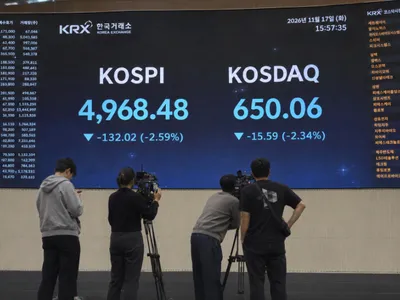
On the 18th, the KOSPI closed up 1.99% at 5067.44, and the KOSDAQ rose 1.96% to 662.81. However, a single day of gains does not resolve the cumulative losses and burden on investors.
According to reports citing Korea Exchange data, cumulative net selling by foreign investors from January 2 to November 16 reached approximately 220 trillion KRW. Selling was concentrated in large-cap semiconductor stocks like Samsung Electronics and SK hynix. However, considering the expansion of market capitalization and purchases of other stocks and ETFs, it is difficult to conclude this as a total exit from the Korean market.
The risk of loss was more evident in leveraged investments. In July, a strategist at Citi Global Markets estimated that retail investor losses in leveraged ETFs based on Korean assets amounted to approximately 56.3 trillion KRW. This is an estimate based on market cap reduction and new inflows, not a confirmed figure of realized gains and losses in individual accounts.
These losses cannot be blamed solely on short selling, nor can they be equated with foreign profits. However, in a situation where investor burdens are increasing, authorities cannot claim to have fulfilled their responsibilities by merely explaining the utility of the system. Policies encouraging market participation and those maintaining trading order must go hand in hand.
Taiwan Tightens Short-Selling Limits; South Korea Must Clarify Response Criteria
The Taiwanese financial authorities reduced the intraday borrowing short-selling order limit for individual stocks from 30% to 3% of the average daily trading volume of the previous 30 trading days, effective from the 9th. The minimum margin requirement for short selling was also raised from 90% to 130%.
Furthermore, the government approved the intervention of the National Financial Stabilization Fund, which has an operating limit of 500 billion TWD. While this does not mean the full amount will be deployed, it establishes a mechanism for market stabilization.
South Korea has taken steps to ease the burden of forced liquidations, such as temporarily exempting the obligation to maintain collateral ratios for credit loans. However, there is a clear difference in the scope of response compared to Taiwan, which implemented both short-selling order restrictions and stabilization fund intervention.
This does not mean Korea should blindly follow Taiwan. However, Korean authorities must clarify what measures they will take under what circumstances. If they judge that short-selling restrictions are unnecessary, they must provide the rationale; if other measures are more effective, they must explain the conditions for implementation. Decisions to refrain from policy action also carry responsibility.
Market Trust Must Precede MSCI Inclusion
Even while pursuing inclusion in the MSCI Developed Markets Index, investor protection and the establishment of market order must not be relegated to the background. If necessary inspections and crisis responses are delayed for the sake of international evaluation, the policy priorities are inverted.
The mere existence of optimistic reports from foreign financial firms alongside short selling does not prove illicit trading. However, it is necessary to check whether there were any improper use of information or violations of conflict-of-interest management between the drafting/distribution of reports and actual trading.
The task for authorities is clear. They must inspect stocks with concentrated short selling and fully explain the results of inspections and investigations into illegal naked short selling and unfair trading to the extent possible. Violations must be strictly punished, and if suspicions are groundless, the reasons for that judgment must be disclosed.
The goal of market stabilization is not to prop up indices or compensate for investment losses, but to maintain the trust that everyone is trading under fair conditions. If authorities cannot provide results of inspections into trading concentration and evidence supporting the fairness of the system, it will be difficult to persuasively answer the criticism that the Korean stock market is a 'playground for foreign short sellers.'
To ask retail investors to trust the market, authorities must first demonstrate the basis for that trust. What is needed is not another principled explanation, but a clear statement and execution of what will be inspected and under what conditions actions will be taken.
As of the morning of the 19th, the South Korean stock market is trending downward.