



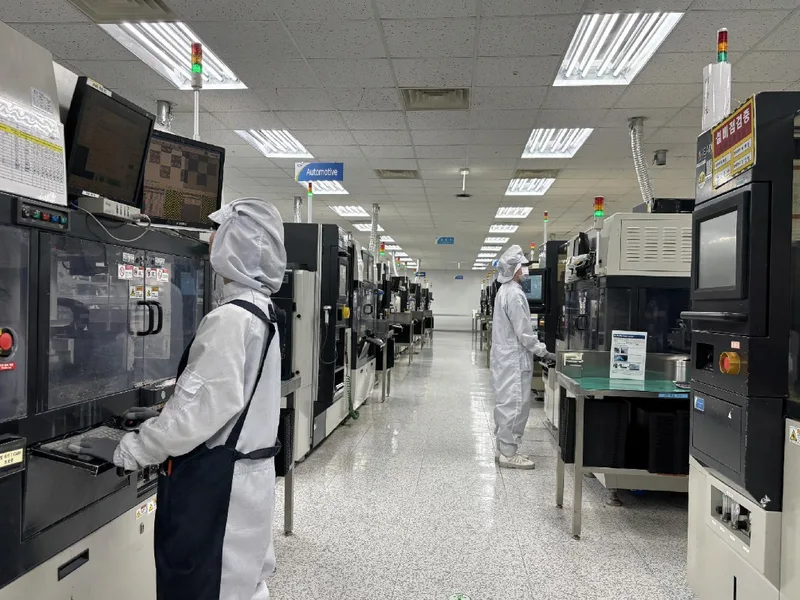
Samsung prioritizes HBM, leading to expanded outsourcing of DDR5 packaging and testing.
Workloads shift to backend process specialists such as SFA Semicon and Hana Micron.
The ramp-up in HBM production is reshaping the landscape for semiconductor backend service providers. As Samsung Electronics prioritizes HBM within its DRAM production capacity and reconfigures its backend facilities to support this high-growth product, a portion of its existing DDR5 packaging and testing volume has begun migrating to external specialized firms. This structural shift is the primary driver behind the recent broad-based rally in backend semiconductor stocks.
Samsung Electronics projects that HBM will account for nearly 30% of global DRAM wafer capacity by next year, up from approximately 20% today. As HBM production accelerates, the available capacity for conventional DRAM, which shares the same manufacturing infrastructure, becomes increasingly constrained.
Kim Tae-woo, Vice President of Samsung’s Memory Business, noted on the 29th of last month that because HBM and conventional DRAM compete for the same wafer capacity, the expansion of HBM production inevitably limits the supply of general-purpose DRAM.
Production Capacity Squeeze: DDR5 Supply Tightens as HBM Takes Priority
HBM is a high-value memory product that achieves faster data processing speeds by vertically stacking multiple DRAM chips. DDR5 is the latest generation of general-purpose DRAM widely utilized in servers and PCs. Because HBM consumes significantly more wafer capacity than standard DRAM, its increasing production share inherently reduces the room available for legacy memory manufacturing.
KB Securities analysis suggests that even as Samsung Electronics increases its overall DRAM capacity, the prioritization of new equipment for HBM and high-capacity server products will limit the growth of conventional DRAM supply.
Supply shortage signals for high-capacity server DDR5 are already emerging. As of September, lead times have reached a maximum of 52 weeks, a significant departure from the six-week lead time typical of a normalized market, meaning it currently takes up to a year from order placement to product delivery.
Kim Dong-won, Head of Research at KB Securities, noted that HBM has consumed 30% of total DRAM wafer capacity in just two to three years, pointing to the high likelihood of a protracted supply deficit for conventional DRAM.
The surge in HBM production extends beyond mere changes in the product mix; it is fundamentally altering how companies prioritize the allocation of limited manufacturing resources.
Offloading DDR5: Workloads Shift to Backend Providers
This shift is most visible in the packaging and testing segments, where Samsung is reorienting its Onyang facility to focus primarily on HBM. Consequently, a portion of the conventional memory backend processing—previously handled in-house—is being outsourced.
SFA Semicon is currently expanding its volume of DDR5 packaging and final testing. Hana Securities estimates that the company’s DDR5 testing sales revenue will grow nearly 4.8 times, from 35.6 billion won last year to 169.2 billion won by 2027. This serves as a key example of how Samsung’s increased outsourcing of DDR5 is translating directly into revenue for backend providers.
Other backend players, including Hana Micron, Hanyang Digitech, and A-Pact, have also recently entered the spotlight of market attention.
The more capacity Samsung allocates to HBM, the more existing DDR5 backend volume is pushed externally, providing a tailwind for these service providers.
Backend Stocks Surge in a Month: High Expectations Priced In
The stock market reacted swiftly to these developments. Throughout September, while the KOSDAQ index rose 2.3%, SFA Semicon jumped 89.1%, Hanyang Digitech gained 55.1%, A-Pact climbed 52.8%, and Hana Micron advanced 33.2%.
In the early stages of the HBM boom, market attention was concentrated on advanced equipment and materials. Now that production volumes are scaling, the focus has shifted downstream to the firms handling packaging and testing. As initial capital expenditures transition into mass production, investor interest has broadened from the manufacturers of machines to the companies actually processing the output.
However, recent share prices already reflect significant expectations regarding expanded outsourcing. Because backend firms differ in terms of their specific processes, client bases, and available capacity, the speed at which this trend impacts their actual financial performance may vary.
While these stocks moved in tandem last month, such synchronization may not persist. Moving forward, the performance gap between individual firms will be determined by how much outsourced volume is successfully converted into actual revenue and whether increased utilization rates effectively translate into improved profitability.



