



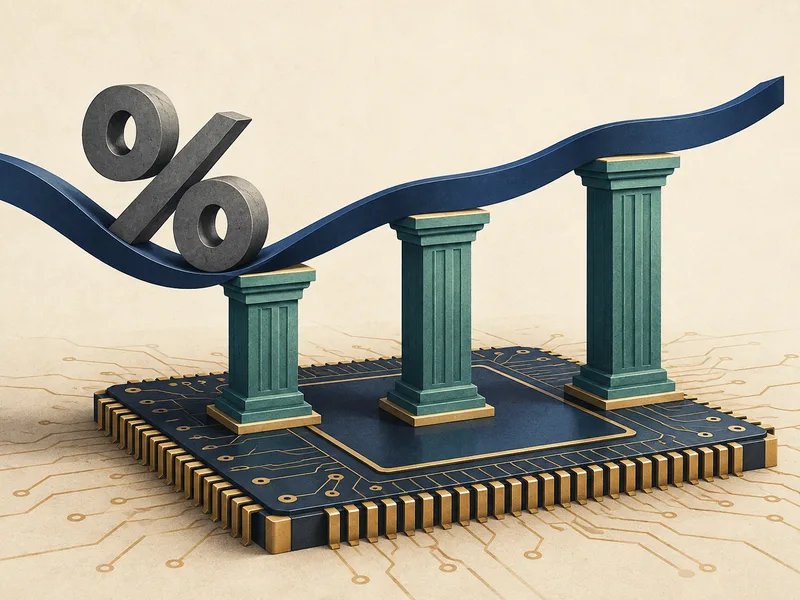
Nasdaq hits all-time high despite 10-year yield crossing 5.3%; expectations for earnings growth absorb interest rate headwinds.
Softening employment data and falling oil prices provide additional support for market sentiment; upcoming third-quarter earnings to serve as the ultimate test of sustainability.
The U.S. stock market continues its upward trajectory despite persistent 5% long-term bond yields. While elevated borrowing costs create significant hurdles for capital allocation and valuation models, the rally is being sustained by optimistic projections for profit growth, particularly within the artificial intelligence (AI) sector. Whether companies can translate these expectations into tangible results will be the critical variable in determining if the stock market can maintain its momentum alongside high interest rates.
On the 5th (local time), the Nasdaq Composite index closed at a record high of 27,477.31, up 1.05%, even as the 10-year U.S. Treasury yield traded near 5.3%. The S&P 500 also gained 0.66%. The rally in major technology stocks pushed the indices higher, brushing off the headwinds from the bond market.
Market sentiment was further bolstered by favorable developments in monetary policy and energy costs. The U.S. labor market report for September, released on the 2nd, came in softer than expected, reducing the likelihood of additional rate hikes by the Federal Reserve in October. Additionally, the decline in international oil prices provided a boost to buyer confidence.
In an environment where long-term yields remain high, corporate earnings become the defining factor for valuation. As Treasury yields rise, corporate borrowing costs increase, and the discount rate applied to future earnings climbs, putting downward pressure on valuations. For a company to justify its stock price, rapid profit growth must essentially absorb this valuation discount.
Market expectations for corporate earnings remain high. According to LSEG data cited by Reuters on the 5th, S&P 500 companies are projected to report a year-on-year profit increase of more than 30% for the third quarter, with AI-related firms expected to lead the growth. Although these figures are not yet finalized, they underscore why investors continue to gravitate toward growth stocks despite the high-rate backdrop.
Some analysts suggest that earnings forecasts have risen faster than stock prices themselves. Brian Levitt, a global market strategist at Invesco, noted on the same day that despite the year’s equity gains, the forward price-to-earnings ratio (PER)—which compares stock prices to expected future earnings—has actually compressed. He interpreted this as evidence that earnings growth has been the primary engine supporting the market, even as interest rates act as a ceiling on valuation multiples.
There is a growing consensus that the AI boom is largely decoupled from interest rate volatility. Lisa Shalett, Chief Investment Officer at Morgan Stanley Wealth Management, stated in a commentary reported by Reuters that this resilience, paired with underlying economic growth, explains why the stock market has maintained stability despite the unrest in bond markets.
However, the ability to withstand high interest rates varies by company. Invesco warned that rising costs of capital are increasingly pressuring more vulnerable firms. Consequently, the strength of the indices should not be interpreted as a uniform adaptation of the broader corporate sector to high interest rates.
The upcoming third-quarter earnings releases will offer a clearer view of these disparities. If companies can meet lofty expectations and see that growth spreading across other sectors, the market’s foundation will broaden. Conversely, if results fall short, the pressure from interest rates could re-emerge as a primary concern. We are in a phase where investors must monitor the speed of corporate earnings growth with the same scrutiny as interest rate fluctuations.



