



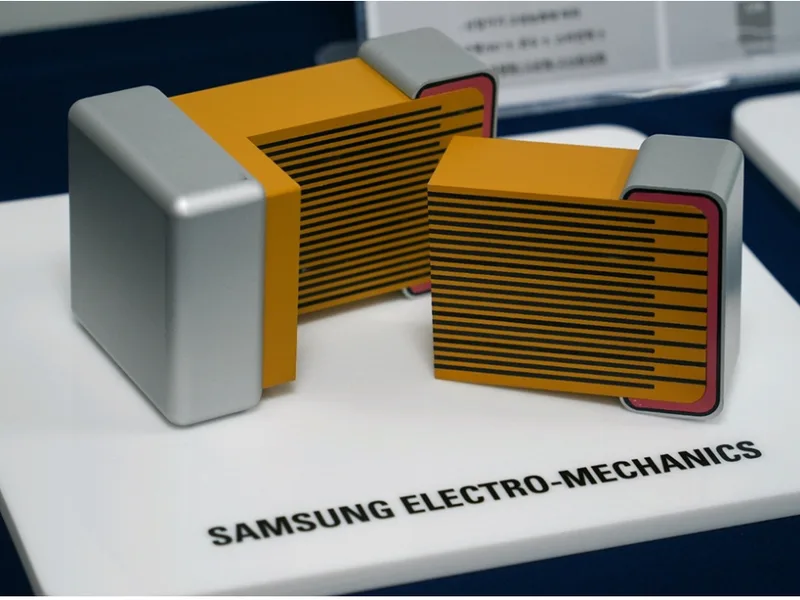
AI-related long-term supply contracts reach 3.9 trillion won; MLCC-specific deals account for 2.4 trillion won across five agreements.
Factory utilization rates remain above 90% with extended lead times; prices for high-spec components continue to climb.
The investment frenzy surrounding AI data centers is spilling over into the market for Multi-Layer Ceramic Capacitors (MLCCs). As the deployment of AI servers equipped with high-performance GPUs accelerates, demand for high-specification MLCCs—which are essential for stable power management and signal integrity—is surging. Samsung Electro-Mechanics has secured nearly 4 trillion won in AI-related long-term supply contracts this year alone.
Samsung Electro-Mechanics (009150) announced on the 6th that it signed a $210.24 million (approximately 285.6 billion won) contract to supply MLCCs for AI servers to a major global client, with a supply period spanning from January 1 to December 31, 2027.
Since May of this year, the company has finalized roughly 3.9 trillion won in Long-Term Agreements (LTAs) for silicon capacitors, AI server MLCCs, and inductors. Of this total, five contracts specifically involving MLCCs account for approximately 2.39 trillion won. This includes four standalone MLCC deals worth 2.11 trillion won and one combined MLCC and inductor contract worth 285 billion won. All five agreements are slated for supply in 2027.
AI Servers Require Over 10 Times More MLCCs Than Standard Models
MLCCs act as temporary energy reservoirs, discharging electricity when needed and suppressing signal interference within electronic circuits. They are ubiquitous components found in smartphones, automobiles, and servers.
However, the requirements for AI servers are significantly higher. Operating multiple high-performance GPUs simultaneously leads to greater power consumption and volatile voltage fluctuations, necessitating high-capacity and high-reliability components.
According to Samsung Electro-Mechanics, a single AI server utilizes more than ten times the number of MLCCs found in standard enterprise servers. This requirement scales with each new generation of GPUs. Market researcher TrendForce estimates that while an NVIDIA GB200 compute board uses approximately 6,500 MLCCs, the next-generation "Rubin" board is expected to require roughly 12,000 units.
Goldman Sachs projects the market for AI server-grade MLCCs will expand from $1.4 billion last year to $5.8 billion by 2030, representing a compound annual growth rate (CAGR) of approximately 34%. Samsung Electro-Mechanics claims to currently hold a market share of over 40% in this specialized segment.
Utilization Rates Top 90%; 20-Week Lead Times as Production Lines Pivot to AI
The surge in orders has tightened production capacity. Samsung Electro-Mechanics reported a 91% utilization rate for its component business in the first half of the year. Lead times for certain high-capacity X6S products have stretched from the previous eight weeks to as long as 20 weeks.
Pricing is also on an upward trajectory. TrendForce expects that prices for Samsung’s AI-focused X6S products will rise by an average of 10–20% following negotiations for the fourth quarter. In the first half of the year, the average selling price (ASP) of Samsung’s MLCCs rose 13.9% compared to the same period last year.
Production lines are increasingly shifting toward high-specification output. As Japanese and Korean manufacturers reallocate X5R production capacity to cater to the demand for AI-centric X6S and X7R products, orders for more common, general-purpose components are shifting to Taiwanese and Chinese suppliers.
A similar trend is visible at global leader Murata, which reported a 49% quarter-on-quarter increase in its capacitor order backlog as of the second quarter. With order books filling up across the industry’s top-tier manufacturers, the demand for AI server-grade MLCCs is driving a broad market recovery.
2.4 Trillion Won in MLCC Contracts Set for 2025 Delivery
Increased sales of AI server components are already showing up in the company’s bottom line. For the second quarter of this year, revenue reached 3.46 trillion won, a 24.2% increase year-on-year, while operating profit surged 106.7% to 440.4 billion won.
The component division, responsible for MLCCs, saw its revenue climb 29% to 1.65 trillion won. The company attributed this performance to the increased sales of high-value-added products, including MLCCs for AI servers, networking, and automotive applications.
With the five major MLCC-related long-term contracts signed this year scheduled for delivery next year, the fiscal impact of these 2.4 trillion won in orders will begin to materialize in 2025.
Samsung Electro-Mechanics is also proactively expanding its production capacity. The company plans to invest approximately 15 trillion won by 2040 to transform its Busan plant into a global hub for AI data center package substrates and high-end MLCC research and production.
As the substantial long-term contracts secured this year transition into the supply phase, Samsung Electro-Mechanics’ revenue from AI server MLCCs is expected to scale significantly. Bolstered by ongoing investments in the Busan site and a steady pipeline of new contracts, data centers are rapidly emerging as the next major growth engine for MLCCs, alongside the smartphone and automotive sectors.



