



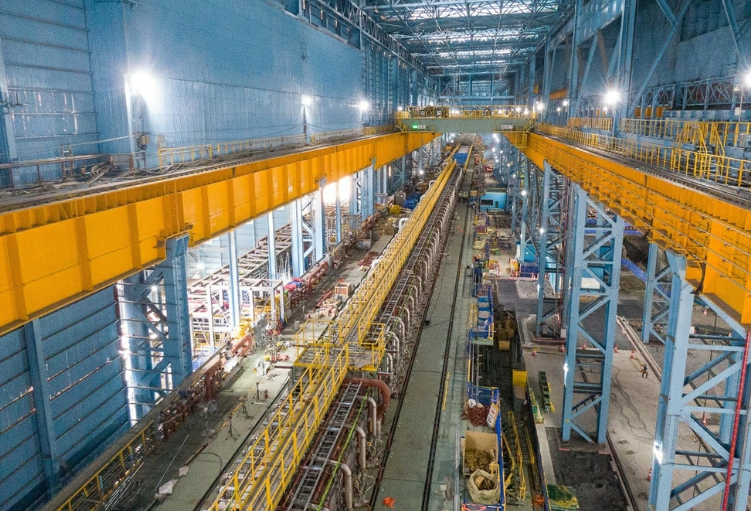
POSCO Holdings (005490) and Hyundai Steel (004020) are actively seeking to restore profitability by prioritizing product price increases. While POSCO is expected to meet market expectations for the third quarter, supported by margin improvements in its steel division, Hyundai Steel has been hampered by a decline in sales volume.
The outlook for the fourth quarter appears more favorable. Analysts anticipate that POSCO will benefit from price hikes and stabilizing raw material costs, while Hyundai Steel is expected to see a recovery in sales volume alongside these tailwinds.
POSCO Q3 Operating Profit Expected Around 800 Billion Won: Steel Profitability Improves
According to the financial investment industry on the 6th, Hana Securities projects POSCO's third-quarter consolidated sales revenue at 19.2 trillion won, with an operating profit of 799.6 billion won. This figure aligns closely with the market consensus of 805.4 billion won.
Sangsangin Securities also estimates a third-quarter operating profit of 808.1 billion won, citing profit growth in the steel segment and robust performance in the energy business of its subsidiary, POSCO International.
In the steel sector, price increases have provided a lift. Higher prices for major product lines, such as automotive steel sheets and heavy plates for shipbuilding, have been reflected in the Average Selling Price (ASP). Simultaneously, the stabilization of raw material input costs has slightly widened the spread between product prices and input costs.
Hana Securities estimates POSCO’s third-quarter steel sales volume at 8.49 million tons, an increase of 3.1% year-on-year and 1.5% quarter-on-quarter.
Park Sung-bong, an analyst at Hana Securities, noted, "The rise in ASP, driven by price hikes for large-scale consumers such as automakers and shipbuilders, appears to have contributed to a modest expansion of margins."
Steel sales volume for the fourth quarter is expected to dip to 8.04 million tons due to maintenance at Gwangyang Steelworks’ Blast Furnace No. 2 and hot-rolling facilities. However, the impact of price hikes and falling raw material input costs is expected to partially offset the decline in volume.
Hana Securities forecasts POSCO’s fourth-quarter operating profit at 825.4 billion won, a 3.2% increase over the third-quarter estimate, suggesting a structure where margin expansion and improved performance from major subsidiaries compensate for lower steel sales volume.
Hyundai Steel Q3 Sales Volume Drops; Operating Profit Forecast to Double in Q4
Hyundai Steel’s third-quarter performance was weighed down by a decline in sales. Hanwha Investment & Securities estimates its consolidated sales revenue for the quarter at 5.638 trillion won, with an operating profit of 64.9 billion won—a figure 44.1% below the market consensus of 116 billion won.
The combination of the Chuseok holiday and the off-season for the construction industry led to an estimated 10% decline in non-consolidated sales volume compared to the previous quarter. Sales of both flat products and long products weakened, and domestic demand for reinforcing bars (rebar) remained sluggish.
The rebound is anticipated in the fourth quarter. Hanwha Investment & Securities projects Hyundai Steel’s fourth-quarter operating profit at 130.1 billion won, effectively doubling from the third quarter’s 64.9 billion won.
As sales volumes normalize, price increases for automotive steel sheets and heavy plates are expected to be fully reflected in earnings. Furthermore, the effect of falling raw material input costs—driven by the strength of the Korean won in the third quarter—may materialize with a time lag.
Kwon Ji-woo, an analyst at Hanwha Investment & Securities, commented, "While an adjustment of expectations for the third quarter was inevitable, the downturn was primarily driven by seasonal volume decline, and the forecast for earnings growth in the fourth quarter remains valid."
Hana Securities also expects performance to improve in the fourth quarter as the company moves past third-quarter sales declines and compressed blast furnace spreads, shifting toward higher sales volume and wider margins.
Steel Industry Raises Prices; Successful Market Integration Remains Crucial
The key determinant for both companies' fourth-quarter performance is how effectively these manufacturer-led price increases can be integrated into actual market prices.
Although Hyundai Steel raised its supply prices for hot-rolled, cold-rolled, and heavy plate products by 40,000 won per ton in October, retail prices for hot-rolled and heavy plates fell by 1% in the first week of October. Additionally, imports of hot-rolled steel in September rose by 50% year-on-year, primarily driven by products from third countries.
The sluggishness of the construction sector remains a burden. If the recovery in demand for long products remains slow, there are limitations to boosting profitability solely through price hikes. On the other hand, tightened trade regulations against low-cost imported steel are a favorable factor for domestic producers to defend their price structures.
As of now, the effect of price increases has not been clearly visible in the distribution market. With weak construction demand and rising import volumes, it remains to be seen to what extent manufacturer price hikes will be reflected in actual transaction prices and final financial results.



