



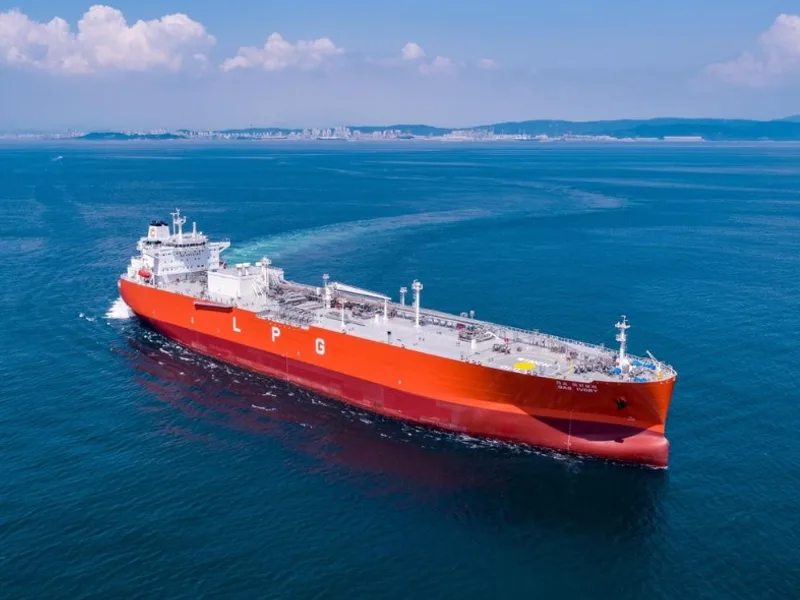
80 VLGC and VLAC Vessels Ordered This Year; South Korean Shipbuilders Secure 56
Delivery Schedules Extend to 2030; Sustained Demand for Aging Fleet Replacement
The market for ultra-large gas carriers is experiencing a significant resurgence. Orders for Very Large Gas Carriers (VLGC), which totaled just 14 vessels last year, have surged to 80 this year—including orders for Very Large Ammonia Carriers (VLAC)—with South Korean shipbuilders capturing 70% of the total.
Freight rates have hit record highs, and delivery slots for newly contracted vessels are already booked through 2030. Industry experts suggest that the gas carrier order cycle may prove more durable than anticipated, fueled by the expansion of U.S. LPG exports to Asia and the persistent need to replace an aging global fleet.
Orders Increase 5.7-Fold Year-on-Year; South Korean Shipbuilders Dominate with 70% Market Share
According to industry data and SK Securities on the 7th, 80 VLGC and VLAC vessels have been ordered this year. SK Securities analyzed that this volume represents a more than 5.7-fold increase compared to the 14 VLGC orders recorded last year.
South Korean shipbuilders secured 56 of these vessels, accounting for 70% of the total. HD Hyundai Heavy Industries led the industry with 26 vessels, followed by HD Hyundai Samho with 18, and Samsung Heavy Industries and Hanwha Ocean with 6 each.
Between 2023 and this year, South Korean shipbuilders have secured 129 out of the 192 VLGC and VLAC vessels ordered globally, a commanding 67% share. Over the same period, China secured 49 orders.
The influx of orders is clearly reflected in the production schedules of domestic shipbuilders. Vessels contracted by HD Hyundai Heavy Industries in July are scheduled for delivery between October and December 2029, while those signed by HD Hyundai Samho in August are slated for completion between January and May 2030.
Last month, Hanwha Ocean secured a contract for three VLGCs from an Oceanian shipowner valued at 477.8 billion KRW, with delivery extended until December 2030. Samsung Heavy Industries also finalized a deal for two additional VLGCs worth 307.4 billion KRW, due for delivery by February 2030.
Including this latest contract, Samsung Heavy Industries' total orders for commercial vessels this year have reached 7.5 billion USD, equivalent to 132% of its annual target of 5.7 billion USD.
Record Freight Rates; Even 19-Year-Old Vessels Command High Prices
As orders for gas carriers accelerate, freight rates are reaching new peaks. According to Clarkson Research, a British shipping and shipbuilding market analyst, freight rates for the U.S. Gulf to Chiba, Japan route reached historic highs in September. The average freight rate for the second quarter of this year also set an all-time record.
The increase in U.S. LPG exports to Asia has led to longer shipping distances. The average shipping distance per ton of LPG is projected to increase by approximately 19%, from 5,738 miles last year to 6,819 miles this year. India's LPG imports are also expected to grow from 24.3 million tons last year to 33.6 million tons by 2028.
Used vessel prices remain firm as well. Last month, VLGCs built in 2007 and 2009 were traded for 77 million USD and 74 million USD, respectively. These 19-year-old vessels are trading at roughly 67% of the cost of a newbuild. Currently, approximately 17% of the global LPG carrier fleet is over 20 years old.
Even during the 2027–2028 period, when a high volume of new vessels is scheduled for delivery, transport demand growth is expected to outpace fleet expansion. The ton-mile growth rate for VLGCs and VLACs is projected at 17.4% in 2027, with fleet capacity growth at 11.3%. For 2028, the figures are estimated at 9.8% and 7.1%, respectively.
Recent contracts signed by South Korean shipbuilders are already pushing delivery dates into 2030. The VLGCs ordered from Samsung Heavy Industries last month are set for delivery in February 2030, while the three vessels ordered from Hanwha Ocean are scheduled for completion by December of the same year. The surge in gas carrier orders this year has effectively filled production schedules four years into the future.



