



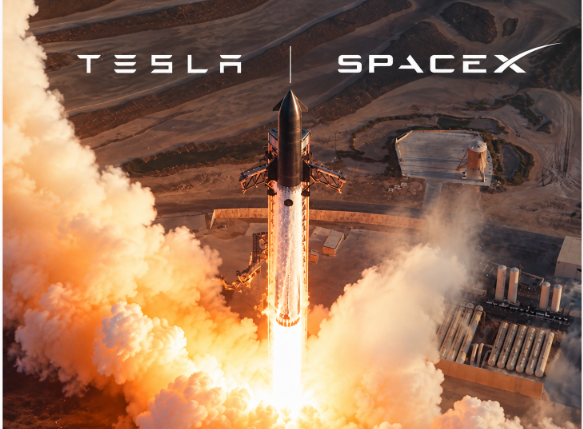
Musk leaves door open to merger following questions; notes rising equity investments and cross-company product transactions.
Tesla’s $2 billion investment into SpaceX and ongoing integration raise questions over Chinese operations and shareholder approval.
The boundaries between Tesla and SpaceX are rapidly blurring. With CEO Elon Musk refusing to rule out a merger, the two companies are seeing their business spheres overlap significantly, driven by equity investments, reciprocal product transactions, and joint mega-projects spanning semiconductors and data centers.
The narrative surrounding a potential merger has shifted this year. Following SpaceX’s acquisition of xAI—the developer of the generative AI model "Grok"—and its subsequent public listing in June, its market valuation has surpassed that of Tesla. While past discussions primarily envisioned Tesla absorbing the then-private SpaceX, the conversation has now evolved to scenarios where the now larger SpaceX could potentially bring Tesla under its corporate umbrella.
Over the last three trading sessions, SpaceX shares have climbed approximately 18%, while Tesla has gained about 7%. As the two firms’ operational and capital ties strengthen, Musk’s revived hints at a merger have reignited market interest.
“Why remain separate?”: Musk keeps the door ajar for a merger
On the 15th of last month (local time), Musk was asked at the "All-In Summit," an annual event hosted by the tech and investment podcast *All-In*, whether Tesla and SpaceX would continue to operate as separate entities. Suggesting that the companies are already collaborating closely across multiple domains, he noted that it is difficult to predict future outcomes. SpaceX President Gwynne Shotwell, also in attendance, echoed this sentiment, describing the integration between the teams as moving “faster than I would have thought.”
This is not the first time the prospect of a combination has surfaced. During Tesla’s earnings call in July, Musk mentioned that the areas of overlap between Tesla and SpaceX were growing. Prior to this, in January, Bloomberg reported that SpaceX was exploring a potential combination with either Tesla or xAI.
xAI, which was discussed as a candidate at the time, was subsequently acquired by SpaceX. This established a precedent for Musk moving beyond mere operational collaboration to formally merging businesses that share strong strategic synergies.
$2 billion in equity and hundreds of millions in transactions: The tightening web of Tesla and SpaceX
Evidence of the two firms’ tightening relationship is visible in both their capital structures and commercial activities. Tesla originally invested $2 billion in xAI, but following xAI’s acquisition by SpaceX, that stake was converted into SpaceX common stock, giving Tesla a holding of less than 1% in SpaceX.
Product transactions between the companies have already reached hundreds of millions of dollars. In the first half of this year, Tesla generated $405 million in sales revenue by supplying Megapack energy storage systems to SpaceX. Conversely, last year, SpaceX and xAI purchased approximately $650 million in Tesla products and services. Of that total, xAI’s Megapack purchases accounted for roughly $506 million, while SpaceX acquired $144 million in goods, including Cybertrucks.
Cooperation extends beyond individual product sales. In its investment prospectus, SpaceX revealed it has established a fundamental framework with Tesla to develop "Terafab," a large-scale manufacturing facility. The initiative is designed to secure long-term access to semiconductors, data centers, and power infrastructure—all essential for the future growth projects Musk is championing, including AI, robotics, and space exploration. Musk recently confirmed that he is also discussing Terafab-related collaborations with TSMC, the world’s largest semiconductor foundry.
Tesla’s new $30 billion credit facility, secured last month, is also tied to these investment plans. A portion of these funds is earmarked for production projects co-developed with SpaceX, signaling a concrete push to build the necessary foundations for Tesla’s automotive and robotics ventures, SpaceX’s aerospace operations, and xAI’s artificial intelligence.
SpaceX’s growing stature: A shift in merger dynamics
SpaceX raised $75 billion during its IPO in June, valuing the company at approximately $1.77 trillion—surpassing Tesla. Given that Musk retains roughly 82% of the voting power post-listing, his influence over SpaceX is significantly stronger than his hold on Tesla. This has fundamentally altered the direction of potential merger speculation compared to the past.
The scenario is no longer about Tesla acquiring SpaceX, but rather the potential for SpaceX to absorb Tesla. *The Financial Times* has analyzed that if the two companies were to merge post-SpaceX’s listing, it could offer significant advantages in terms of capital formation and business integration.
Of course, the option to remain separate remains on the table. Some analysts argue that since the companies are already cross-holding shares and engaging in significant product trade, there is little incentive to navigate the complexities and costs of a formal merger. *The Wall Street Journal* noted that if a structure where SpaceX acquires Tesla were to materialize, it could have significant implications for Musk’s compensation packages and governance control over Tesla.
Conflicts in Chinese operations and U.S. defense interests: Hurdles to a merger
Integrating these two commercially aligned companies into a single entity presents massive complications. Tesla maintains a massive production and sales base in China, with the Chinese market accounting for approximately 18% of total sales revenue in the first half of this year. SpaceX, meanwhile, counts the U.S. government and the Department of Defense as its primary customers, creating a stark geopolitical divide between the two.
SpaceX’s Starlink and satellite launch operations are directly tied to U.S. national security. A merger would place Tesla’s extensive Chinese interests under the same roof as SpaceX’s U.S. defense business, potentially heightening regulatory and security scrutiny in both Washington and Beijing.
Indeed, *The Wall Street Journal* reported that discussions had taken place within Tesla regarding spinning off its China operations in preparation for a future merger with SpaceX. However, as Musk promptly dismissed this report as "fake news," it is difficult to conclude that a separation is currently underway.
Additional challenges remain, including the valuation of the companies, the merger exchange ratio, and securing shareholder approval. While a merger is far from certain, Tesla’s role as a SpaceX shareholder, combined with extensive product transactions and joint industrial projects, has undeniably brought the two companies closer than ever before.



