



FDA review documents confirm variations in tumor response rates across different KRAS mutations.
Overall survival benefits confirmed; Phase 3 trials for combination therapy with a selective G12D inhibitor are underway.
With the US approval of Revolution Medicines' new pancreatic cancer treatment, Dalaxonrasib, the drug's success in extending patient survival has been tempered by a burgeoning debate over its performance across specific genetic mutations. Recently disclosed US Food and Drug Administration (FDA) review documents indicate that tumor response rates vary across certain mutations, drawing investor attention to the drug's clinical efficacy per patient subgroup and the potential for future competitive threats.
Shares of Revolution Medicines fell 6.3% on the 8th (local time). According to the pharmaceutical trade publication Fierce Pharma on the 9th, investor concerns were triggered by the FDA’s release of review data regarding the KRAS G12D mutation cohort, fueling speculation that future rival therapies could encroach on Dalaxonrasib's market position. However, analysts at Leerink Partners and Jefferies have characterized the market reaction as overblown, citing the drug's robust survival data as the primary metric for its clinical value.
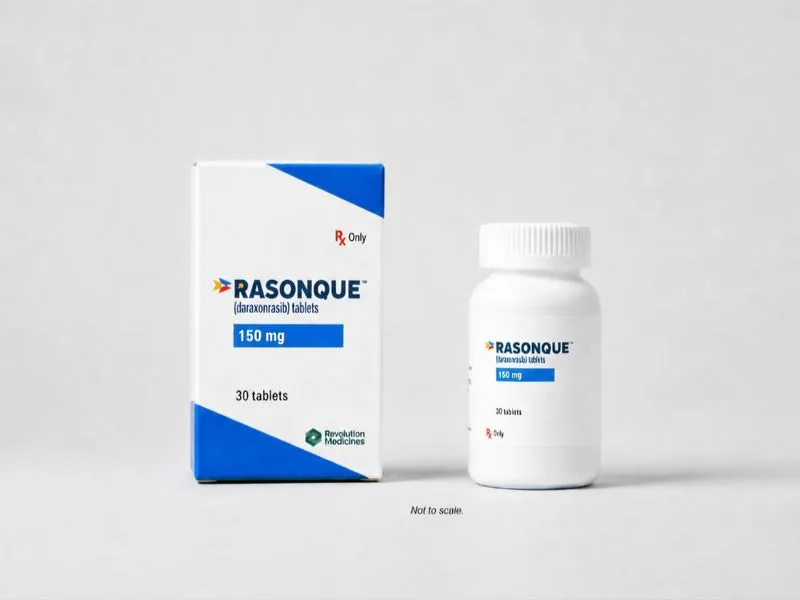
Dalaxonrasib is an oral targeted therapy that inhibits the RAS protein, a key driver of cancer cell proliferation. On August 26, the FDA approved the drug under the brand name 'Rasonque' for adult patients with metastatic pancreatic adenocarcinoma who have received at least one prior systemic therapy or are ineligible for intensive combination chemotherapy. The approval was not restricted to patients with specific RAS mutations.
The approval was based on the Phase 3 'RASolute 302' clinical trial, which involved 500 patients with metastatic pancreatic cancer whose disease had progressed after prior treatment. In the initial analysis, the median overall survival (OS) was 13.2 months for the Dalaxonrasib group compared to 6.7 months for the chemotherapy group. Follow-up analysis as of June 15, included in the FDA review report, maintained these favorable results for the new drug, with OS figures of 12.4 months and 6.8 months, respectively. The FDA noted that the updated results were largely consistent with the initial findings.
The current point of contention lies in an exploratory analysis that segmented patients by genetic mutation. Among the KRAS variants, G12D accounted for approximately 43% of the total trial population. In this cohort, the objective response rate (ORR)—the percentage of patients whose tumors shrank by a pre-defined threshold—was 24% for the Dalaxonrasib group versus 10% for the chemotherapy group. For G12V, the rates were 50% and 15%, respectively, while for G12R, they were 7% and 14%.
Experts emphasize that a distinction must be made between ORR, which measures tumor shrinkage, and overall survival, which evaluates long-term patient outcomes. In the mutation-specific exploratory analysis submitted to the FDA, the hazard ratio (HR) for death in G12D patients was 0.49, indicating a 51% lower risk of death in the Dalaxonrasib group compared to chemotherapy. For G12V, the hazard ratio was 0.32, representing a 68% reduction in mortality risk. While both cohorts showed survival benefits, statisticians caution that efficacy differences between variants cannot be definitively concluded based solely on subgroup estimates.
The G12R results warrant more cautious interpretation. Although the hazard ratio estimate of 0.61 favored the new drug, the 95% confidence interval (0.29–1.30) was wide and included 1.0, indicating no statistically significant difference between the cohorts. Given that only 61 patients in the entire study were G12R-positive, it is difficult to confirm survival improvements or dismiss the drug's efficacy based solely on low response rates in this small subgroup.
Revolution Medicines is already positioning itself to address the competitive landscape surrounding the G12D mutation. Prior to the disclosure of the review data, the company announced on the 5th the dosing of the first patient in 'RASolute 309,' a Phase 3 trial evaluating the combination of Dalaxonrasib with its proprietary selective G12D inhibitor, 'Zoldonrasib.' The strategy aims to enhance clinical outcomes by pairing a pan-RAS inhibitor with a highly targeted agent.
While the initial monotherapy study targeted patients whose disease had progressed after previous treatment, RASolute 309 focuses on first-line therapy for metastatic G12D-mutant pancreatic cancer. The study compares the combination therapy against the standard-of-care gemcitabine plus nab-paclitaxel chemotherapy. The trial will assess progression-free survival (PFS) and overall survival to gauge the efficacy and safety of the combination. The future role of this regimen in clinical practice will likely depend on whether the combination therapy can consistently outperform standard chemotherapy in survival metrics while maintaining an acceptable safety profile.



