



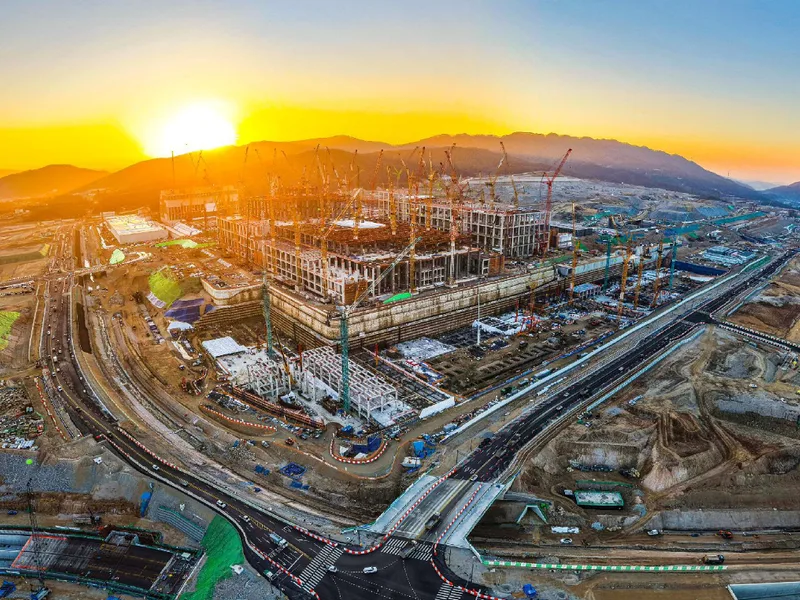
Beyond the 54 trillion won investment in Yongin and Cheongju, expansion into Honam signals an aggressive push for AI memory capacity.
Construction in Honam mooted for 2028; Micron warns of supply shortages through 2028.
SK hynix (000660) has pulled forward the completion date of its Yongin Semiconductor Cluster by 12 years, yet its factory construction plans continue to grow. Following the confirmation of 54.3 trillion won in investments for its Yongin and Cheongju sites, the company is now pushing for a large-scale production base in the Honam region. The global memory market is bracing for a supply shortfall that is projected to last until 2028.
SK Group Chairman Chey Tae-won visited the Gwangju military airport site on the 9th and hinted at the possibility of building the Honam facility in parallel with the Yongin cluster. "We estimate that semiconductor demand will continue to grow at a significantly rapid pace," Chairman Chey stated. "If necessary, it seems we may need to build the facility in parallel with the Yongin cluster to meet that demand."
The conceptual plan for the Honam production base is roughly two-thirds the scale of the Yongin cluster, with room for further expansion should demand surge. Preparations are already underway; SK hynix executives have visited the Honam site over ten times, and the government, in coordination with local authorities, is reviewing a plan to prioritize the development of 2.08 million square meters out of the 8.2 million square meters designated for the national industrial complex. A schedule aiming for the start of construction in 2028, coinciding with the planned handover of the military airport site, is also being discussed.
54 Trillion Won Investment Confirmed for Yongin and Cheongju: A "Speed War" for Factory Construction Amid HBM Boom
SK hynix plans to construct four advanced semiconductor plants at its Yongin cluster. The company has moved up its target for full completion from 2045 to 2033. As investments in AI data centers drive a surge in demand for High Bandwidth Memory (HBM) and other memory semiconductors, the firm has adjusted its original strategy of phased capacity expansion over a long period.
In August, the company approved a total investment of 54.3 trillion won, including 35.2 trillion won for the Yongin "Y2" fab and 19.1 trillion won for the Cheongju "M17" fab. The target is to have the first cleanrooms operational by June 2029 for Yongin Y2 and December 2028 for Cheongju M17. Both facilities will still require the installation of equipment, test runs, and yield stabilization before commercial mass production can begin.
The rush to build new fabs is heavily influenced by the expansion of HBM production. HBM manufacturing processes are significantly more complex than those for standard DRAM, consuming more wafers and facility resources. As HBM production scales up, it can inadvertently reduce the capacity available for conventional DRAM; however, demand for both AI server HBM and standard server DRAM is currently increasing simultaneously.
In its recent earnings call, U.S.-based Micron Technology also projected that supply constraints in the DRAM and NAND flash markets would persist through 2027 and 2028. Despite an expected annual growth in DRAM bit shipments in the low 20% range, the company anticipates that supply shortages will not be easily resolved.
Micron CEO Sanjay Mehrotra noted, "We expect demand to exceed supply in 2027 and 2028, with market conditions remaining even tighter than this year."
Even with new plants under construction in Yongin and Cheongju, it takes years to achieve full production capacity. Securing an additional production hub in Honam would allow for the phased activation of new facilities well before the entire Yongin cluster reaches completion.
Construction Mooted for 2028: Hurdles Include Military Airport Relocation and Power Supply
The Honam Semiconductor Cluster is slated for development in the vicinity of the Gwangju military airport. A long-term investment plan announced by the government in June includes a proposal for SK hynix and Samsung Electronics to each build two semiconductor fabs, totaling four plants.
Regarding the scale of the Honam production base, Chairman Chey noted, "As of now, we are planning for a size roughly two-thirds that of Yongin," while leaving the door open for further expansion if demand increases. The company is also reviewing the possibility of starting construction on certain portions of the site before the core infrastructure is fully completed to accelerate the timeline.
"Even if water and power infrastructure are delayed, I believe we should move in early if it allows us to hit the right timing," said Chey.
The Honam project must still navigate the complex processes of relocating the military airport, preparing the site, and establishing water and power supply facilities. While the government and the Jeonnam-Gwangju municipal governments have proposed a target of initial mass production by June 2030, the specific construction start date and investment schedule for each plant by SK hynix have yet to be finalized.
The burden of such large-scale expansion is significant. Reuters previously analyzed the facility expansion plans of both Samsung Electronics and SK hynix, warning that should the growth in AI investment slow, the risk of oversupply could intensify. Historically, the memory industry has suffered from price crashes when massive facility investments made during boom cycles lead to a supply glut years later.
SK hynix's decision to pull forward the completion of the Yongin cluster by 12 years and consider an additional Honam hub is a strategic bet on memory demand in the 2030s. Having already committed 54.3 trillion won to Yongin and Cheongju, the realization of the Honam plant would further escalate financial pressure. The success of this expansion will ultimately depend on the sustainability of long-term AI memory demand.



