




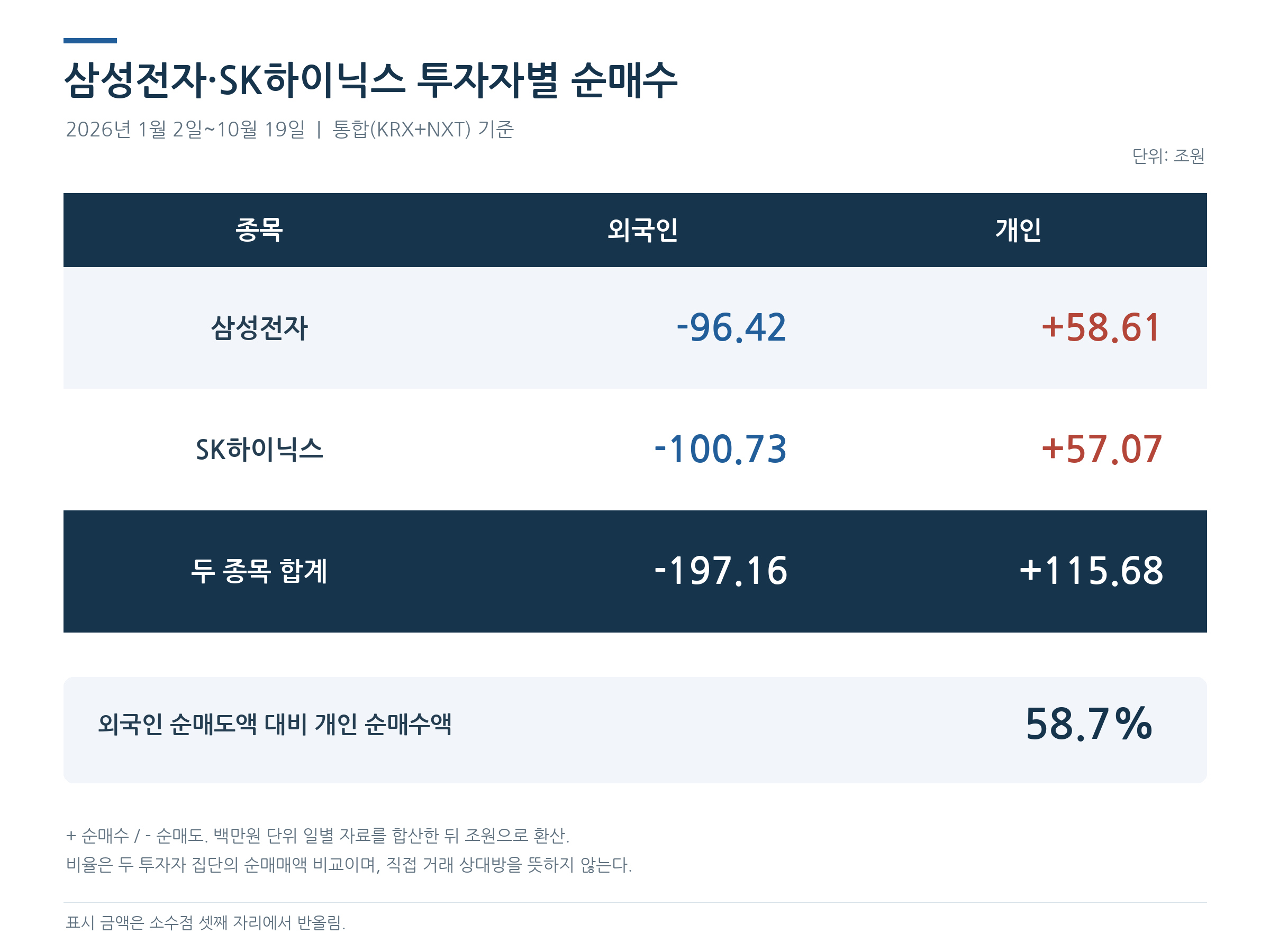
Retail investors net-purchased 115.7 trillion won of Samsung Electronics and SK hynix from January through October 19, accounting for roughly 59% of total foreign net selling.
JPMorgan, which previously advocated for overweight positions, refrains from calling a bottom in the recent market rout; critics question whether target-price rationales and downside risks were adequately communicated.
Even as sky-high price targets of 670,000 won for Samsung Electronics and 4.7 million won for SK hynix emerged this year, foreign investors aggressively unloaded the two heavyweights. According to integrated trading data including Nextrade, foreign net sales of the two semiconductor giants totaled 197.1556 trillion won between January 2 and October 19. Over the same period, retail investors net-purchased 115.6793 trillion won worth of the shares—representing approximately 59% of the foreign outflow. As optimistic projections fueled by a semiconductor boom echoed through the market, the cumulative trading directions of foreign and retail investors diverged sharply.
Domestic and foreign brokerages cascaded upward revisions to their price targets last June. Nomura bumped its Samsung Electronics target from 590,000 won to 670,000 won and raised SK hynix from 4 million won to 4.7 million won. Domestically, Hanwha Investment & Securities hiked its SK hynix target to 4.3 million won on June 22. That same month, JPMorgan set its baseline 12-month KOSPI target at 12,500, with a bull-case scenario of 15,000 and a bear-case floor of 8,000, while also warning of foreign selling pressure and the volatility risks tied to leveraged ETFs. JPMorgan attributed the foreign sell-off to involuntary liquidations triggered as the soaring market caps of the two stocks breached emerging-market index weight caps. Citing earnings growth in artificial intelligence-related firms, the bank advised overweighting South Korean equities during pullbacks, maintaining its base target of 12,500 even during the July correction.
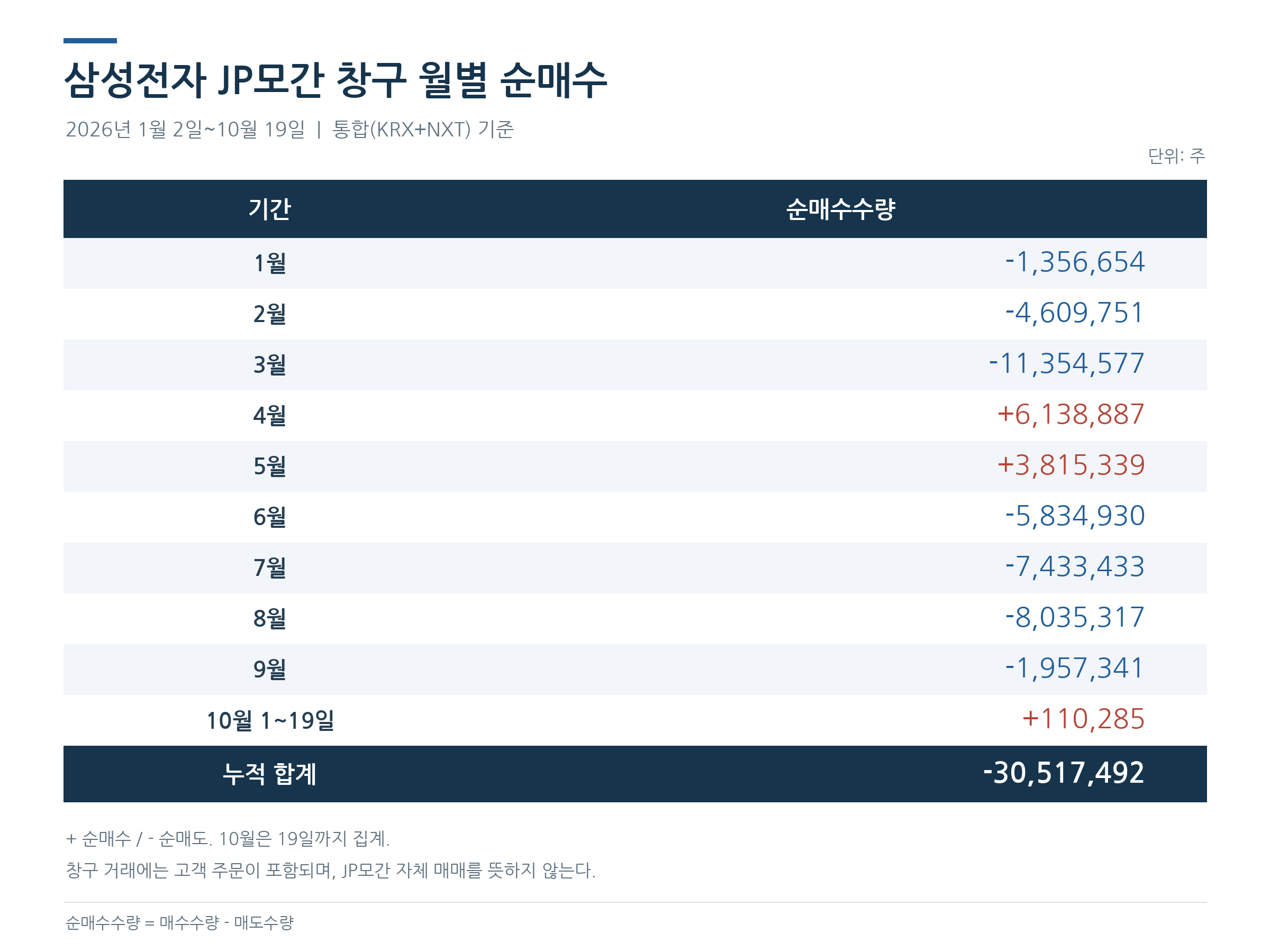
Trading data via JPMorgan's brokerage desks showed a cumulative net-selling bias in Samsung Electronics since the beginning of the year. Aggregated trade data from January 2 to October 19 reveals net sales of 30,517,492 shares of Samsung Electronics through the channel. Although the accounts recorded net purchases on a monthly basis in April and May, net selling persisted from June through September. Net sales between June 1 and October 19 reached 23,150,737 shares—accounting for 75.9% of the year-to-date cumulative net sales—while July and August alone saw net outflows of approximately 15.47 million shares. October 1 to 19 marked a cumulative net purchase of roughly 110,000 shares. However, because these figures aggregate flows passing through the designated channel and include diverse client orders, this data alone cannot determine whether JPMorgan executed trades with its proprietary capital or how the flows correlated with its published research stances.
In the recent market plunge, what JPMorgan emphasized was a dearth of buying momentum to underpin a rebound. In a recent South Korean equity strategy report, JPMorgan assessed that while the local market trades at historically undervalued levels, calling a definitive bottom remains difficult. The exhaustion of share buybacks by Samsung Electronics and SK hynix has weakened the buying foundation, the report noted, while foreign capital continues to rotate out of Asia. Local institutional buying has been negligible, and retail investor sentiment remains fragile. While the firm views South Korea's macroeconomic fundamentals as sound over a 6-to-12-month medium-to-long-term horizon, this report notably omitted specific index targets. Even back in June, when the firm was championing overweight stances, foreign investors unloaded 25.5751 trillion won in Samsung Electronics alone. The core issue is whether investors were provided with sufficient, granular explanations of how such intense selling could constrain the bullish thesis.
The conditions underpinning lofty price targets also raise critical questions regarding earnings forecasts. In September, Nomura trimmed its third-quarter operating profit estimate for SK hynix by roughly 10.5%—from 86 trillion won to 77 trillion won—to reflect a stronger South Korean won, yet left its 4.7 million won price target intact. While analyzing that a 10% appreciation in the local currency structure typically trims operating profit by about 12%, the firm projected that surging memory prices would offset foreign exchange headwinds, while underscoring earnings stability driven by supply shortages and long-term supply contracts. Trimming a single quarter's earnings forecast does not automatically necessitate lowering a price target. However, it elevates the burden of persuasion for the long-term assumptions supporting that target. Depending on how much volume expansion versus price hikes contributes to profit growth, and how severely price targets would shift if supply bottlenecks ease or pricing momentum slows, the risks absorbed by investors change fundamentally.
The uncertainties of long-term forecasts pose even graver hazards for investors holding leveraged products. Domestic single-stock leveraged instruments debuted on May 27, and the market capitalization of the 16 products swelled from 4.4 trillion won at launch to 11.9 trillion won by July 15. Merely 50 days after their introduction, financial regulators unveiled remedial measures on July 16, including the provisional suspension of new listings, a ban on promotional and event-based marketing, and tighter deposit requirements and preliminary training mandates. Products that track daily returns of specific stocks by a multiple can leave investors with permanent capital losses through market volatility, even if the underlying asset eventually recovers its initial price. Relying solely on long-term price targets to justify holding such instruments exposes investors to severe structural risks. This underscores why scrutiny must extend beyond brokerage research forecasts to encompass the disclosures and protective safeguards provided to retail investors acquiring high-risk instruments.
Brokerages cannot be held financially liable for investment losses simply because their price targets missed the mark. Yet, the principle of personal investment responsibility cannot serve as a blanket exemption that shields target rationales, sales management, and regulatory product approvals from rigorous examination. One must ask whether the underlying assumptions of towering price targets and downside risks were adequately communicated to retail investors who net-purchased over 115 trillion won in the two stocks. While optimistic projections abounded, the scarcity of explanations regarding the conditions under which those forecasts could fail—coupled with inadequate safeguards—turns the market into a tilted playing field for individual investors. It is time for financial authorities and brokerages to answer: how rigorously did research evaluate foreign selling pressures and vulnerable earnings projections, and did internal controls and risk management for high-risk products operate effectively amid the race to inflate price targets? Just as much as they exhibited zeal in raising price targets, the financial industry must now be held accountable for explaining downside risks and protecting investors.



