



YMTC Captures 38.5% of China Market to Surpass Samsung; Global Gap Also Narrows
Samsung and SK hynix Target 286-Layer and 240-Layer Upgrades in Xi'an and Dalian, Navigating U.S. Equipment Regulations
Samsung Electronics has lost its crown in China's NAND flash market to a local competitor. Yangtze Memory Technologies Corp. (YMTC), which lagged behind Samsung by 8 percentage points as recently as last year, flipped the market dynamics in the second quarter of this year by pulling 5 percentage points ahead. The combined market share of South Korea's two memory giants—including SK hynix—also slipped to 50.5% in China. While Samsung maintains its leadership in the global NAND market, the narrowing gap with YMTC has drawn intense focus on how South Korean chipmakers will respond as they seek to transition their Chinese factories to advanced production nodes.
Reuters reported on the 21st that Samsung Electronics and SK hynix are moving forward with plans to upgrade their NAND production facilities in China to advanced nodes. Both companies confirmed the factory upgrades and stated they are in discussions with the U.S. government regarding the matter.
YMTC Rises to No. 1 in China as Global Gap Narrows
According to market researcher Omdia, YMTC's market share in China's NAND sector rose from 28% for the full year of 2023 to 38.5% in the second quarter of this year. Over the same comparative periods, Samsung's share declined from 36% to 33.5%, while SK hynix dropped from 20% to 17%.
Comparing full-year 2023 to the second quarter of this year, the gap between Samsung and YMTC reversed by 13 percentage points. The combined market share of the two South Korean chipmakers also fell by 5.5 percentage points.
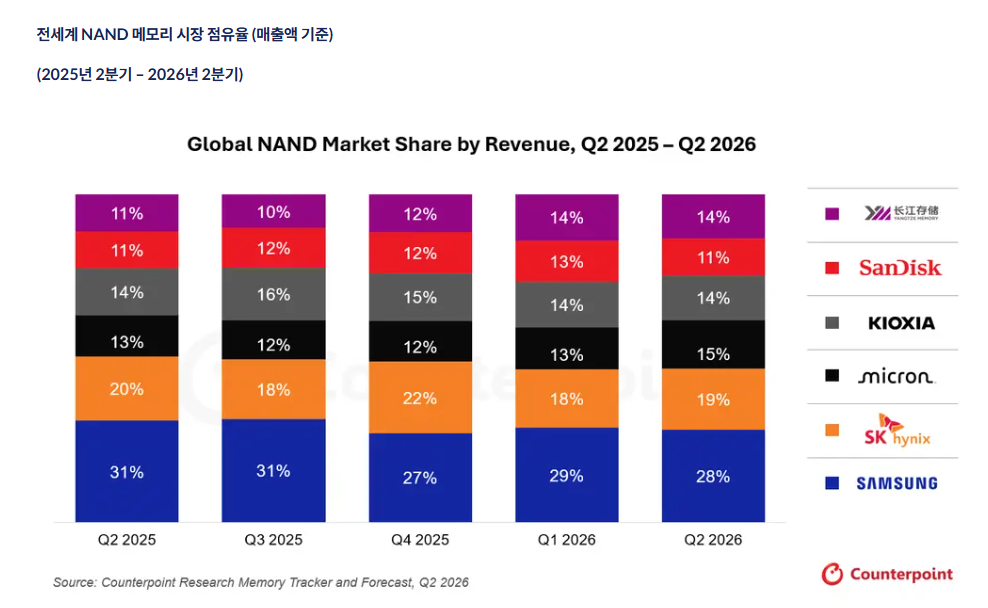
The shift at the top has already occurred in the domestic Chinese market, and the gap is closing globally as well. According to Counterpoint Research, second-quarter global NAND revenue shares stood at 28% for Samsung, 19% for SK hynix, and 14% for YMTC. In the same period last year, Samsung and YMTC held 32% and 9% respectively, narrowing the gap between the two from 23 percentage points to 14 percentage points in just one year. Although Samsung retains its global No. 1 ranking, YMTC's pursuit extends far beyond the Chinese market.
 YMTC's technological prowess is also advancing rapidly. While currently mass-producing 160-layer and 232-layer NAND chips, the company is supplying small quantities of 294-layer products and aims to produce chips with over 300 layers in the future.
NAND flash is a type of non-volatile memory that retains data even when power is turned off, widely used in smartphones, PCs, and solid-state drives (SSDs) for artificial intelligence (AI) data centers. Increasing the number of vertical stacks of memory cells allows for greater storage capacity and lower production costs per unit.
Samsung Xi'an (286-Layer) and SK Dalian (240-Layer): Advancing Chinese Plants
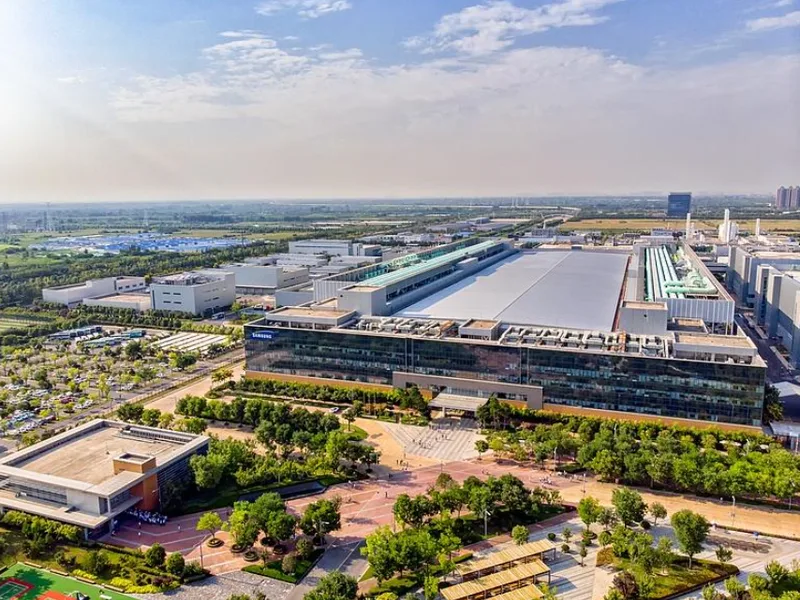
Samsung Electronics is currently transitioning its NAND production processes at its Xi'an plant in China from the current ~200-layer level to its 9th-generation (V9) 286-layer product. The Xi'an facility is a core production hub, accounting for approximately 40% of Samsung's total NAND output.
According to Reuters, Samsung is internally pursuing a project dubbed 'Monami.' The initiative aims to start monthly production of 5,000 wafers of 286-layer NAND in December of this year, scaling up to 40,000 wafers per month by December 2027.
Regarding the process conversion, Samsung stated that it is "aimed at responding to the growing demand of global customers, including the U.S.," clarifying that it does not represent an expansion of overall production capacity or the construction of a new plant.
SK hynix is also pushing to upgrade its Dalian plant in China. The plan involves elevating its current 192-layer NAND production process to over 240 layers, utilizing the manufacturing facilities acquired through its takeover of Intel's NAND business in 2021. The Dalian plant currently serves as Solidigm's sole NAND manufacturing base.
Reuters reported that SK hynix has obtained approval to manufacture products with up to 240 layers at the Dalian facility, and may seek additional approval from the U.S. government in the future for R&D on products exceeding 300 layers.
There are differences in the process migration strategies of the two firms. While Samsung is focusing on converting existing production lines at its Xi'an plant to 286 layers, SK hynix must simultaneously handle the process upgrading at the Dalian plant and the installation of equipment in Module B, an idle facility.
Outside of China, both companies have already commercialized more advanced nodes—286-layer NAND for Samsung and 321-layer for SK hynix. In August, Samsung also unveiled a prototype for a NAND flash exceeding 400 layers. Advancing the technology at Chinese factories is also an effort to narrow the technological gap between local production facilities and global manufacturing hubs.
Factory Upgrades Amid U.S. Export Controls; SK hynix U.S. Investments Also Under Discussion
The U.S. government restricts the export of equipment for advanced semiconductor production facilities within China. Samsung and SK hynix are in consultations with U.S. authorities regarding equipment imports and process conversions for their Chinese plants, and the extent to which equipment required for these advanced plans has been approved remains unverified.
SK hynix is also discussing tying the issue of importing equipment for its Chinese factory to investments in a new NAND plant in the United States.
Earlier on the 15th, Reuters reported that SK hynix's U.S. subsidiary, Solidigm, had requested permission from the U.S. government to install additional U.S.-made semiconductor equipment in 'Module B' at the Dalian plant in China. Module B was completed in 2023 but remained unequipped due to the downturn in the memory market at the time.
According to the previous Reuters report, boosting production at the Dalian plant could help Solidigm secure the capital needed to build a new NAND facility in the United States. Solidigm is also reportedly reviewing options to secure funds for the U.S. plant construction through an initial public offering (IPO) as early as next year. Separately, SK hynix is known to be in discussions to lease a portion of Intel's semiconductor manufacturing facilities in Ohio, USA.
While explaining that the equipment installation in Module B is proceeding under consultation and approval from the U.S. government, SK hynix emphasized that it is not pushing to expand the overall production capacity of the Dalian plant.
With YMTC overtaking Samsung in the Chinese NAND market, the local production strategies of South Korean firms face a new turning point. Although Samsung Electronics and SK hynix are rushing to transition to advanced nodes to counter Chinese rivals, their investment options remain constrained by U.S. equipment export controls. In particular, SK hynix is navigating its manufacturing strategy between the semiconductor policies of Washington and Beijing by simultaneously negotiating equipment import permits for its Chinese factory and investments in new U.S. production facilities.



