



Scoring 823.6 billion won in the US and 108.7 billion won in Europe amid domestic market doldrums
Raising 400 billion won to fund production capacity; operating profit turnaround projected for 2027
Doosan Fuel Cell, which has experienced persistent operating losses due to a prolonged downturn in the domestic fuel cell market, is pivoting aggressively toward overseas expansion, catalyzed by the power crunch plaguing U.S. artificial intelligence (AI) data centers. Having secured approximately 930 billion won ($670 million) in supply contracts across the U.S. and Europe, the company is moving swiftly to translate these massive orders into production and revenue by finalizing a 400 billion won capital-raising initiative.
While high power-generation costs and shifting hydrogen power bidding systems have worsened business conditions at home, grid connection delays stemming from the construction of U.S. AI data centers are generating unprecedented demand for new power generation facilities. This has opened a crucial window of opportunity for the company to expand its business footprint beyond domestic utility projects and into the overseas private power market.
US Data Center Grid Bottlenecks Drive Surging Fuel Cell Demand
In September, Doosan Fuel Cell signed two separate phosphoric acid fuel cell (PAFC) supply contracts totaling 823.6 billion won with HyAxiom, a U.S. subsidiary of Doosan Corp. Following an initial 501.4 billion won deal on Sept. 2, the company secured an additional 322.2 billion won order on Sept. 15.
Deliveries for the initial order are scheduled sequentially from the second half of this year through the first half of 2028, while shipments for the supplementary order will be directed to the North American market starting in 2028. HyAxiom will oversee local sales, engineering, commissioning, and long-term maintenance in the U.S. market.
Earlier in August, the company also clinched a solid oxide fuel cell (SOFC) stack supply contract worth 108.7 billion won with Germany's Liburdi. Combined with its domestic contracts, Doosan's cumulative order intake for the year stands at approximately 1.11 trillion won.
In the United States, the surging power demands of AI data centers are outpacing the construction timelines of conventional power plants and transmission grids. As an increasing number of developers face prolonged waits for adequate grid connections even after facility completion, "on-site" power generation solutions are rapidly emerging as a viable alternative.
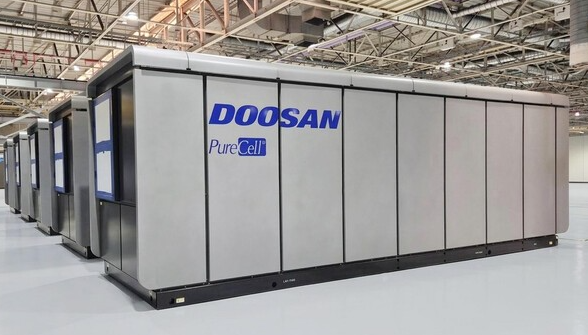
Doosan Fuel Cell’s flagship PAFC products generate electricity through the electrochemical reaction of hydrogen and oxygen. Capable of utilizing hydrogen extracted from natural gas, these modular systems allow for phased capacity expansions tailored to shifting power demands. Their relatively low noise and minimal air pollutant emissions also make them an optimal choice for power generation facilities located in close proximity to urban data centers.
Meanwhile, the domestic fuel cell market has been restructured around competitive bidding following the introduction of the Clean Hydrogen Energy Portfolio Standards (CHPS). Stubbornly high power generation costs and regulatory uncertainties have dampened new project orders, weighing heavily on Doosan Fuel Cell’s earnings recovery.
The decentralized power market for U.S. data centers is thus emerging as a vital new revenue stream capable of overcoming the limitations of the domestic market.
A Doosan Fuel Cell official remarked during last month’s additional order announcement that the company’s product competitiveness and supply execution capabilities have earned broad recognition in the U.S. market, adding that management remains fully committed to ensuring stable delivery schedules and rigorous quality control.
Prospects for further follow-on orders also appear bright. According to a Eugene Investment & Securities report released on Sept. 22, the pipeline of potential orders currently under discussion between HyAxiom and U.S. clients exceeds four times the volume of existing contracts. The company is also in talks with multiple European vendors regarding follow-on contracts for its SOFC business.
W400B Capital Raise to Fuel Production; Revenue Projected to Double Next Year
On Sept. 13, Doosan Fuel Cell announced a 400 billion won capital-raising plan comprising 300 billion won in perpetual convertible bonds (CBs) and 100 billion won in perpetual bonds with warrants (BWs).
The proceeds will be channeled primarily toward purchasing raw materials and expanding PAFC production lines required to fulfill its growing backlog of orders from the U.S. and Europe.
Because large-scale orders do not translate immediately into cash inflows, and fuel cell manufacturing requires substantial upfront capital outlays for raw materials and equipment procurement, securing adequate working capital has become paramount alongside order growth.
The financing is also expected to alleviate balance sheet pressures. The company's debt-to-equity ratio had climbed to approximately 350% in the second quarter due to sluggish domestic operations and persistent losses.
Manufacturing capacity is scaling up in tandem. Doosan Fuel Cell’s annual PAFC production capacity is projected to reach approximately 350 megawatts (MW) by the end of this year, with further investments poised to push that figure to 400 MW.
With overseas orders slated to be fully reflected on the balance sheet by 2027, the company's top-line growth is expected to accelerate significantly.
Eugene Investment & Securities estimates that Doosan Fuel Cell’s consolidated revenue will surge 99.1% from 484.1 billion won this year to 964 billion won by 2027. Over the same period, the company's operating result is projected to swing from an operating loss of 102.2 billion won to an operating profit of 18 billion won, with operating profit expanding further to 59.9 billion won by 2028.
Near-term earnings, however, remain burdened by cost pressures. Third-quarter revenue is estimated to have risen 56.4% year-on-year to 142 billion won, while the operating loss is projected to widen to 16.5 billion won. Expenses tied to legacy fuel cell stack replacements and rising fixed costs at the SOFC plant continue to weigh on profitability.
Han Byung-hwa, an analyst at Eugene Investment & Securities, noted that U.S.-bound fuel cell shipments are set to begin rolling out at the end of the first quarter of next year and accelerate through the second half, paving the way for the company to post a quarterly operating profit turnaround by the latter half of 2027.
Han also noted that Doosan Fuel Cell compares favorably against Bloom Energy in the U.S. data center fuel cell market. Based on projected 2027 revenue, Doosan’s price-to-sales ratio (PSR) stands at an attractive 2.3x, compared with Bloom Energy’s 6.5x.
While maintaining a "Buy" rating on the stock, Eugene Investment & Securities lowered its target price from 80,000 won to 70,000 won, reflecting an estimated 14% potential equity dilution stemming from the capital raise.
Doosan Fuel Cell has officially entered a transitional phase, successfully offsetting domestic stagnation with overseas momentum. Bolstered by expanding U.S. shipments and strengthened manufacturing capabilities, the company is poised to accelerate both revenue growth and profitability starting next year.



