



H1 revenue jumps 66.7% to 32.2 billion KRW; strong demand for ESS and 46-pi inspection systems cited.
Commercialization of 'One-Pass Ring CT' boosts inspection speed by 40% while reducing installation footprint by 50%.
Company secures supply contracts for TGV (Through-Glass Via) inspection equipment and pushes for HBM inline CT commercialization.
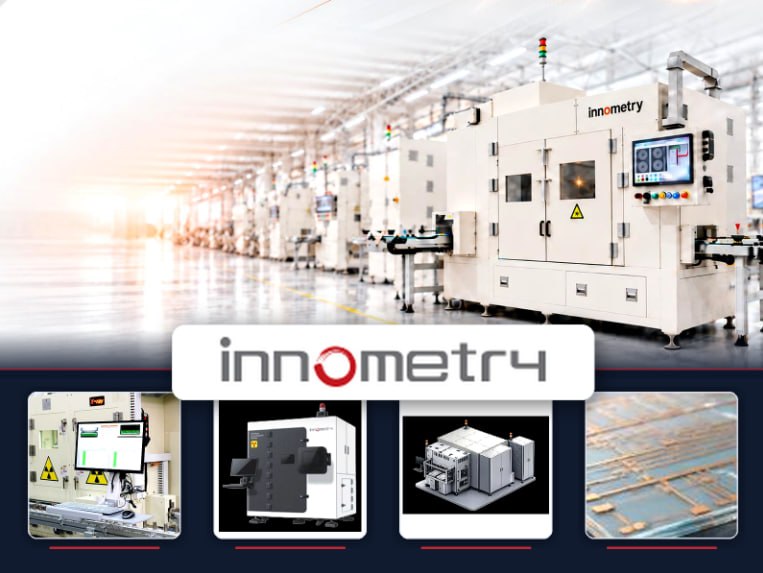
Small Insight Research reported on the 26th that InnoMetry (302430) is seeing a recovery in its core battery inspection business, driven by the shift of EV production lines toward Energy Storage Systems (ESS) and the proliferation of 46-pi cylindrical batteries. Beyond its established domain, the company is actively expanding its technological reach into semiconductors, specifically targeting glass substrates and High Bandwidth Memory (HBM).
InnoMetry posted consolidated revenue of 32.2 billion KRW for the first half of 2026, a 66.7% increase compared to the same period last year. Notably, the company achieved 83.4% of its entire 2025 annual revenue (386 billion KRW) within just the first six months of 2026. However, profitability remains a challenge; the operating loss widened from 1.2 billion KRW to 1.9 billion KRW year-on-year, despite the robust top-line growth.
A specialist in X-ray and CT-based non-destructive testing (NDT), InnoMetry counts major battery manufacturers—including domestic leaders like Samsung SDI, LG Energy Solution, and SK On, as well as global players like BYD, BAK, and EVE—among its key clients. The company is leveraging its extensive track record in battery testing to support both facility retrofits and new project deployments.
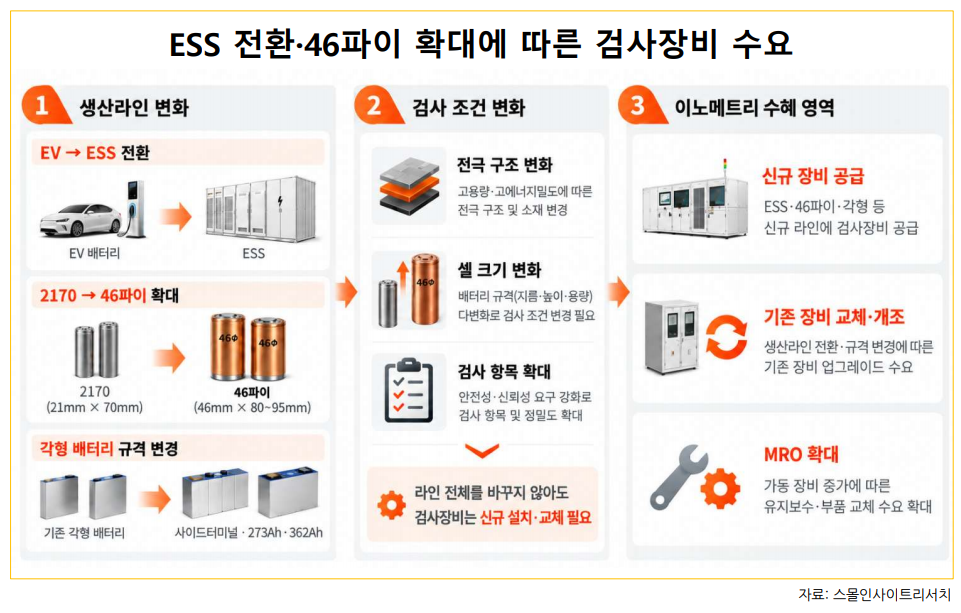
A key growth driver is the rising demand for inspection equipment during the conversion and retrofitting of existing EV battery lines into ESS production lines. As battery dimensions, internal structures, and inspection requirements shift, clients necessitate equipment upgrades or new installations. InnoMetry secured approximately 22 billion KRW in new orders for secondary battery inspection equipment in the first half of 2026 and signed an additional 4.96 billion KRW contract in August for U.S.-bound ESS inspection systems.
The company has also established a footprint in the 46-pi cylindrical battery market, having delivered the world's first inline CT and contamination inspection system for mass production lines. It successfully shipped equipment in August that was ordered in February 2026. Furthermore, it is currently engaged in projects for CT and foreign material inspection for 4680 cylindrical batteries in Hungary, with plans to expand applications to large-capacity and prismatic batteries.
InnoMetry is also sharpening its competitive edge in testing technology. It has commercialized the "One-Pass Ring CT," which rotates the inspection unit around the cell rather than rotating the battery cell itself, as seen in legacy systems. This innovation has reduced the required installation space by roughly 50% while improving inspection speeds by approximately 40%. The company aims to complete development of its next-generation "Helical CT"—a continuous inspection system for moving cells—in 2026, targeting mass production by 2027.
In its new business ventures, InnoMetry is reporting initial supply wins for glass substrate inspection equipment. By applying X-ray and CT technology to detect internal defects in Through-Glass Vias (TGV), the company has already supplied equipment to JWMT and Extol, and has expanded its client base to include plating specialist AnyCasting. Revenue from glass processing and plating inspections is beginning to materialize, with expectations for significant growth by 2027.
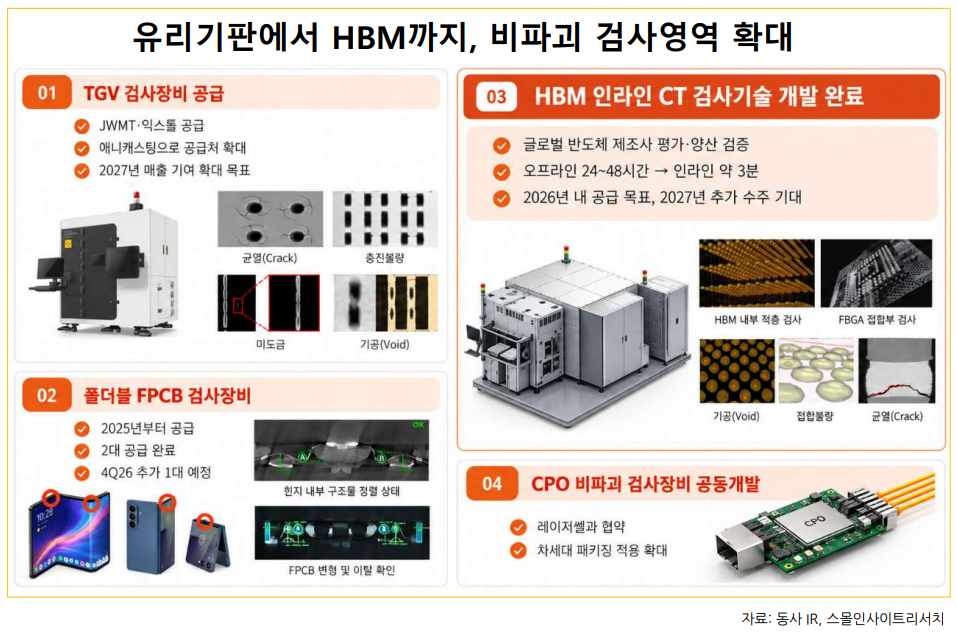
In the HBM sector, InnoMetry has completed development of inline CT inspection technology and is currently undergoing verification trials with a global semiconductor manufacturer. Unlike traditional off-line testing, which requires 24 to 48 hours for sample transport and result validation, the inline CT system allows for inspection in approximately three minutes per unit. The company aims for commercial supply to global customers within 2026. Additionally, it has supplied two inspection units for foldable smartphone FPCBs, with a third delivery scheduled for the fourth quarter.
Management is also prioritizing a turnaround in profitability. Since September 2026, an internal task force has been focused on a 30% cost reduction goal through product redesign and manufacturing process optimization. Key variables for a full earnings recovery include improved cost-to-sales ratios per project, favorable product mix shifts, and an expansion in overseas maintenance, repair, and operations (MRO) revenue.
Choi Sung-won, an analyst at Small Insight Research, noted: "While InnoMetry’s revenue recovery in the first half is clear, the widening operating loss indicates that further improvements are needed before the company reaches a normalized earnings structure. Future revaluation of the company will hinge on its ability to restore profitability through cost optimization and the successful large-scale commercialization of its TGV and HBM inspection equipment."
[SOURCE]


