



Remaining KRW 55 trillion to 75 trillion in shareholder returns to be finalized next January; investors trigger sell-off following conference call.
Record profits fail to meet market expectations, contrasting with SK hynix’s performance.
Samsung Electronics failed to satisfy investor expectations despite reporting record-breaking earnings and unveiling a shareholder return package of up to KRW 110 trillion. Although the company announced its highest-ever quarterly profit on the 29th, shares plunged more than 6% during intraday trading. The announcement largely reiterated return targets initially disclosed in August, while plans for additional share buybacks—which investors had eagerly anticipated—were deferred until next January.
The market had high hopes for Samsung’s update, particularly after SK hynix announced concrete details regarding its own share buyback and cancellation program just a day earlier. While the total value of shareholder returns between the two tech giants appeared similar, a significant gap emerged in the transparency and execution timelines of their respective plans. Samsung’s stock, which had rallied over 9% the previous day, could not sustain its early-session momentum and turned downward following the conference call.
The sharp decline in Samsung Electronics also weighed heavily on the KOSPI. After climbing past the 6,100-point threshold early in the session, the index surrendered all gains, falling back to the 5,900 level just one day after reclaiming the 6,000 mark on the back of a semiconductor rally.
The Urgency of Specific Buyback Plans Over Headline Figures
In its third-quarter earnings announcement, Samsung stated that it would allocate between KRW 90 trillion and 110 trillion for shareholder returns through 2026. Excluding approximately KRW 35 trillion already executed or confirmed, the remaining balance stands at KRW 55 trillion to 75 trillion. The company confirmed a Q3 cash dividend of KRW 4,601 per share for both common and preferred stock, totaling KRW 30 trillion.
While Samsung indicated that the remaining funds would be used for cash dividends and share buybacks, it failed to provide a specific breakdown of the allocation. The final scale of returns and the specific execution plan will be determined at a board meeting at the end of January next year.
In contrast, SK hynix has pursued a shareholder return program worth approximately KRW 100 trillion this year, with clear allocations: over KRW 30 trillion for cash dividends and over KRW 60 trillion for share buybacks and cancellations. The company completed a KRW 40 trillion buyback program on the 21st, with all those shares slated for cancellation.
Furthermore, on the 28th, SK hynix decided on an additional KRW 20 trillion in buybacks. Of this, KRW 10 trillion will be fully cancelled for shareholder value, while the remaining KRW 10 trillion will be used for employee compensation (which is excluded from the shareholder return figures).
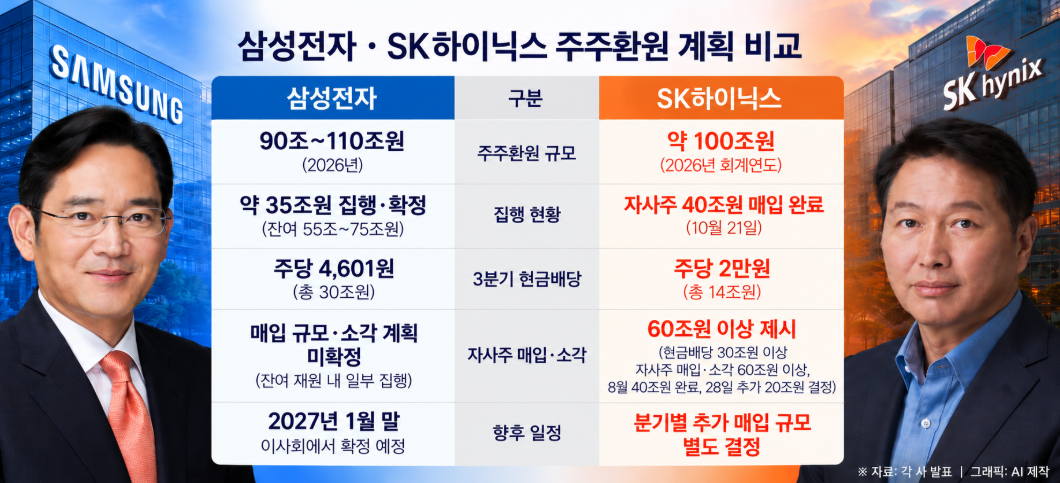 While the headline totals were comparable, investors were sensitive to the lack of granular detail from Samsung. Whereas SK hynix provided a concrete roadmap for buybacks, Samsung investors are left waiting until January. Because Samsung’s "remaining resources" also include potential future dividends, the actual amount earmarked for share repurchases remains ambiguous.
Reuters also highlighted the lack of new, detailed shareholder return measures as a primary catalyst for the stock’s decline, despite the company’s record performance.
Record Earnings Overshadowed by Market Expectations
Samsung Electronics reported a third-quarter consolidated operating profit of KRW 107.44 trillion, a 783.1% increase year-on-year, driven by surging demand for AI memory chips and rising semiconductor prices.
The DS (Device Solutions) division, which oversees the semiconductor business, recorded an operating profit of KRW 106.5 trillion. According to Reuters, the semiconductor division’s performance fell slightly short of market consensus.
During the conference call, Samsung projected that memory supply shortages would persist into next year. Management noted that demand for high-value-added memory, including HBM4, is growing rapidly and that the company is expanding long-term supply contracts with major clients.
To meet this rising demand, the company is increasing capital expenditure. Investment in the semiconductor segment this year is expected to reach approximately KRW 76.8 trillion, a 62% increase from the previous year.
However, the semiconductor boom had already been priced into the stock. With the previous day’s 9% surge and the backdrop of SK hynix’s aggressive return announcement, expectations for additional measures from Samsung had reached a fever pitch. Consequently, the lack of new initiatives triggered profit-taking, as the market's high expectations were not met.
KOSPI Reverses Course Following Samsung’s Slide
The KOSPI closed at 6,012.44 on the previous day, bolstered by a joint rally in Samsung Electronics and SK hynix, which jumped 9.01% and 10.89%, respectively.
However, Samsung’s decline today shook the momentum of the semiconductor-led rally. Conversely, SK hynix fluctuated throughout the day before ending in positive territory, contrasting sharply with Samsung’s performance.
Other large-cap stocks also weakened. LG Energy Solution plummeted following news of a stake sale by its parent company, LG Chem, while nuclear power-related stocks saw further losses due to company-specific headwinds.
While disappointment over Samsung’s shareholder policy is cited as the primary factor, the broader index decline was exacerbated by weakness in other major market-cap constituents and profit-taking pressures following the previous day’s rally. With investors awaiting further clarity until January, the market remains cautious.
[SOURCE]


