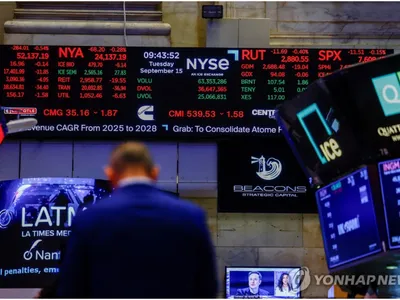
Intraday volatility peaks on U.S. midterm election outcomes
Sharp drop followed by recovery amid AI regulation fears; semiconductors remain weak
Major Market Trends
① Even Texas flips... Sharp decline on AI regulation concerns
The domestic stock market showed extreme volatility, reacting sensitively to the U.S. midterm election results. The market opened higher, buoyed by the strength of U.S. semiconductor stocks the previous day, but the sentiment shifted rapidly as vote counting progressed.
Recently, the semiconductor sector had fallen more than 20% from its October peak, and the short-term pullback for the Nasdaq 100 had also exceeded 10%. Combined with historical statistics showing strong stock market performance following past midterm elections, the prevailing initial perception was that the drop was overdone.
However, as stronger-than-expected Democratic election results were confirmed, caution toward AI-related stocks spread once again. Notably, the victory of Democratic candidate Gina Hinojosa in the gubernatorial race in Texas—a traditional Republican stronghold—drew significant market attention.
Texas is a major hub for U.S. data center investments. As data center power consumption, electricity rates, and tax incentives emerged as key issues during the campaign, concerns that related policies could be tightened going forward stimulated bearish AI investment sentiment.
U.S. stock index futures plunged, and the domestic stock market slid rapidly as well. The KOSPI fell by about 7% from its intraday high before recovering a substantial portion of its losses later in the session.
② Trump accepts results and pledges cooperation; losses narrow rapidly
By the afternoon, the market regained stability. President Trump’s statement accepting the midterm election results and expressing a willingness to cooperate with the Democrats positively influenced the recovery of investor sentiment.
Market focus also shifted toward the possibility that data center regulations would proceed in the direction of adjusting power consumption, electricity rate burdens, and corporate incentives, rather than restricting the AI industry itself.
Given that AI data center investments have a massive impact on U.S. growth, regional investments, and employment, further confirmation is needed as to whether regulations will actually lead to a halt in investments. The recognition that the election results themselves do not alter the growth trajectory of the AI industry also lent momentum to narrowing the losses.
③ Semiconductor weakness, secondary battery rebound; massive foreign selling
Highlighted by concerns over data center investments, Samsung Electronics and SK hynix traded lower. Secondary battery stocks turned higher after falling intraday, and renewable energy-related issues also showed strength.
On the KOSDAQ, Alteogen suffered a sharp decline, weighing on the index. Conversely, select pharmaceutical stocks such as Hanmi Science and Celltrion advanced.
Foreign investors engaged in massive net selling, centered around electrical/electronic and financial shares, while net-buying IT services, transportation warehousing, and electric/gas utilities. Institutional investors scooped up electrical/electronics, financials, transport equipment, and pharmaceuticals.
Supply, Demand, and Sectors
At the center of the day's volatility was foreign selling. As the U.S. election results filtered through, selling pressure on large-cap stocks, including semiconductors, mounted rapidly, causing the index to plunge.
On the other hand, institutional investors stepped in as net buyers in major sectors such as electrical and electronics, playing a role in mitigating the market losses. On the KOSDAQ as well, institutions net-bought electrical and electronics.
By sector, while semiconductors remained weak, secondary batteries, renewable energy, and certain pharmaceutical stocks showed relative strength. Sectoral differentiation reflecting the potential for policy shifts in the wake of the election results also became apparent.
Market Analyst's Perspective
Today’s market arguably overreacted to the U.S. midterm election results. While controversies surrounding data center power costs and community burdens are tangible policy variables, they need to be viewed separately from issues that would significantly retard the AI industry itself.
The crux of the data center debate in Texas also lies in power consumption and electricity rate burdens. Policy adjustments are being discussed in the direction of reducing the costs borne by households while increasing the burden on data center operators. While volatility in AI stocks may persist as related policies take concrete shape, whether this fundamentally alters the trajectory of data center investment is a separate matter.
The midterm election results should also be viewed from other angles. If political checks and balances between the White House and Congress intensify, the momentum and pace of existing policies—such as tariffs, fiscal policy, and foreign policy—could change. Now that President Trump has accepted the election results and signaled cooperation with the Democrats, it is necessary to ascertain the actual extent of future policy shifts.
In the short term, market conditions that react sensitively to election outcomes and AI-related news may persist a little longer. However, it is also worth noting that the major uncertainty of the election is passing its peak. As volatility subsides, it is essential to continuously monitor the price reactions of existing market leaders, stocks with verified earnings, and those experiencing continuous institutional buying.
Source: Market Analyst's Stock Story (t.me/shmstory)
YouTube: Market Analyst TV www.youtube.com/@blueoak1004
This article has been reorganized from a Telegram post by Market Analyst's Stock Story with the author's consent. All content may contain errors and does not constitute a recommendation to buy or sell, and therefore cannot be used as a basis for trading. The contents of this post cannot be used as legal grounds under any circumstances.