SITC 2026 Abstracts Released… Demonstrates Faster Tumor Control than Conventional CAR-T Comparators
Reduction in T-Cell Exhaustion Markers and No Off-Target Accumulation in Normal Lung Tissue Observed
Preclinical studies of ‘SynKIR-110’, a CAR-T cell therapy for solid tumors being developed by Verismo Therapeutics—a U.S. subsidiary of HLB (HLB Innovation, 024850)—have demonstrated faster tumor control alongside a reduction in major cytokine production of up to approximately 97% compared to conventional CAR-T comparators.
Verismo announced on the 3rd (local time) that the preclinical research abstract for SynKIR-110 containing these findings has been released. Following the announcement of its upcoming presentation at an academic conference on the 16th of last month, the company has now disclosed specific comparative figures and results related to off-target activity.
The study is scheduled to be presented as a poster at the Society for Immunotherapy of Cancer (SITC 2026) annual meeting, held in Phoenix, Arizona, from the 4th to the 8th. SynKIR-110 was directly compared with conventional CD28- and 4-1BB-based single-chain CAR-Ts to evaluate the characteristics of Verismo’s multi-chain KIR-CAR platform.
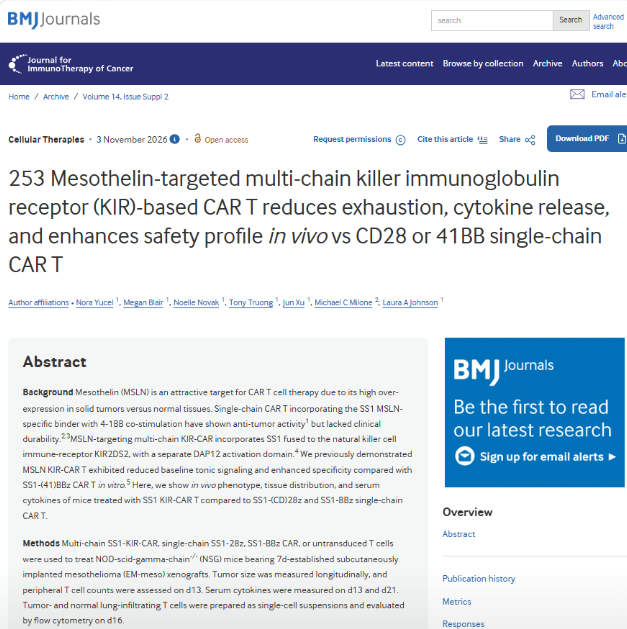 [Source: Captured from the preclinical research abstract of the solid tumor CAR-T therapy ‘SynKIR-110’ presented at SITC 2026 by HLB Innovation]
According to the published abstract, SynKIR-110 showed the fastest tumor control in direct comparisons with CD28- and 4-1BB-based single-chain CAR-Ts. Meanwhile, major cytokines generated during the immune cell activation process remained at relatively low levels.
Notably, compared to CD28-based single-chain CAR-T, interferon-gamma (IFN-γ) levels were approximately one-tenth, while tumor necrosis factor-alpha (TNFα) and interleukin-2 (IL-2) were approximately one-thirtieth each. This indicates that the production of TNFα and IL-2 was about 96.7% lower than that of the comparator group.
CD8+ T cells infiltrating tumor tissues also showed lower expression of exhaustion-associated markers TIM3, LAG3, and PD1 than the conventional comparator group. T-cell exhaustion is a phenomenon where immune cells lose their anti-cancer function due to persistent stimulation.
Differences were also observed in off-target activity. In the conventional CD28- and 4-1BB-based CAR-T comparator groups, in vitro off-target activity and CD8 CAR-T cell accumulation within normal lung tissue were observed. In contrast, these phenomena were not identified in the SynKIR-110 administration group.
“These preclinical head-to-head results provide mechanistic evidence that our multi-chain KIR-CAR platform, which separates antigen binding from T-cell activation, can maintain anti-tumor activity while reducing chronic signaling and non-specific off-target activity that can occur with conventional single-chain CAR-Ts,” said Dr. Laura Johnson, Chief Scientific Officer (CSO) and Chief Operating Officer (COO) of Verismo Therapeutics.
SynKIR-110 is currently undergoing a Phase 1 clinical trial (STAR-101, NCT05568680) in the United States involving patients with mesothelin-expressing advanced solid tumors, including mesothelioma, ovarian cancer, and cholangiocarcinoma. The study is currently in the dose-escalation phase to determine the recommended Phase 2 dose (RP2D).
Early clinical data released in May at the American Association for Cancer Research (AACR 2026) annual meeting confirmed tumor reduction in some of the 9 patients across the first three dose-escalation cohorts. Dose-limiting toxicities (DLT), Grade 3 or higher cytokine release syndrome (CRS), and immune effector cell-associated neurotoxicity syndrome (ICANS) were not observed.
At the upcoming SITC conference, SynKIR-110’s anti-tumor activity and immune response characteristics are presented with concrete figures through direct comparison with existing CAR-Ts. Verismo is currently evaluating safety and anti-tumor activity via dose escalation in the ongoing Phase 1 trial and plans to determine the recommended dose for subsequent clinical trials.