EU Raises Additional €21.3B Out of €150B Defense Fund; Restricts Extra-EU Component Costs to 35%
Hanwha Fails to Secure Romanian Armored Vehicle Order Despite Offering 80% Localization; U.S. Firms Also Expand European Footprint
As the European Union (EU) initiates applications for an additional €21.3 billion (approx. KRW 32 trillion) in defense financing, South Korea’s defense exporters are being forced to rethink their European strategy. The EU’s SAFE (Supporting Ammunition Production) defense loan program, worth a total of €150 billion (approx. KRW 225 trillion), caps the cost of components produced outside the eligible region at 35% or less for supported weapons systems. While European rearmament has driven up weapons demand, the traditional model of exporting fully assembled goods manufactured in South Korea is increasingly colliding with barriers in major procurement projects.
On October 29, the European Commission opened its second call for applications regarding unallocated funds, prioritizing air defense and missile defense systems, drones, counter-drone systems, and ammunition and missiles. It has approved loan agreements for 19 participating member states, signed contracts with 16 of them, and disbursed approximately €13.5 billion to 11 nations. As the execution of European defense funds accelerates, winning bids depends not only on weapon performance and pricing, but increasingly on where production facilities and component supply chains are anchored.
Beyond Buying Weapons: Europe Demands Factories and Jobs
To counter military threats from Russia, European nations are boosting defense budgets while tightening procurement conditions to ensure those funds circulate back into domestic industries. SAFE is a long-term loan program supporting member states' defense procurement. Weapons systems eligible for support must meet the requirement that components produced outside eligible regions—such as the EU, European Free Trade Association (EFTA) countries belonging to the European Economic Area (EEA), and Ukraine—account for no more than 35% of the total cost.
This does not constitute an outright ban on importing South Korean weapons. Rather, it means that component origins and supplier credentials must be strictly vetted for projects utilizing SAFE financing. This explains why companies that previously manufactured and exported finished goods from South Korea are now compelled to weigh local European production and expanded local sourcing.
Poland is aggressively leveraging this policy to foster its domestic defense industry. During a SAFE-related agreement signing ceremony on May 8, Prime Minister Donald Tusk reaffirmed the policy of channeling 89% of allocated funds into Polish industry. Having been allocated approximately €43.7 billion, Poland is pursuing projects that tie weapon imports to domestic production facilities and job creation.
Poland, which previously purchased massive quantities of tanks and self-propelled howitzers from South Korea, is now securing manufacturing plants and component supply chains within its borders. According to Yuanta Securities, Europe accounted for 69% of South Korea’s defense exports between 2022 and 2025, with Poland alone taking up 65%. Given that 68% of total orders concentrated on artillery, multiple rocket launchers, tanks, and armored vehicles, shifts in European procurement policies strike directly at the core export markets of South Korean defense firms.
Was 80% Localization Not Enough? The Romanian Armored Vehicle Bid
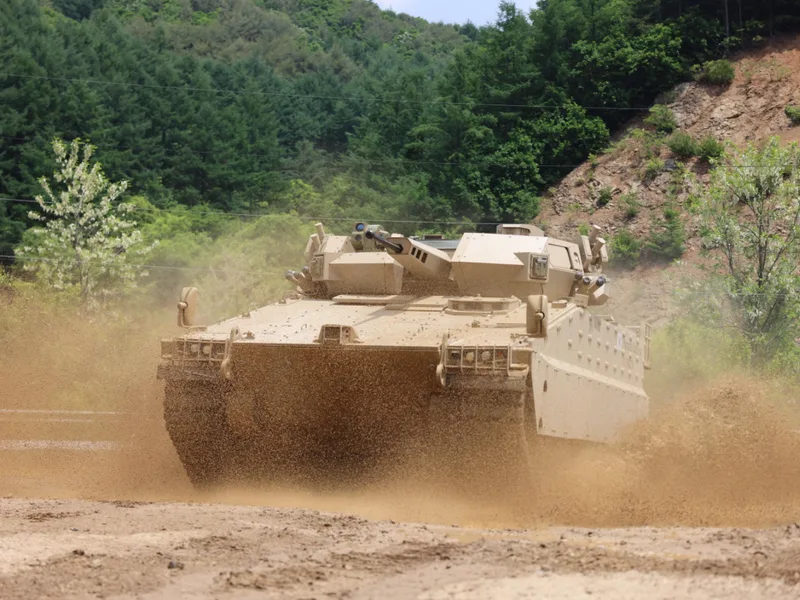
Europe’s altered purchasing landscape was laid bare during this year’s armored vehicle procurement race in Romania. In an interview with Romanian state news agency Agerpres last December, Hanwha Aerospace unveiled plans to raise the localization rate of its Redback armored vehicle up to 80%.
CEO Son Jae-il outlined a vision to foster Romania not merely as a purchasing nation but as a production hub, explaining that the transfer of production, R&D, and maintenance facilities alongside technology could create over 2,000 direct and indirect jobs. He also noted that more than 30 local subcontractors had been secured. The plan involved transferring major production processes for hulls and turrets while integrating Romanian firms into the global supply chain.
However, the choice made by Romania in April fell on German firm Rheinmetall’s Lynx armored vehicle. The framework agreement, signed on May 29, covers 298 armored and variant vehicles worth approximately €3.337 billion. Of these, 232 units are slated for financing via SAFE funds.
Rheinmetall’s industrial localization plan was similarly concrete. "More than 50% of production will take place in Romania or through cooperation with local companies," said Mihai Jurca, head of the Romanian Prime Minister's Chancellery, during the contract announcement. Rheinmetall plans to expand existing production facilities and incorporate over 200 subcontractors into its supply chain.
Rheinmetall already possessed a production base in Romania prior to this bid. Having acquired a stake in local military vehicle maker Automecanica Mediaș in 2024 to secure production facilities, the company plans to invest hundreds of millions of euros more on the back of this contract. While Hanwha proposed a high localization rate and greenfield investments, Rheinmetall opted to expand its pre-existing production facilities and supply network.
The calculation methods for localization rates differ between the two companies, and multiple factors—including pricing, delivery schedules, and technical evaluations—influence final selections. It would be an oversimplification to conclude that SAFE regulations alone caused Hanwha’s bid to fail. Nonetheless, competing against the entrenched local production bases of European defense giants remains a heavy burden for South Korean firms.
South Korean companies are taking countermeasures. Hyundai Rotem is pursuing the local production of K2PL tanks in Poland, while Hanwha Aerospace broke ground in February on production facilities for K9 self-propelled howitzers and K10 ammunition resupply vehicles in Petrești, Romania.
The expansion of local production is reshaping export modalities for domestic defense companies. If core components fed into European factories continue to be supplied from South Korea, domestic subcontractors retain export opportunities. Conversely, if component sourcing shifts entirely to local soil, manufacturing volumes originating in South Korea may shrink. Even if finished-product export contract values remain identical, the share of production and component supply retained domestically could vary widely.
U.S. Cites Trade Barriers, Yet Lockheed Martin Joins Hands with Germany
South Korea is not alone in voicing dissatisfaction with Europe’s defense procurement policies. In its 2026 National Trade Estimate Report on Foreign Trade Barriers published in March, the Office of the United States Trade Representative (USTR) took issue with the intra-EU production requirements of SAFE and the European Defence Industry Programme (EDIP). Washington raised concerns that participation by U.S.-made weapons could be restricted and that European small and medium-sized enterprises relying on U.S. components might suffer disadvantages.
Even as the U.S. government flags trade barriers, American defense contractors are expanding production partnerships with European players. On July 7, Lockheed Martin signed a Memorandum of Understanding (MOU) with Germany’s Rheinmetall for the joint European production of ATACMS missiles. The partners are also pushing to utilize Germany’s Unterlüß plant as a manufacturing hub.
Rheinmetall may have beaten Hanwha Aerospace in the Romanian armored vehicle contest, but to Lockheed Martin, it is a partner for joint European production. While South Korean and U.S. firms scale up local manufacturing to sell more weapons in Europe, European defense companies are securing business managing production for overseas firms.
The EU is scrutinizing not only production facilities but also design control to prevent over-reliance on foreign firms after weapons are procured. For certain weapon systems like air and missile defense, SAFE mandates the authority to alter designs or replace components without third-party restrictions. EDIP similarly enforces requirements regarding intra-EU production and design control, compelling foreign enterprises to align their procurement terms with provisions governing equipment modification alongside physical manufacturing facilities.
Although South Korea has signed a security and defense partnership with the EU, enabling participation in SAFE joint procurement, a separate agreement is required to broaden the eligibility requirements applied to South Korean firms and components. As of November 4, the formal conclusion of such an agreement has not been confirmed in official records.
The €21.3 billion additional recruitment launched by the European Commission on October 29 targets unallocated portions of the original €150 billion envelope. Member states can submit procurement demands for air defense, missile defense, drones, ammunition, and missiles. While consultations to expand South Korea’s participation terms continue, the EU continues to disburse funds to member states under pre-approved loan plans.