S&P 500 rises 1.58% and Nasdaq gains 1.44% as easing political uncertainty improves investor sentiment
Semiconductor index drops 3.13% amid AI data center regulation concerns; international crude oil plunges 8%
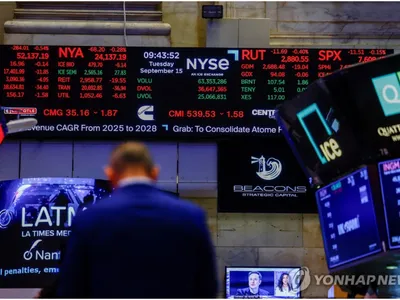
The three major New York stock indices closed higher across the board on the 4th (local time), driven by easing political uncertainty after the Democratic Party secured control of both the Senate and the House of Representatives in the midterm elections. While the Dow Jones Industrial Average surged more than 3%, stock performance diverged sharply by sector, with artificial intelligence (AI) data center and semiconductor-related stocks declining over concerns of heightened regulation.
On this day, the Dow Jones Industrial Average finished up 1,569.40 points (3.03%) at 53,356.12. The S&P 500 rose 119.70 points (1.58%) to 7,688.62, while the tech-heavy Nasdaq Composite gained 364.50 points (1.44%) to close at 25,736.51. The Philadelphia Semiconductor Index fell 331.75 points (3.13%) to 12,68.65.
The primary catalyst for the market rally was the outcome of the U.S. midterm elections. With Democrats securing majorities in both chambers of Congress, they have reclaimed legislative leadership. Consequently, congressional checks on key policies pursued by Republican President Donald Trump are expected to intensify.
Market participants formed expectations that the division of power between the executive branch and Congress could limit the likelihood of abrupt changes to major economic policies, such as tariffs and fiscal spending. With the election results finalized, uncertainty surrounding future policy directions was partially alleviated.
However, the reduction in political uncertainty did not translate into gains for all sectors. As the possibility of increased oversight of the AI industry came to the forefront, selling pressure concentrated on data center operators and semiconductor-related equities.
Notably, attention was drawn to the fact that Democrats won key elections in states like Texas and Georgia, where data center investments have been robust. Public opposition has been brewing in these regions over surging power demand and infrastructure burdens resulting from large-scale data center construction.
Goldman Sachs economists raised the possibility that Democratic victories in state and local elections could lead to short-term halts in data center construction. They analyzed that this could impact approximately 45% of planned data center facility expansions in the United States. This outlook is predicated on the possibility of policy shifts rather than the confirmed impact of actual regulations.
Related equities also traded on a weaker footing. Data center operators and infrastructure-related companies such as Iris Energy (IREN), Hut 8, Applied Digital, and Core Scientific declined. Conversely, some mega-cap tech stocks, including Amazon, Alphabet, and Meta, advanced, showing differentiation even within AI-related shares.
The semiconductor sector also experienced notable weakness. Major chipmakers including NVIDIA, Micron, and Intel declined, dragging down the Philadelphia Semiconductor Index.
In contrast, AMD finished up 1.01% at $488.78. The company announced in its third-quarter earnings report released the previous day that data center revenue surged 97% year-over-year and provided growth outlooks through 2027. Despite AMD's gains, the broader semiconductor sector remained weak.
Eco-friendly energy stocks showed strength. Solar energy companies drew attention on expectations that federal support policies for the clean energy industry would be maintained due to the Democratic takeover of Congress. Major solar stocks like First Solar advanced, and the Invesco Solar ETF (TAN) also showed strength.
Defense stocks declined. Major defense contractors including Northrop Grumman, RTX, Lockheed Martin, and L3Harris all traded lower. Sentiment was weighed down by concerns that President Trump's $1.5 trillion defense budget expansion initiative could face constraints during congressional deliberations.
International crude oil prices also plummeted significantly. West Texas Intermediate (WTI) crude for December delivery fell 8.3% from the previous trading day to settle at $88.12 per barrel on the New York Mercantile Exchange.
The market focused on the possibility that the U.S. midterm election results could bring changes to foreign policy regarding the Iran conflict. Expectations that the war could end early eased concerns over crude oil supply disruptions, exerting downward pressure on oil prices.
While falling oil prices burden energy companies' share prices, they can act as a positive factor for other sectors by lowering corporate costs and inflationary pressures.
In the fixed-income market, U.S. long-term Treasury yields declined. The yield on the 10-year U.S. Treasury note hovered around 4.88% near the New York close. The U.S. dollar also weakened against major currencies.
In this trading session, the easing of policy uncertainty stemming from the Democratic sweep of Congress drove a broad market rally. However, semiconductor, data center, and defense stocks decoupled from major indices as the potential for AI data center regulations and concerns over defense budget adjustments came to the fore.
Looking ahead, key variables for the market are expected to include budget and industrial policy negotiations between the Democrat-controlled Congress and the Trump administration, discussions on AI data center construction regulations, and movements in international crude oil prices.