


Cumulative Operating Profit Exceeds 7 Trillion Won in Q3... 437.6 Billion Won Invested in R&D
China Surpasses South Korea in October LNG Carrier Orders... Acceleration of Core Technology Localization
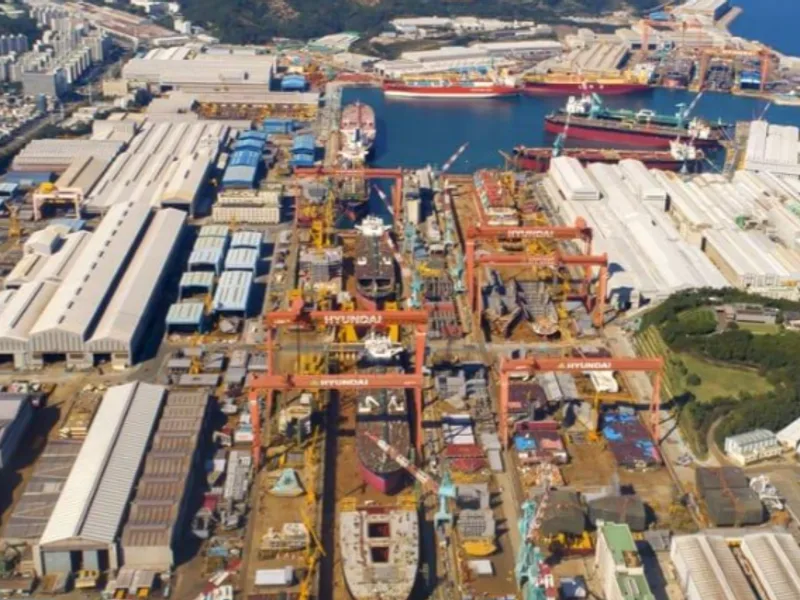
South Korea's top three shipbuilders have generated over 7 trillion won in operating profit through the third quarter of this year, boosting their research and development (R&D) investments by 78% compared to the previous year. As Chinese shipbuilders expand their order intake and production capacity in the liquefied natural gas (LNG) carrier market, domestic firms are stepping up investments in the localization of core technologies and the development of high-value vessels.
The combined operating profit of HD Korea Shipbuilding & Offshore Engineering, Hanwa Ocean, and Samsung Heavy Industries reached 7.0477 trillion won for the first three quarters of this year, already surpassing the total annual operating profit of 4.3527 trillion won from last year. With a Q3 operating profit alone of 2.2713 trillion won, expectations are rising for the companies to achieve a combined annual operating profit of 10 trillion won.
Backed by strong earnings, R&D investments have also grown significantly. According to quarterly reports, the cumulative R&D expenditures of the three shipbuilders reached 437.6 billion won in the third quarter, a 77.7% increase from 246.3 billion won in the same period last year.
HD Korea Shipbuilding & Offshore Engineering invested 243.6 billion won, already surpassing its entire 2023 annual R&D expenditure of 226.7 billion won. Hanwha Ocean posted the highest growth rate, surging 168% from 41.4 billion won to 110.8 billion won in the same period last year, while Samsung Heavy Industries expanded its investment from 68 billion won to 83.2 billion won.
R&D is underway across various fields, including unmanned vessels, core submarine equipment, and offshore plants. HD Hyundai Heavy Industries, a subsidiary of HD Korea Shipbuilding & Offshore Engineering, unveiled an unmanned surface vessel co-developed with U.S. defense firm Anduril, while Hanwha Ocean successfully localized the water-ram horizontal launching system, a core submarine component. In September, Samsung Heavy Industries secured Approval in Principle (AiP) and Basic Design Verification (BDR) from the American Bureau of Shipping (ABS) for its independently developed LNG liquefaction system, 'SENSE', applied to floating liquefied natural gas (FLNG) production facilities.
China Surpasses South Korea in October LNG Carrier Orders... Intensifying Price and Technology Competition
While domestic shipbuilders expand their technology development investments, China is witnessing a series of shipyard expansions and reopenings. According to NH Investment & Securities, global shipyard expansions and reopenings announced from 2021 to the first quarter of this year reached 27.4 million CGT (compensated gross tonnage), with approximately 75% of this capacity concentrated in China.
The market expansion of Chinese shipbuilders is also evident in actual LNG carrier order figures. Citing Clarksons Research data, the Hong Kong-based South China Morning Post (SCMP) reported on the 11th (local time) that China outperformed South Korea in October by securing 5 out of 7 large LNG carrier orders globally. For the cumulative January-October period, South Korea maintained its lead with 44 vessels (57.9%) compared to China's 32 vessels (42.1%), but China's order volume has increased sharply from just 3 vessels for the whole of last year.
The number of LNG carrier builders in China is also increasing. According to British shipbuilding specialized media Riviera Maritime Media, Hengli Heavy Industry has newly entered the LNG carrier construction market, while Hudong-Zhonghua Shipbuilding and Jiangnan Shipyard, alongside Dalian Shipbuilding, have secured order backlogs. As LNG carrier construction spreads beyond a few select shipyards, China's capacity to supply high-value vessels is also expanding.
With Chinese shipbuilders increasing orders backed by relatively low construction prices, the expansion of global supply capacity could also exert pressure on domestic firms' vessel price negotiations. NH Investment & Securities projected global LNG carrier orders next year at 87 vessels, warning that if annual construction capacity increases from 70 to around 100 vessels, supply growth could limit increases in vessel prices.
Domestic shipbuilders are pursuing the localization of core technologies, such as LNG cargo containment systems and eco-friendly propulsion systems, while broadening the scope of technology development to include high-value vessels and offshore plants. They are focusing on reducing construction costs by lowering reliance on foreign technology and securing profitability in high-value ships despite price competition with China.