Three scenarios presented for growth and employment impact; no mention of short-term interest rate direction. Jefferson notes limits of monetary policy on structural unemployment; market prices in a 93.7% probability of a 0.25 percentage point hike in December.
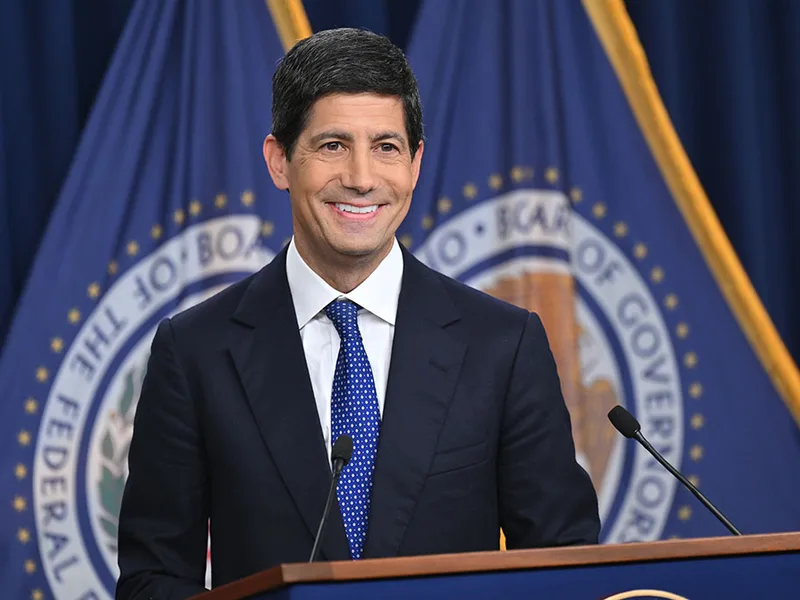
Federal Reserve Governor Kevin Warsh acknowledged the potential for artificial intelligence (AI) to enhance productivity while warning that economic growth and employment could diverge. He explained that even if technological advancements increase output, the combination of automation and labor market frictions could lead to higher unemployment rates.
Warsh made these remarks on the 16th (local time) during his opening address at the 'Productivity and Jobs Task Force Conference,' co-hosted by the Federal Reserve Board and the Federal Reserve Bank of San Francisco. The event was organized to examine the impact of emerging technologies on the economy and the labor market.
Referring to AI as 'Super Intelligence (SI),' Warsh noted that it could fundamentally alter the speed and method of generating new ideas. He suggested that if the foundation for innovation broadens, the U.S. economy could sustain growth rates significantly above its long-term average.
Warsh introduced three scenarios analyzed by Fed staff regarding the potential economic path of these changes. In the most optimistic case, the benefits of productivity gains are widely distributed among workers, firms, and investors, leading to high growth and near-full employment. Conversely, if technology acts to replace rather than complement labor, unemployment could remain above full-employment levels despite higher growth.
The final scenario involves investment outcomes falling short of expectations. If expected returns decline following massive investment and stock price appreciation, it could trigger a market correction, leading to an economic slowdown and rising unemployment. In this case, the anticipated productivity gains may not materialize even if the economy recovers.
Warsh emphasized that these three scenarios are "examples, not predictions," noting that other outcomes are possible. He did not comment on recent inflation data or the direction of the next interest rate decision, and his remarks were not seen as signaling a specific policy path.
The question remains whether monetary policy can mitigate job losses caused by AI. Fed Vice Chair Philip Jefferson stated in a speech at the University of California, San Diego on the 13th that if the pace of technological job displacement exceeds the rate of worker adaptation and retraining, unemployment could rise.
Jefferson noted that policymakers must determine whether such an increase in unemployment is a structural phenomenon resulting from a persistent mismatch between worker skills and corporate demand. He argued that while monetary policy can address cyclical conditions like temporary contractions in employment or spending, it cannot resolve structural factors that determine long-term employment rates.
Productivity gains could also exert upward pressure on interest rates. Jefferson explained that if productivity growth rates rise sustainably, corporate investment may increase while household savings decrease, potentially raising the long-term neutral interest rate. However, he added that predicting changes in the neutral rate is difficult because the relationship between productivity growth and real interest rates is not constant.
AI investment is already impacting inflation. Jefferson observed that while the capacity-expanding effects of AI are emerging gradually, construction of data centers and equipment investment are currently driving up demand and prices. He noted that price pressures have intensified in sectors where supply, such as memory and logic semiconductors, cannot keep pace with demand.
He assessed that while economic activity and the labor market remain largely robust, inflationary pressures persist. He stated that inflation trends are a more critical signal for determining the stance of monetary policy, adding that future adjustments must be decided by monitoring data trends, evolving economic outlooks, and the balance of risks.
Taken together, the comments from both officials suggest that the Federal Reserve is balancing expectations for long-term AI-driven growth with concerns over potential employment shocks and immediate inflationary burdens. This implies that expectations of productivity gains do not serve as an immediate justification for interest rate cuts.
Following October's higher-than-expected consumer price index, the market has increasingly leaned toward further rate hikes. According to CME FedWatch, the probability of a 0.25 percentage point interest rate hike in December stood at 93.7% during intraday trading on the 16th.