


Major tech firms shift to free cash flow deficits, increasing reliance on bonds and private credit. Financial regulators in the U.S. and Europe monitor surging debt levels, noting a stronger earnings foundation than the dot-com era.
The battleground for the artificial intelligence (AI) industry is expanding beyond technological prowess to the ability to secure capital. As even the most profitable big tech companies find it difficult to cover investment costs with internal cash alone, they are turning to corporate bond issuance and private credit. Wall Street estimates that new borrowing for AI infrastructure construction could approach $1 trillion next year.
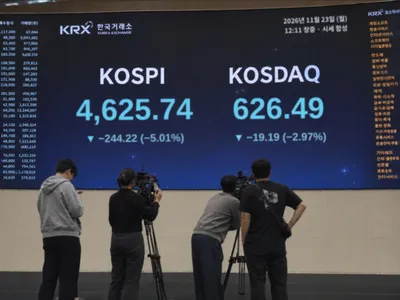
Recent volatility in global stock markets has revived concerns about an AI bubble. However, unlike many internet companies during the dot-com era that lacked clear revenue models, today's core AI firms are generating robust earnings.
Nevertheless, astronomical investment costs have shifted market standards. Investors are now scrutinizing not just how much big tech is pouring into AI, but when and how much of that capital can be recouped.
Big Tech Faces Cash Crunch: Turning to Bonds and Loans for AI Investment
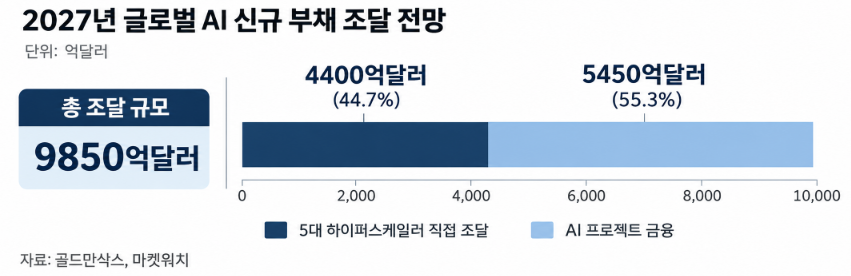
According to MarketWatch, Goldman Sachs estimates that global debt issuance for AI infrastructure will reach $985 billion by 2027. This includes $440 billion in direct financing by the five major hyperscalers and $545 billion in project financing for individual AI infrastructure ventures.
The credit strategy team at Goldman Sachs, led by Amanda Lynam, noted that the ability to leverage diverse financial markets, instruments, and currencies has become a competitive advantage in building AI infrastructure.
 Big tech companies have historically funded AI investments with cash generated from core businesses like advertising, cloud, and software. However, as the scope of investment expands beyond high-performance chips to include data center construction, power facilities, and transmission grids, cash expenditures have surged.
On the 17th, Morgan Stanley estimated that hyperscaler investment between 2026 and 2028 would total approximately $3.8 trillion, with more than half expected to be sourced from credit markets.
Jay Bacow, co-head of global credit at Morgan Stanley, stated at a credit market symposium, "We are now financing not just the technology, but the entire ecosystem."
$4 Trillion in Off-Balance-Sheet Commitments: Growing Caution in Financial Circles
In its Financial Stability Review released this month, the European Central Bank (ECB) noted that most U.S. hyperscalers have shifted to free cash flow deficits this year due to increased AI capital expenditures, meaning they are spending more on facilities than they are generating from operations.
Off-balance-sheet payment obligations have also snowballed. The ECB estimates that off-balance-sheet financial commitments for major tech firms exceeded $4 trillion as of the second quarter of this year. This includes future costs such as data center and semiconductor usage contracts that have not yet been recorded as liabilities on balance sheets.
The ECB also highlighted circular transactions within the AI supply chain, where semiconductor suppliers provide funding to AI developers, who then use those funds to purchase or lease chips from the suppliers.
The U.S. Federal Reserve also addressed the surge in data center-related debt in its Financial Stability Report released on the 13th.
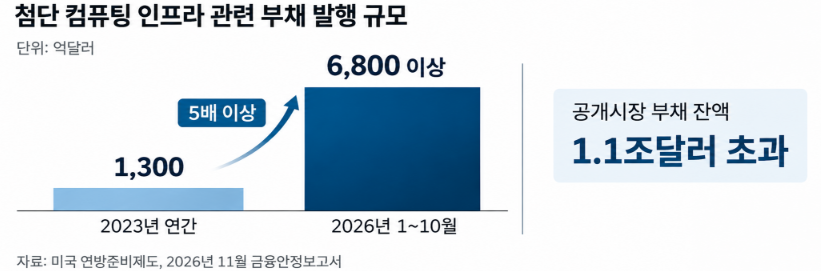
According to the Fed, debt issuance related to advanced computing infrastructure jumped from $130 billion in 2023 to over $680 billion as of October this year. The share of such borrowing in total debt issuance by non-financial investment-grade firms also surged from less than 6% to approximately 31% during the same period.
As of October, the outstanding balance of public market debt related to advanced computing was estimated to exceed $1.1 trillion. The actual debt figure may be higher when accounting for private credit that is difficult to track externally.
Nvidia's Doubled Profits: How Does This Differ from the Dot-Com Bubble?
Nvidia reported $115.8 billion in revenue for the third quarter of fiscal year 2027 on the 17th, a 103% increase year-over-year. GAAP operating profit rose 115% to $77.5 billion, and net income grew 105% to $65.3 billion, with an operating margin reaching 66.9%.
Data center revenue, which accounts for over 90% of total sales, grew 110% to $107.6 billion, and operating cash flow increased 103.2% to $48.3 billion.
While the hyperscalers funding data center construction have seen their free cash flow turn negative, Nvidia generated $43.8 billion in free cash flow in a single quarter—a 98.2% increase from the same period last year.
The Federal Reserve has compared the recent data center investment frenzy to the high-speed telecommunications investment cycle of the late 1990s and early 2000s. Unlike that era, current investments are led by companies with strong cash-generating capabilities, though the pace of external borrowing has accelerated this year.
Future capital requirements are even more massive. The ECB projects that cumulative capital expenditures by seven major U.S. tech firms will reach approximately $5.5 trillion by 2030. Annual funding required for total AI investment between 2025 and 2032 is estimated to exceed 3% of U.S. GDP.
Even during the dot-com bubble, profitable tech companies were not spared from stock market crashes. While the internet industry continued to grow, the financial aftermath of over-investment was severe.
Will AI Investment Persist Despite Rising Financial Costs?
Morgan Stanley believes that given the high return on investment for AI computing infrastructure, companies have the capacity to absorb rising financial costs.
Vishwas Patkar, a senior credit strategist at Morgan Stanley, stated, "For a hyperscaler expecting a return on invested capital (ROIC) of 25-50%, a rise in funding costs from 5% to 6% or 7% would not be a significant obstacle."
Beyond financial costs, data center operators face burdens regarding power procurement and attracting long-term tenants. If AI service revenue fails to keep pace with investment speed, projects with lower profitability may face delays or downsizing.
For domestic semiconductor firms like Samsung Electronics and SK hynix, the announced investment figures from big tech should be viewed with caution. There are numerous hurdles to clear—from financial agreements to data center construction and power grid connection—before these astronomical capital expenditure plans translate into actual semiconductor orders.