

North American natural gas transport equipment sees large-scale orders, while carbon fiber applications expand to power transmission facilities.
China subsidiary sales rise 27% with net losses halved, nearing a break-even point next year.
New markets are opening up for HS Hyosung Advanced Materials' carbon fiber business, which previously struggled with oversupply from China and slowing growth in traditional markets. The catalyst is artificial intelligence (AI) data centers. As grid connections are delayed, a growing number of data centers are opting for captive gas power generation, increasing the adoption of carbon fiber in high-pressure vessels and power transmission facilities used to transport generation fuel.
In July, North American gas transport equipment maker Hexagon Agility secured a mobile gas transport module order worth approximately $100 million from CNG transporter Certarus. It marks the largest single order ever for the product. The deal includes an option to purchase up to an additional $25 million in equipment by 2028.
The order includes the new 'Titan 510' transport module, developed to meet the power demands of large-scale data centers. Utilizing carbon fiber composite high-pressure vessels, this product increases natural gas transport capacity by approximately 13% compared to previous models.
Philip Schram, CEO of Hexagon Composites, stated at the time, "The pace of data center construction is outpacing the development of the energy infrastructure required to support them."
To operate captive gas generation facilities in areas lacking natural gas pipelines, compressed natural gas must be transported via land. Transporting more gas at once requires materials that reduce the weight of the vessel itself while withstanding high pressures. This is why the carbon fiber industry, facing slowing growth in traditional sectors such as high-pressure vessels for hydrogen vehicles and wind power, is turning its attention to the data center market.
Targeting North American Power Infrastructure from Gas Transport to Transmission Facilities
While a direct supply contract between HS Hyosung Advanced Materials and Hexagon has not been publicly confirmed, HS Hyosung Advanced Materials has also begun building a track record in the North American power infrastructure market. In September, the company announced it began supplying carbon fiber products for power line cores to power infrastructure firms in Virginia and California.
Power line cores serve as the backbone of transmission lines. Replacing traditional metal cores with carbon fiber composites reduces the weight of transmission lines and mitigates sag caused by high temperatures. By enhancing power transmission capacity while utilizing existing transmission infrastructure, this approach effectively addresses rising power demand driven by data center expansions.
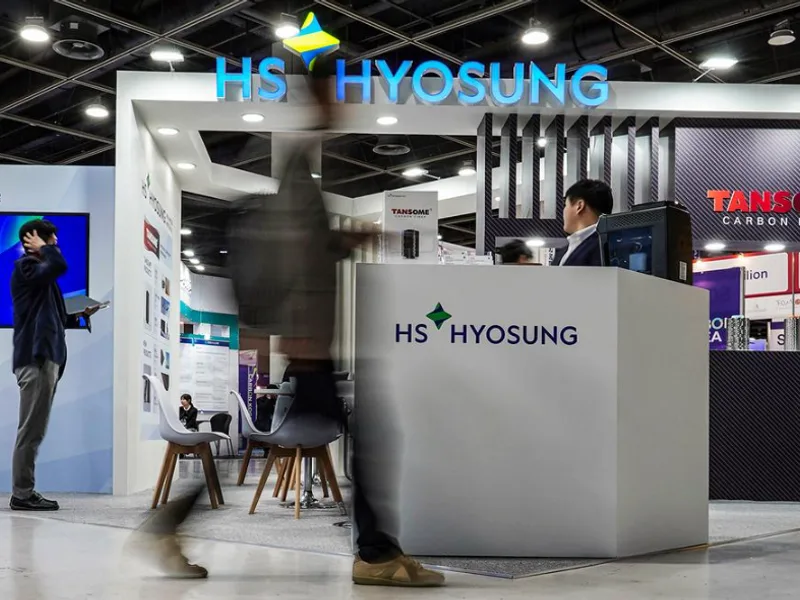
At 'Carbon Korea 2026' held in Seoul on the 5th, HS Hyosung Advanced Materials showcased carbon fiber fabrics and composites for drones, as well as high-pressure vessels for artificial satellites. The company explained that carbon fiber demand is also expanding in the composite vessel market for natural gas transport used in AI data center captive power generation.
Having developed its proprietary carbon fiber brand 'TANSOME' in 2011 and commenced commercial production at its Jeonju plant in 2013, HS Hyosung Advanced Materials has since expanded its production bases to China and Vietnam.
According to iM Securities on the 24th, following an increase in drone carbon fiber shipments from its Chinese plant in the first half of this year, the Jeonju and Vietnam plants also resumed operations in the second half, driven by growing demand for North American high-pressure vessels.
China Subsidiary Losses Cut in Half as Selling Price Recovery Becomes a Variable
Signs of recovery in the carbon fiber business are also reflected in the earnings of overseas production subsidiaries. Sales at the Chinese carbon fiber production subsidiary, HS Hyosung Carbon Materials, reached 45.1 billion won from January to September this year, up about 27% year-on-year. This is nearly triple the 15.8 billion won recorded during the same period in 2024.
Net loss narrowed from 24.8 billion won in the same period last year to 12.6 billion won this year. However, total equity at the end of September remained in a capital impairment state at minus 30.3 billion won.
Selling prices, which previously dented the profitability of the carbon fiber business, are also showing changes. Global carbon fiber prices have been on a downward trend as aggressive capacity expansions by Chinese firms intensified oversupply in 2023–2024. Following Japan's Toray raising carbon fiber prices by 10% to 20% earlier this year, HS Hyosung Advanced Materials' third-quarter selling prices were found to have risen by about 7% to 8% from the previous quarter.
Despite the price rebound, competition with Chinese firms remains a burden. Raising production facility utilization rates while defending selling prices has become just as critical as securing new demand.
Hana Securities stated in a report on the 2nd that HS Hyosung Advanced Materials aims to turn its carbon fiber business profitable by the first half of next year. iM Securities projected that losses will narrow to break-even levels based on next year's annual earnings.
Its core legacy business, tire cords, is backing the investment burden of new ventures. HS Hyosung Advanced Materials' industrial materials division recorded a capacity utilization rate of 89.4% from January to September this year, while maintaining a roughly 50% market share in the global polyester (PET) tire cord market.
Jeon Yu-jin, an analyst at iM Securities, forecasted that increased carbon fiber shipments from Chinese, Vietnamese, and Jeonju plants next year will drive revenue growth and reduce fixed cost burdens. She estimated that HS Hyosung Advanced Materials' consolidated revenue next year will edge down 0.8% year-on-year to 3.5688 trillion won, while operating profit is projected to climb 14.6% to 257.3 billion won.