

Tesla weighs $3.1 billion investment but faces limits in self-sourcing, targeting plant operations by 2030
OCI Holdings secures buyers for existing volume through 2029, while expansion contracts face delays
Even as the global solar market suffers from oversupply, competition to secure non-Chinese polysilicon is heating up in the United States. While Tesla considers a $3.1 billion investment in a polysilicon production facility, OCI Holdings is securing sales outlets for its existing production volume and accelerating efforts to double its production capacity.
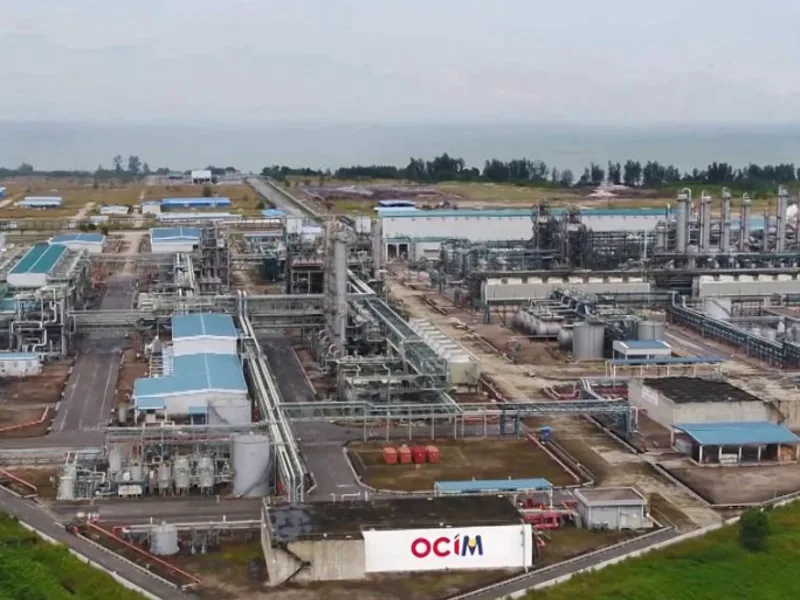
Signs of a rebound are also appearing in the earnings of OCI Holdings, which had previously been weighed down by falling polysilicon prices and sluggish demand. Third-quarter polysilicon sales at its Malaysian subsidiary, OCI TerraSus (formerly OCIM), increased by 45% compared to the previous quarter. Recording 162.2 billion won in revenue and 20.8 billion won in operating profit, the company posted its first quarterly operating profit of the year.
As U.S. solar supply chain regulations tighten, local customers' purchasing criteria have also shifted. Beyond price, the ability to prove the origin of raw materials and supply history has become a core contract condition. In its quarterly report submitted on the 13th, OCI Holdings stated that tightening U.S. Foreign Entity of Concern (FEOC) regulations are creating price premiums for polysilicon that meet the requirements compared to general products.
Tesla's review of a massive investment has also emerged from this supply chain restructuring trend.
Reuters reported on the 20th (local time) that Tesla has applied for tax incentives to build a $3.1 billion polysilicon plant in Nueces County, Texas. The goal is to start plant operations by 2030 and create 515 jobs by 2032.
Tesla previously announced plans to invest $10.1 billion in a solar manufacturing facility in Texas. The strategy is to directly secure key raw materials following solar product manufacturing. In the case of the polysilicon plant, variables remain until final confirmation, as the company attached a condition that it will not invest in the region if it fails to receive tax incentives.
Even with massive capital injection, self-sourcing polysilicon is no easy task. Citing past plant construction costs of German chemical firm Wacker, iM Securities researcher Jeon Yu-jin estimated Tesla's expected production capacity at around 25,000 tons per year on the 24th. This accounts for only 10% of the volume (approximately 250,000 tons) required to operate Tesla's targeted 100GW solar manufacturing capacity. Analysts suggest that even if the plant construction materializes, the company will need to source most of its required volume externally.
Securing buyers for existing volume through 2029; expanding supply to space solar
Along with expanding production capacity, OCI Holdings has also achieved success in attracting long-term clients. By signing a long-term supply agreement (LTA) with a new U.S. customer, the company has secured sales outlets through 2029 for a volume equivalent to its existing annual production capacity of 35,000 tons.
Supply destinations are expanding beyond terrestrial solar into the space industry. In August, OCI Holdings signed a long-term polysilicon and wafer supply agreement with a U.S. customer pursuing space-based solar power, with product shipments scheduled to begin in the first quarter of next year. A 'Take or Pay' condition—requiring payment even if the agreed volume is not accepted—has been applied, and some advance payments have been secured.
The company is also expanding its non-Chinese material supply chain by linking its Malaysian polysilicon plant and Vietnamese wafer production base. It plans to boost its annual polysilicon production capacity to 70,000 tons by 2029, while increasing its Vietnam wafer production capacity from 2.7GW this year to 11.5GW.
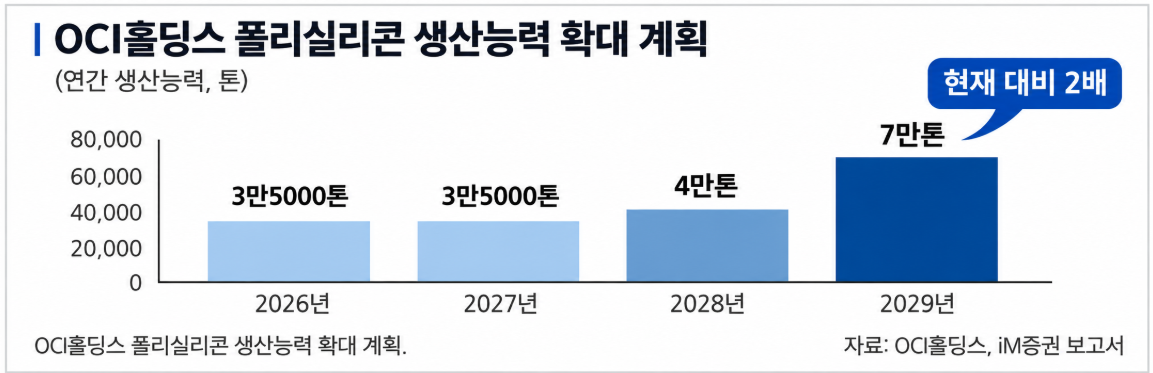 Malaysia also holds an advantage in production facility construction costs. During its third-quarter earnings presentation, OCI Holdings pointed out the profitability limits of direct local investment, noting that building a polysilicon plant in the U.S. could cost two to three times more than in Malaysia.
Expansion contract delays: Volume growth expected over price recovery
While sales channels for existing volume have been solidified, it will take more time to absorb expanded volumes. As policy uncertainties in the U.S. prolong, new long-term supply agreements for expansion volumes currently under discussion with customers have been delayed by more than half a year beyond the initial plan.
The U.S. Minimum Import Price (MIP) system for polysilicon, scheduled to take effect on the 4th of next month, is also unlikely to be immediately reflected in short-term earnings. The U.S. has set the minimum import price for polysilicon at $21 per kg. However, iM Securities projected that with U.S. solar module inventories reaching 60 to 70GW, it will take at least six months to reduce them to appropriate levels.
The immediate engine driving earnings will be sales volume rather than selling prices. iM Securities estimated that OCI TerraSus' polysilicon sales next year will approach 30,000 tons, an increase of about 30% from this year. Operating profit for OCI TerraSus is projected to jump from 15.5 billion won this year to 195.4 billion won next year, while OCI Holdings' consolidated operating profit is expected to grow from 276 billion won to 453.9 billion won.