


Domestic and US plant utilization rates exceed 90%; Gumi production facilities expand
Market share rises on Taiwanese supply chain diversification; financial burdens persist regarding raw material procurement
Wonik QnC, a specialized quartz glass manufacturer for semiconductors, is ramping up its domestic and overseas production capacities. Boosted by new production line investments from Samsung Electronics and SK hynix, alongside surging demand for components from global semiconductor equipment makers, operating rates at domestic and US plants have surpassed 90 percent. In Taiwan, facility expansions are already underway to prepare for 2028 supply volumes. The ripple effects of investment competition surrounding artificial intelligence (AI) semiconductors are extending deep into consumable component supply chains.
According to the Financial Supervisory Service's electronic disclosure system on the 26th, Wonik QnC's cumulative average operating rate for domestic quartz production facilities reached 93.9% in the third quarter of this year, with the US facility hitting 95.0%. Domestic utilization has maintained an upward trajectory, rising from 88.9% last year to 91.3% in the first half of this year.
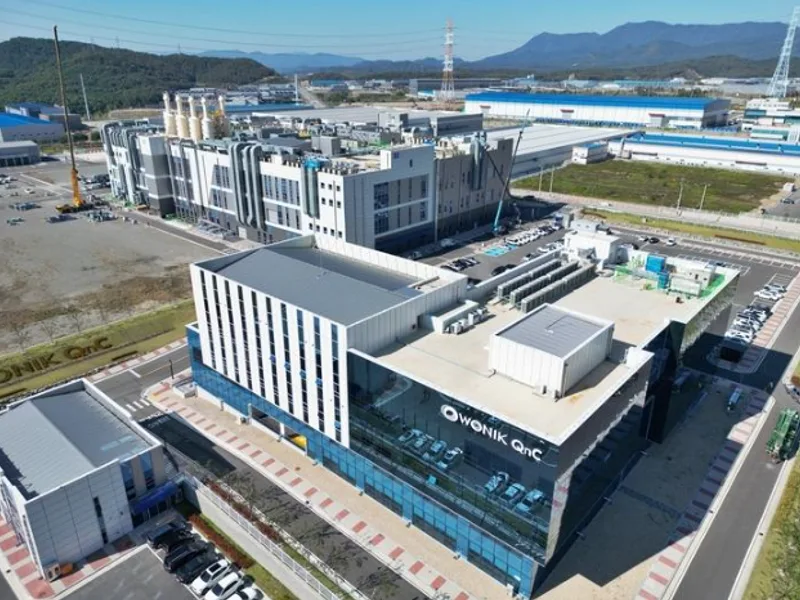
To address escalating customer demand, Wonik QnC approved a 25.52 billion won machinery investment at its headquarters last May. Through the expansion of its Gumi business site scheduled for completion by the end of this year, the company is expected to secure an additional annual production capacity equivalent to approximately 45 billion won in revenue.
Demand Expands Beyond Samsung and SK to Global Equipment Makers
Quartz exhibits exceptional resistance to high temperatures and chemical agents, making it an essential material for protecting and transporting wafers during semiconductor manufacturing. It is deployed across major front-end processes—such as oxidation, diffusion, etching, and deposition—and requires replacement every 1 to 36 months depending on the specific process.
Unlike the equipment market, which is highly sensitive to new fab construction and process transitions, the consumable components market is directly influenced by the operating rates of existing production lines. Even if semiconductor manufacturers decelerate their capital expenditure (capex) on new facilities, replacement demand persists as long as legacy factories maintain high operational rates.
For quartz suppliers, the construction of an additional semiconductor plant translates not only into one-off sales but also into years of subsequent replacement demand.
Process evolution is likewise accelerating demand. The adoption of gate-all-around (GAA) technology, DRAM miniaturization, and higher stacking in NAND flash memory are making etching processes increasingly complex. Etching demand is also expanding within the through-silicon via (TSV) processes required to manufacture high-bandwidth memory (HBM).
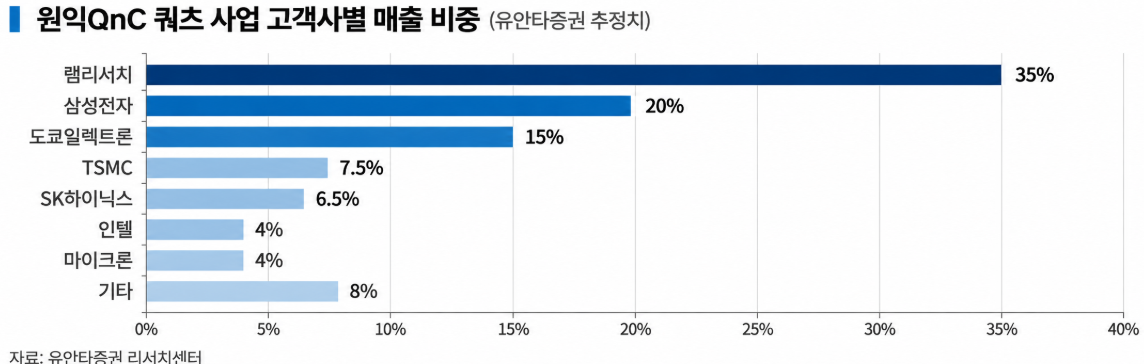
Wonik QnC's growth momentum cannot be attributed solely to investments by domestic memory makers. Yuanta Securities estimates that Wonik QnC's revenue breakdown by quartz customer includes Lam Research of the US at 35%, Samsung Electronics at 20%, Tokyo Electron of Japan at 15%, TSMC at 7.5%, and SK hynix at 6.5%.
Lam Research, a global semiconductor etching equipment leader, is projected to procure roughly 2 trillion won worth of South Korean components this year—double last year's figure of approximately 1 trillion won. Parts sourced from domestic partners are also deployed across Lam Research's overseas manufacturing hubs.
Beyond supplying components directly to domestic chipmakers, the company has successfully secured a supply chain capable of absorbing capex demand from overseas semiconductor giants like TSMC and Micron via global equipment manufacturers.
Yuanta Securities forecasts that Wonik QnC's supply volume bound for Lam Research will increase by over 30% this year and more than 20% next year.
Expanding Footprint in Taiwan's Quartz Market Formerly Dominated by Japanese Peers
Next year, new fab investments by domestic memory players—such as Samsung's Pyeongtaek P4 and P5 and SK hynix's Yongin Y1—are projected to propel quartz business growth. Meanwhile, supply preparations for 2028 volumes have already kicked off in Taiwan.
Wonik QnC's expanding business opportunities in Taiwan extend beyond simple increases in semiconductor production output. Amid heightening supply chain uncertainties stemming from US-China trade tensions, Taiwanese foundry operators are diversifying their quartz component supply chains away from a heavy reliance on Japanese vendors.
Park Sung-soon, a researcher at the Korea IR Council, noted in a June report that Wonik QnC has been aggressively expanding its market share among Taiwanese clients since 2024, leveraging its superior price competitiveness and supply responsiveness compared to Japanese rivals.
Baek Kil-hyun, a researcher at Yuanta Securities, reported on the 26th that Wonik QnC is expanding its local plant as Taiwanese foundry clients have requested supply readiness for 2028 volumes. Revenue from the Taiwan subsidiary is projected to jump 22.2% from 92.5 billion won next year to 113 billion won in 2028.
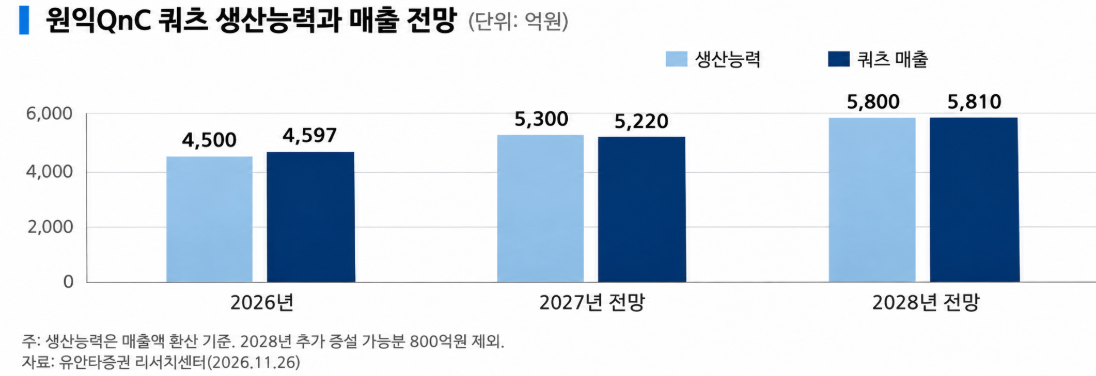
Domestic and overseas quartz revenues, expected to reach 459.7 billion won this year, are projected to climb to 522 billion won next year and 581 billion won by 2028. Over the same period, production capacity (expressed in revenue equivalents) is estimated to expand from 450 billion won to 530 billion won, and eventually to 580 billion won.
Excluding potential incremental expansions for 2028, even with steady capacity scaling, the margin to absorb anticipated revenue streams remains relatively tight.
Persistent M&A Financial Leverage Despite Core Profitability Recovery
The earnings recovery is also unmistakable. Wonik QnC posted a consolidated operating profit of 44.4 billion won for the third quarter of this year, marking a 455.3% surge compared to the same period last year.
Yuanta Securities projected that this year's annual operating profit will hit 130.4 billion won, more than doubling last year's 59.6 billion won. Operating profit forecasts for next year and 2028 stand at 167.8 billion won and 190.6 billion won, respectively.
A notable highlight is that earnings are expanding at a faster pace than revenues. While headquarters quartz revenue next year is projected to rise 16.1% year-on-year, operating profit is estimated to jump 31.7%. The operating profit margin for the headquarters quartz business is also forecasted to climb from 16.1% last year to 22.3% this year and 25.3% next year.
In 2020, Wonik QnC acquired the quartz and ceramics business of US-based Momentive, laying the groundwork for vertical integration spanning from raw material procurement to finished product manufacturing. While this carried significant strategic weight by breaking into the quartz raw material market previously monopolized by a handful of global players, the acquisition also saddled the company with substantial debt.
Yuanta Securities estimates that net debt on a consolidated basis will reach 692 billion won by the end of this year, with annual net interest expenses touching 35 billion won. In calculating his target price, researcher Baek conservatively excluded the equity value of MT Holdings, which owns Momentive, evaluating the semiconductor components business alone at 1.0593 trillion won.
Bolstered by accelerating investments from global semiconductor corporations, the profitability of Wonik QnC's core business is rebounding swiftly. Nevertheless, addressing mounting demand will necessitate additional capital expenditures. How the company allocates the cash harvested from the semiconductor boom between capacity expansion and debt reduction will ultimately dictate its financial performance well beyond the current earnings recovery.