


Demonstrating manufacturing equipment operation at CES 2027; conducting field trials with major domestic conglomerates.
Expanding North American ESS automation business; Q3 standalone operating profit jumps 293%.
T-Robotics, a company specializing in industrial robots, is expanding its business scope beyond vacuum robots and autonomous mobile robots (AMR) into the industrial humanoid sector.
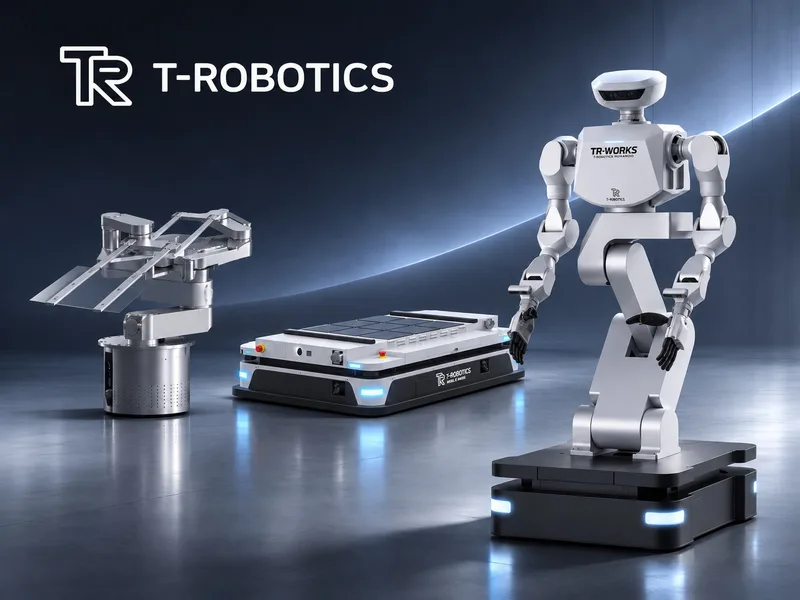
On the 26th, T-Robotics announced that it will participate in 'CES 2027,' held in Las Vegas from January 6-9 next year, to unveil its manufacturing-specialized humanoid, 'TR-WORKS,' to the North American market for the first time.
Manufacturing-Specialized Humanoid and Commercialization Efforts
TR-WORKS combines an AMR-based lower body with an upper body utilizing vacuum robot technology. The goal is to deploy the robot directly into production processes, such as operating manufacturing equipment, rather than just logistics transport.
Since its initial domestic unveiling in March, the company has been conducting Proof of Concept (PoC) trials with major domestic manufacturing conglomerates. At CES, the company plans to demonstrate the robot performing actual manufacturing equipment operations.
In September, T-Robotics was selected as the lead agency for a government-funded project worth 4.5 billion KRW focused on Humanoid AI Transformation (AX) technology. In collaboration with a major domestic display manufacturer and the Korea Advanced Institute of Science and Technology (KAIST), the company aims to develop technologies for manufacturing process applications by 2030.
This month, the company also joined a national project worth 7.7 billion KRW to develop non-stop battery replacement technology. The plan is to enable continuous long-term operation by replacing batteries within five minutes without shutting down power.
Recovery in Vacuum Robot Shipments and North American ESS Market Expansion
For the first three quarters of this year, standalone revenue from vacuum robots reached 27.7 billion KRW, accounting for 87.2% of total revenue, while revenue from autonomous logistics robots stood at 2 billion KRW, representing 6.2%.
The North American logistics automation business is expanding from electric vehicle batteries to Energy Storage System (ESS) production processes. This year, the company secured orders worth approximately 23 billion KRW from Ford Energy in the U.S. for logistics robots and process automation equipment.
Driven by a recovery in vacuum robot shipments, standalone revenue for the third quarter reached 14.8 billion KRW, a 14.1% increase compared to the same period last year. Operating profit surged 293% to 2.65 billion KRW.
Conversely, on a consolidated basis, revenue rose 58.7% to 20.8 billion KRW, but the operating loss widened from 130 million KRW to 2.65 billion KRW. The newly incorporated subsidiary, AI Robotics, also recorded a net loss of 5.3 billion KRW.
The key moving forward will be whether the expansion of the North American logistics automation business and the commercialization of humanoids can lead to improvements in consolidated earnings.