

Sanofi acquires Insmed for $41 billion, triggering a rally in U.S. biotech stocks.
Despite a 4% drop in the KOSPI, Alteogen, Yuhan Corporation, and SK bioscience post gains of 6-9%.
Big Pharma's race to secure new drugs fuels expectations for a revaluation of technology exporters and platform companies.
As the semiconductor rally loses momentum, the biotechnology sector has emerged as a new focal point. News of a major merger and acquisition (M&A) that boosted U.S. biotech stocks provided a much-needed lift to the domestic market on the 25th. With biotech leaders—previously overshadowed by the semiconductor boom—showing strength in a down market, expectations for sector rotation are rising.
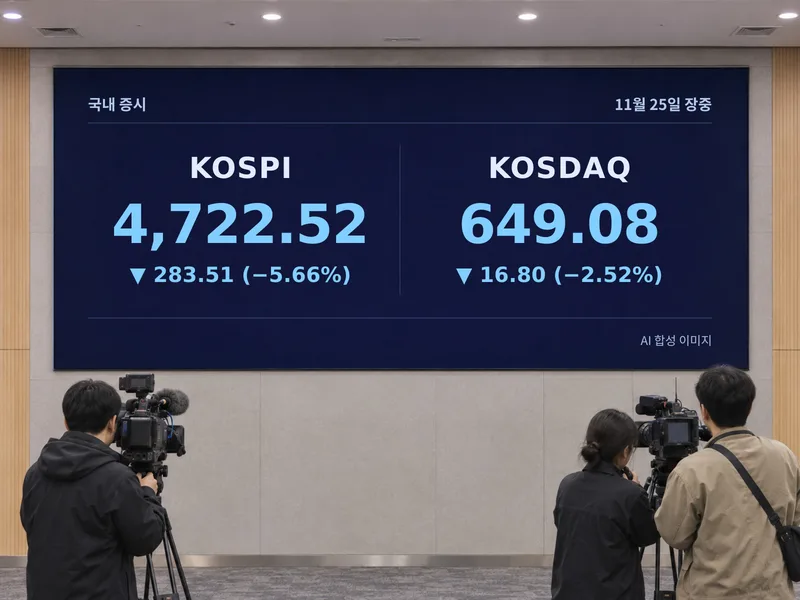
On the 25th, the KOSPI opened sharply lower, falling over 4% and surrendering the 4,800 level in the wake of a plunge in U.S. semiconductor stocks. Despite widespread selling that triggered a sidecar mechanism, Alteogen, Yuhan Corporation, and SK bioscience bucked the trend, rising between 6% and 9%. This mirrors the divergence seen overnight, where the Philadelphia Semiconductor Index plummeted 7.88% while the U.S. biotech ETF, XBI, climbed 6.56%.
The catalyst for this renewed sentiment was Sanofi's massive acquisition. The French pharmaceutical giant announced on the 24th (local time) that it would acquire U.S. respiratory disease specialist Insmed for $175 per share, totaling $41 billion in an all-cash deal. This represents the largest M&A of the year, priced at a 17.5% premium over the previous closing price and over 46% higher than the stock price before acquisition rumors surfaced.
The deal reflects Sanofi's strategy to secure new growth engines ahead of patent expirations for its flagship products. Sanofi expects a revenue decline of approximately 8 billion euros between 2031 and 2035 due to the patent expiry of its immunology drug, Dupixent. Conversely, Insmed’s bronchiectasis treatment, Brensocatib, generated $1.09 billion in revenue from its U.S. launch in August 2025 through the end of September 2026. Sanofi is effectively deploying significant capital to secure a drug with proven commercial success.
In the U.S. market, major biotech stocks rallied following the announcement. On the 24th, Insmed surged 14.2%, Revolution Medicines rose 7.3%, Moderna gained 6.3%, and Vertex and Regeneron both climbed 4.4%. The major M&A news appears to have bolstered investor sentiment across the broader biotech sector.
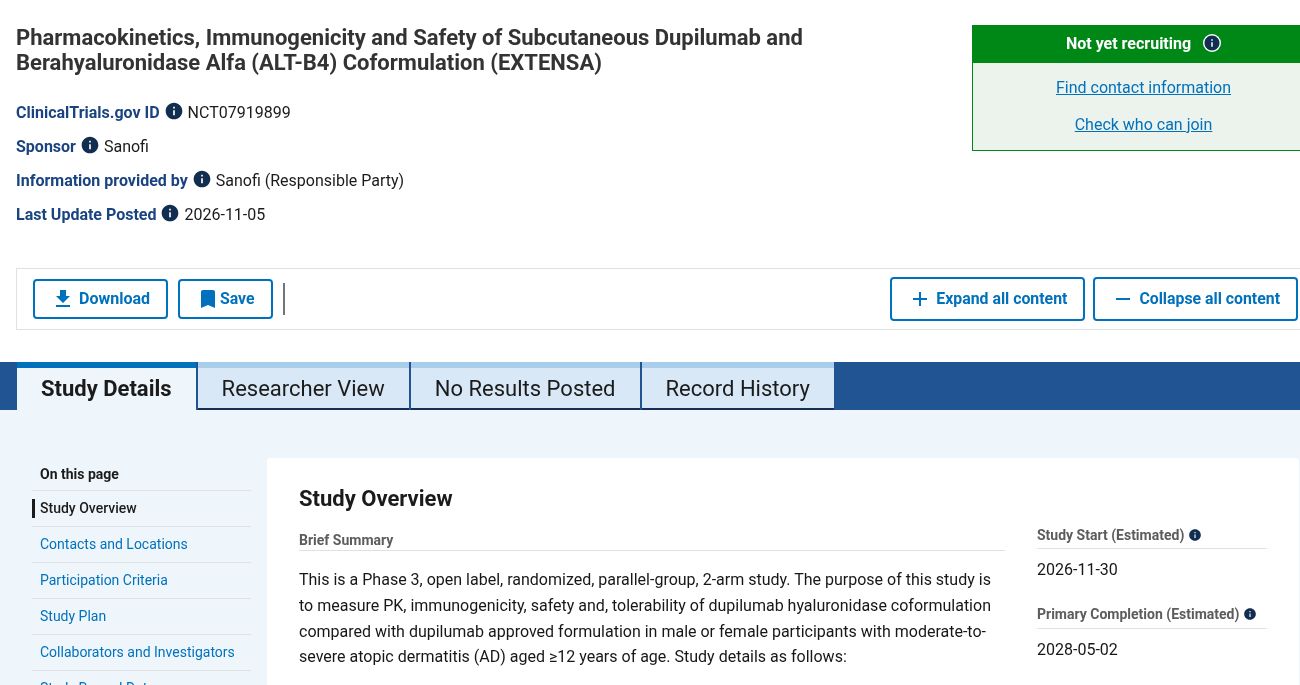 [Photo: A screen capture of the 'EXTENSA' Phase 3 clinical trial registration for the Dupixent and ALT-B4 subcutaneous co-formulation, disclosed by Sanofi on the U.S. clinical trials registry. / Source: ClinicalTrials.gov]
Domestically, Alteogen has drawn significant attention due to its technical partnership with Sanofi. Sanofi has registered the 'EXTENSA' Phase 3 clinical trial for a new subcutaneous co-formulation that combines Alteogen’s hyaluronidase, ALT-B4, with Dupixent. The study compares the pharmacokinetics, immunogenicity, and safety of this new formulation against the existing subcutaneous Dupixent in 150 patients aged 12 and older with moderate-to-severe atopic dermatitis.
Alteogen had previously faced a sharp decline due to concerns over a reduction in patient numbers for the Phase 1 clinical trial of its subcutaneous (SC) version of Enhertu. However, Hana Securities clarified that the reduction was merely due to the completion of recruitment for the first dose-escalation stage, and the trial is proceeding normally. With no changes to the clinical timeline and expectations that patient numbers will increase in the dose-expansion phase, the stock is rebounding alongside the broader recovery in biotech sentiment.
SK bioscience also showed strength, likely influenced by the rally in vaccine stocks in the U.S., where Moderna rose 6.3% and Vaxcyte climbed 10.3%.
This rebound stands in stark contrast to the market's recent obsession with semiconductors. When the KOSPI surged 6.32% to reclaim the 5,000 level previously, the pharmaceutical sector rose only 1.70%. While Samsung Electronics and SK hynix each gained over 6%, Samsung Biologics managed only a 0.16% increase. Until now, biotech had been largely sidelined while semiconductors led the index.
While it is premature to declare a definitive trend reversal based on a single day's movement, the large-scale investment by global Big Pharma serves as a notable catalyst for re-evaluating the sector. The race to secure new drugs ahead of patent cliffs creates business opportunities not only for acquisition targets but also for platform companies and technology exporters. This is why firms like Alteogen and Yuhan Corporation, which have established partnerships with global pharmaceutical giants and built a track record of commercial success, are being highlighted for revaluation. Sanofi has also indicated that it retains the capacity for further early-stage business development and M&A following this acquisition.
However, the interest rate environment remains a burden. The Federal Reserve is set to hold its final FOMC meeting of the year on December 8-9. With October consumer inflation rising 0.4% month-on-month, exceeding expectations, the market is pricing in a high probability of a 0.25 percentage point hike to the current 3.75-4.00% policy rate. JPMorgan and Bank of America anticipate further hikes in January and March 2027.
The fact that biotech stocks rose despite these pressures suggests that large-scale deals and revenue growth from new drugs are currently driving investor sentiment. The FOMC results and the 'dot plot' to be released on December 10 at 4:00 AM (KST) will be key variables in determining whether this upward trend can be sustained. If the interest rate path remains within market expectations and is supported by individual corporate performance, this rebound could lead to a selective revaluation centered on biotech firms with proven earnings and technological capabilities.