

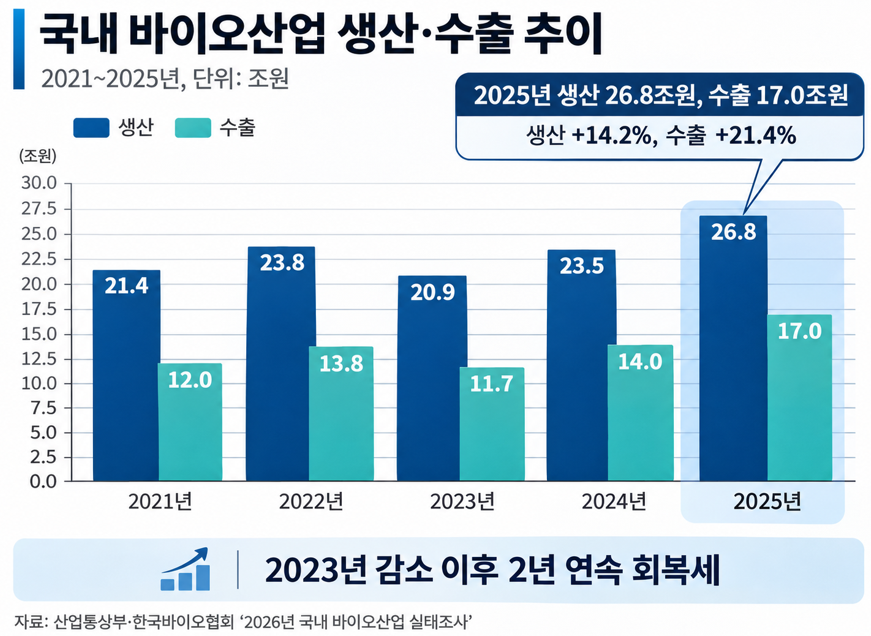
Production reaches 26.8 trillion won and exports 17 trillion won, marking double-digit growth for two consecutive years.
Export share of biopharmaceuticals and services expanded from 40% to 72.4%.
Overall facility investment decreased by 29.9%, while biopharmaceutical investment surged by 53.8%.
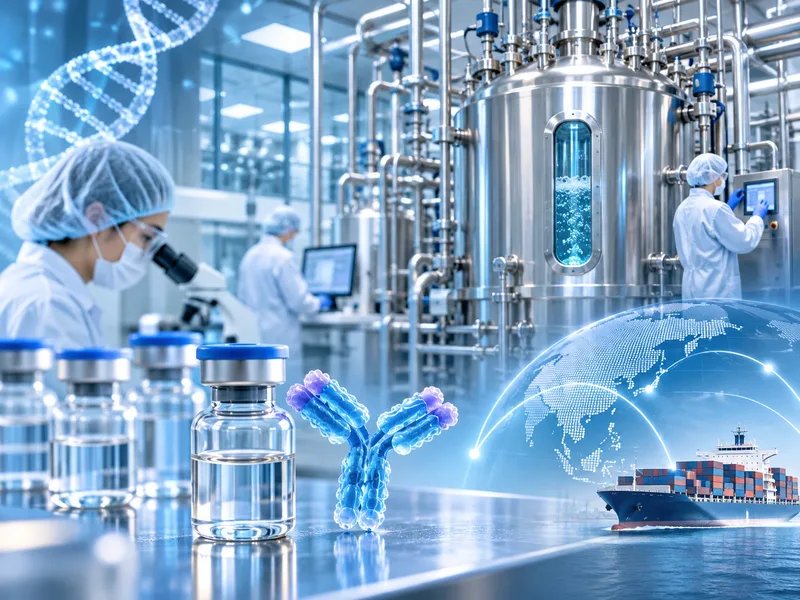
South Korea's domestic bio industry's production and exports have reached their highest levels in the past five years. While biopharmaceuticals and contract manufacturing drove export growth, investment trends varied widely by sector.
According to the '2026 Domestic Bio Industry Survey Report' published on the 26th by the Ministry of Trade, Industry and Energy and the Korea BioAssociation, last year's domestic bio industry production reached 26.8236 trillion won and exports hit 16.9556 trillion won, up 14.2% and 21.4% year-on-year, respectively. This survey is a nationally approved statistic based on responses from 1,343 domestic bio companies.
Record Production and Exports: Export-Led Growth
Following a simultaneous decline in production and exports in 2023, South Korea's bio industry has recorded double-digit growth rates for two consecutive years. In particular, export value surged by 44.8% over a two-year period, rising from 11.7081 trillion won in 2023 to 16.9556 trillion won last year.
While domestic sales growth remained sluggish at 3.7% last year, exports jumped 21.4%. Exports accounted for 89.4% of the total production increase of 3.3402 trillion won. The share of exports in total production also rose from 56.1% in 2021 to 63.2% last year.
Biopharmaceuticals and Services Drive 94% of Export Growth
The growth axis of South Korea's bio industry is shifting toward biopharmaceuticals and bio-services.
Last year, production in the biopharmaceutical industry reached 10.008 trillion won, up 18.2% year-on-year, while the bio-service industry grew 28.8% to 5.8156 trillion won. These two sectors accounted for 59.0% of total bio industry production.
Biopharmaceutical exports expanded 2.3-fold from 3.4447 trillion won in 2021 to 7.7851 trillion won last year. Over the same period, bio-service exports expanded 3.3-fold from 1.3575 trillion won to 4.4935 trillion won.
The combined export share of these two sectors increased from 40.0% in 2021 to 72.4% last year. Furthermore, 94.0% of the total export growth last year originated from these two sectors.
By product category, exports of therapeutic antibodies and cytokine products reached 5.5344 trillion won, and contract manufacturing and agency services reached 4.2885 trillion won, with the two categories accounting for 57.9% of total exports.
Decline in Facility Investment Amid Expansion in Biopharmaceutical Investment
Total investment in the bio industry last year stood at 4.7898 trillion won, down 12.7% year-on-year. While R&D expenditures rose 4.9% to 2.8344 trillion won, facility investments fell 29.9% to 1.9554 trillion won.
Investment trends differed by sector. R&D and facility investments in the biopharmaceutical industry increased by 6.1% and 53.8%, respectively, whereas those in the bio-service industry declined by 16.0% and 37.4%, respectively.
Notably, the drop in facility investment within the bio-service industry amounted to 944.6 billion won, surpassing the overall bio industry facility investment decline of 833 billion won. This explains why the contraction in overall investment cannot be simply interpreted as a broad downturn across the entire industry.
The number of bio industry workers reached 68,133, a 1.9% increase from the previous year. The growth rate for research personnel stood at 4.3%, outpacing production workers (1.6%) and other staff (0.2%).
To maintain sustained growth in South Korea's bio industry, it is necessary to strengthen the global competitiveness of biopharmaceuticals and contract manufacturing while diversifying the growth foundation through proprietary new drug development and the localization of core materials and equipment.