

Bank of England projects cloud giants' bond issuance to exceed $305 billion this year.
Bank of Korea: Deteriorating financial conditions could push 2028 memory prices 30% below Gartner forecasts; combined with investment delays and Chinese production increases, the drop could reach 51%.
Rising borrowing costs for some low-credit artificial intelligence (AI) firms are beginning to impact the financing of data center projects. In its Financial Stability Report released on the 26th, the Bank of England (BoE) noted that the credit risk of a single firm could influence the financing terms for similar data center projects. On the same day, the Bank of Korea (BOK) analyzed that if data center demand contracts due to worsening financial conditions, memory semiconductor prices in 2028 could fall 30% below Gartner's projections.
Big Tech bond issuance projected at $305 billion; lease and purchase agreements add to burden
The BoE estimates that bond issuance by hyperscalers—firms operating large-scale cloud infrastructure—will exceed $305 billion this year, accounting for approximately 8% of global investment-grade bond issuance. The total borrowing scale, including data center operators and other AI infrastructure firms, has nearly doubled compared to last year.
The BoE estimates that the potential burden on hyperscalers, including off-balance-sheet contractual obligations such as lease and purchase agreements, slightly exceeds $4 trillion. Even if a facility is not yet operational and thus not recorded as a liability on the balance sheet, lease agreements require rent payments over the contract term once the facility is in use.
A case in point is Meta's contract for the Hyperion data center in Louisiana, signed last year with a fund managed by Blue Owl Capital. Of the estimated $27 billion in development costs, Meta's share corresponds to its 20% equity stake. Meta agreed to lease the facility upon completion and guarantee its residual value under certain conditions, meaning Meta's actual financial exposure could exceed its initial equity investment.
Data center operators often finance construction and equipment purchases based on projected revenue from contracts with major clients. Consequently, the client's creditworthiness and payment capacity directly influence loan terms. The BoE reported that some private credit funds are becoming more selective in choosing AI and data center projects for lending, with some funds even exploring the sale of existing loans to other investors due to concerns over portfolio concentration.
Meta contracts and GPU collateral dictate CoreWeave's loan terms
Bloomberg reported on the 26th that CoreWeave is seeking a $4.5 billion loan collateralized by graphics processing units (GPUs) used to provide computing services to Meta. If successful, the funds will be used to purchase GPUs for the Dalton data center in Georgia. The interest rate under discussion is 7–7.5%. According to transaction documents cited by Bloomberg, the yield on CoreWeave's unsecured corporate bonds maturing in 2031 was approximately 18%.
For the same company, the expected yield on loans backed by Meta contracts and GPU collateral is less than half that of its unsecured bonds. If CoreWeave were to issue new unsecured debt to repay existing obligations, such high market yields could prove burdensome.
Interest expenses on existing debt are already significant. According to filings with the U.S. Securities and Exchange Commission (SEC), CoreWeave's net interest expense for the third quarter was $846 million, more than four times its operating profit of $207 million.
BOK analyzes three shocks: Financial conditions pose the greatest risk
The BOK identified delayed AI investment, worsening financial conditions, and increased supply of general-purpose memory from China as key factors that could drive down memory prices. If AI services fail to generate expected returns, firms may adjust the pace of capacity expansion. Rising borrowing costs hinder the funding of planned projects, while increased production by Chinese firms exerts downward pressure on general-purpose memory prices.
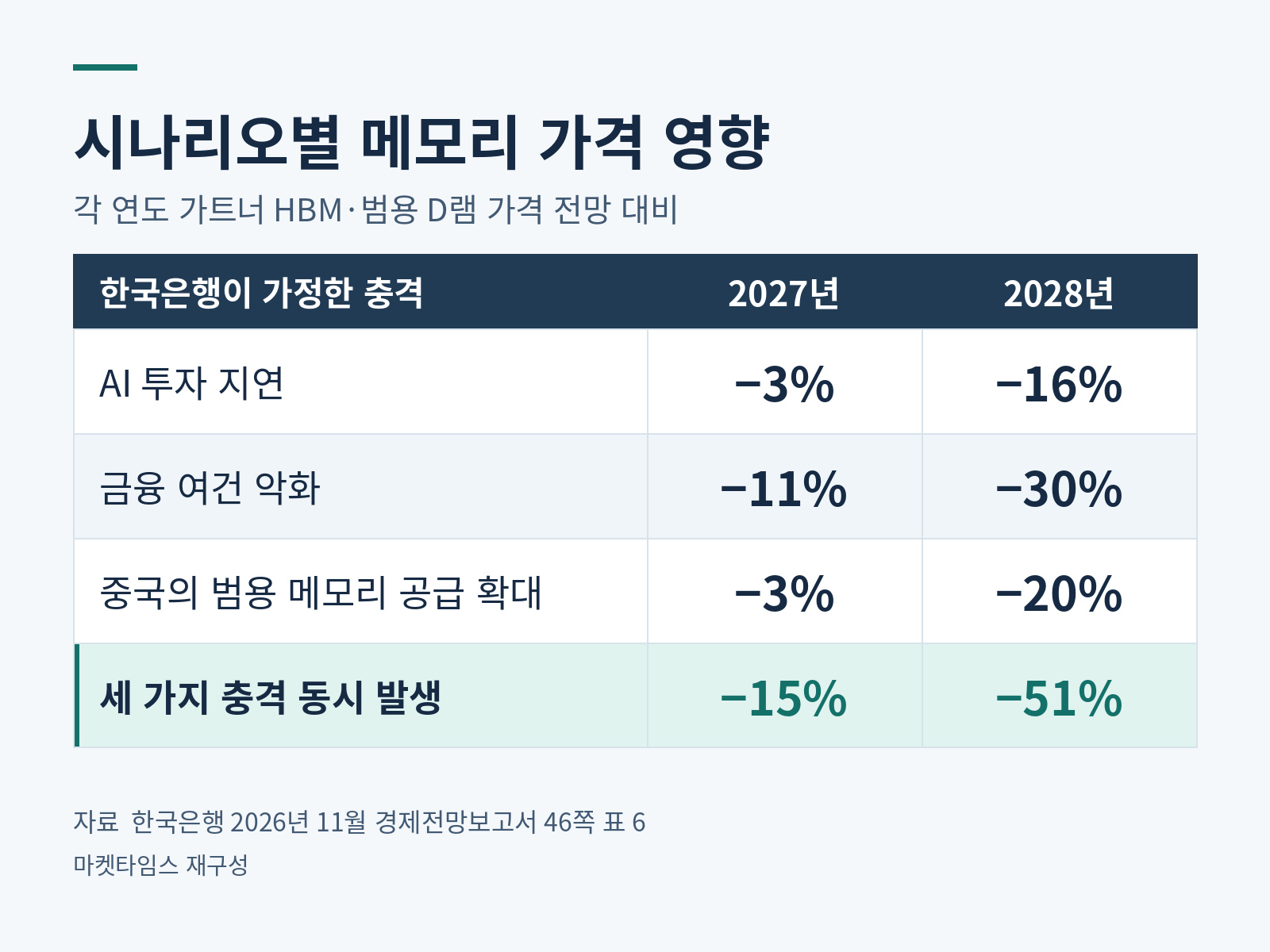
In the BOK's scenarios, the impact of worsening financial conditions becomes pronounced starting in 2027. If financial conditions deteriorate, memory prices in 2027 are estimated to be 11% lower than Gartner's forecast—more than triple the 3% decline projected for AI investment delays or increased Chinese supply individually. The BOK assumed that under worsening financial conditions, data center demand could fall by up to 15% below expectations by early 2028 before partially recovering.
The HBM and general-purpose DRAM analyzed by the BOK are key memory products for Samsung Electronics and SK hynix. If all three shocks occur simultaneously, semiconductor exports are estimated to fall by $129.4 billion in 2027 and $307.5 billion in 2028 compared to the BOK's baseline forecast.
When accounting for indirect impacts through financial markets and economic sentiment, real GDP growth is projected to decline to 3.4% in 2027 and 2.1% in 2028, compared to the BOK's baseline forecasts of 4.1% and 3.0%, respectively. Even under the combined shock scenario, the BOK expects total customs-cleared exports to exceed $1 trillion in 2027.
Semiconductors account for nearly half of exports from Nov 1–20; the key is investment execution timing
According to the Korea Customs Service, semiconductors accounted for $38.5 billion of South Korea's $77.4 billion in exports from November 1 to 20, nearly half of the total. The BOK noted that the memory boom could last longer than expected if applications expand to include agentic and on-device AI in the consumer sector and physical AI in the industrial sector. The duration of this boom depends on how quickly announced data center investments are actually executed.
Even for projects with secured client contracts, delivery schedules can be delayed if power supply is delayed. AI cloud firm Nebius announced that it plans to deliver more than half of the computing capacity promised to Microsoft at its New Jersey data center by the end of this year, with the remainder to be supplied in the second quarter of 2027. The company explained that the schedule slipped because local operator DataOne halted some temporary power generation facilities earlier than expected during a transition to Bloom Energy fuel cells. Nebius lowered its revenue forecast for this year to reflect these operational delays.
If server orders or equipment delivery schedules change due to data center operational delays, it could also affect the timing of memory shipments. The execution of data center project loans and server order schedules serve as indicators of whether financial market pressures are translating into actual semiconductor orders.